 Poland · 12th century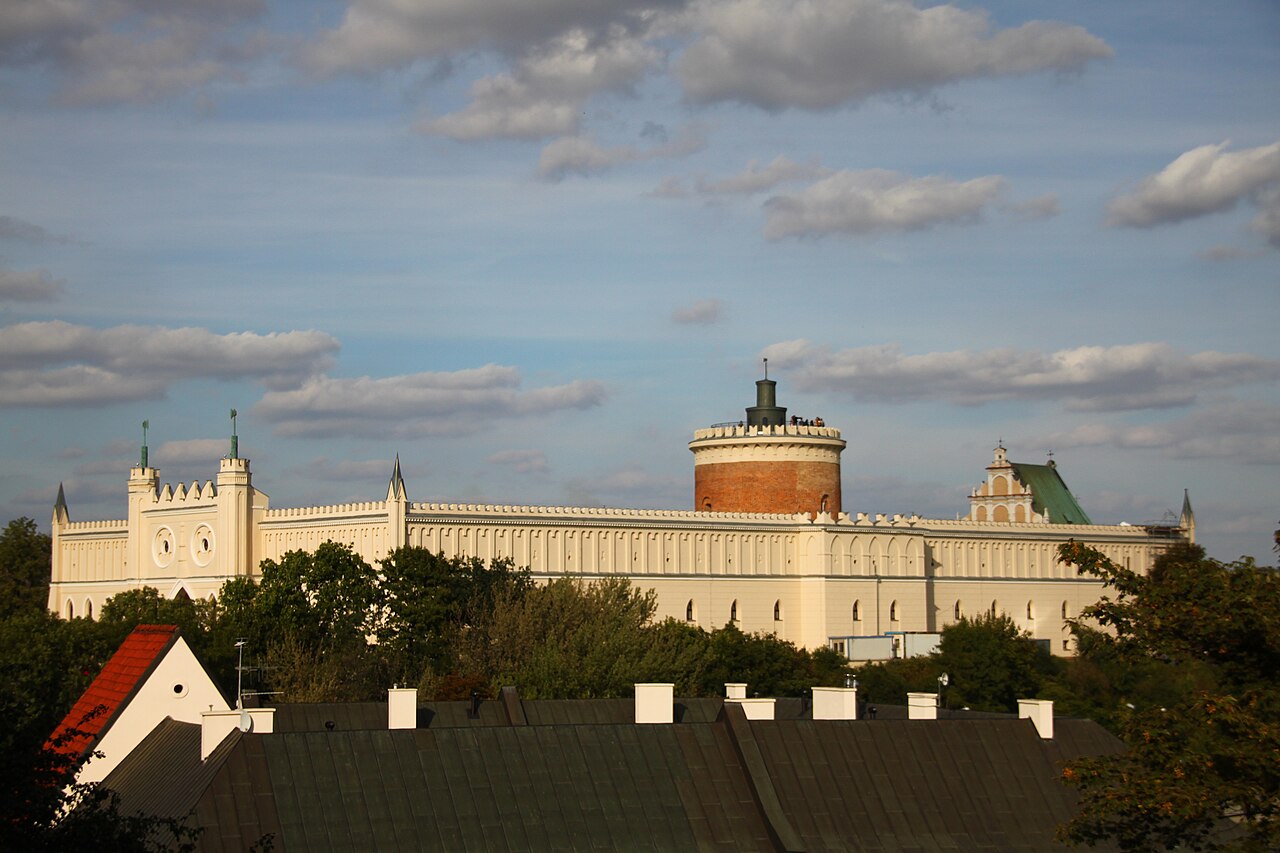
The Lublin Castle (Polish: Zamek Lubelski) is a medieval castle in Lublin, Poland, adjacent to the Old Town district and close to the city center. It is one of the oldest preserved royal residencies in Poland, initially established by High Duke Casimir II the Just. Its contemporary Gothic Revival appearance is largely due to a reconstruction undertaken in the 19th century.
The hill it is on was first fortified with a wood-reinforced earthen wall in the 12th century. In the first half of the 13th century, the stone keep was built. It still survives and is the tallest building of the castle, as well as the oldest standing building in the city. In the 14th century, during the reign of Casimir III the Great, the castle was rebuilt with stone walls. Probably at the same time, the castle's Chapel of the Holy Trinity was built as a royal chapel.
In the first decades of the 15th century, King Władysław II Jagiełło commissioned a set of frescoes for the chapel. They were completed in 1418 and are preserved to this day. The artist was a Ruthenian, Master Andrej, who signed his work on one of the walls. Because of their unique style, mixing Western and Eastern Orthodox influences, they are acclaimed internationally as an important historical monument.
Under the rule of the Jagiellon dynasty the castle enjoyed royal favor and frequent stays by members of the royal family. The sons of King Casimir IV Jagiellon were brought up in the castle under the tutelage of Jan Długosz. In the 16th century, it was rebuilt on a grandiose scale, under the direction of Italian masters brought from Kraków. The most momentous event in the castle's history was the signing in 1569 of the Union of Lublin, the founding act of the Polish–Lithuanian Commonwealth.
As a consequence of the wars in the 17th century (The Deluge), the castle fell into disrepair. Only the oldest sections, the keep and the chapel, remained intact. After Lublin fell under Russian rule following the territorial settlement of the Congress of Vienna in 1815, the government of Congress Poland, on the initiative of Stanisław Staszic, carried out a complete reconstruction of the castle between 1826 and 1828. The new buildings were in the English neo-Gothic style, completely different from the structures they replaced, and their new purpose was to house a criminal prison.
Text adapted from “Lublin Castle” on Wikipedia, CC BY-SA 4.0.
Lublin Castle ranks #747 of 9,079 worldwide in the atlas's castle fame ranking, and #19 of the 398 mapped in Poland. Founded c. 1150, it is older than 80% of the atlas's dated landmarks — one of 756 atlas entries founded in the 12th century. Its Wikipedia articles were opened 5,319 times in the last 60 days, more than 87% of the atlas. See how Poland compares in the castle statistics.
View on the interactive castle map →