 Russia · 19th century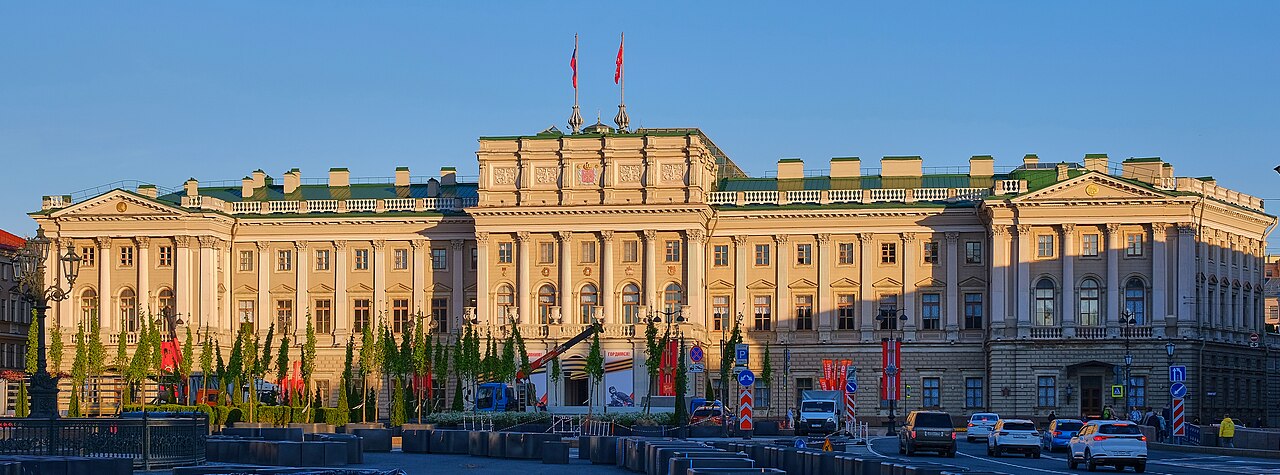
Mariinsky Palace (Russian: Мариинский дворец, romanized: Mariinskij dvorec), also known as Marie Palace, was the last neoclassical Imperial residence to be constructed in Saint Petersburg. It was built between 1839 and 1844, designed by the court architect Andrei Stackenschneider. It houses the city's Legislative Assembly.
The palace stands on the south side of Saint Isaac's Square, just across the Blue Bridge from Saint Isaac's Cathedral. The site had been previously owned by Zakhar Chernyshev, and contained his home designed by Jean-Baptiste Vallin, which was built between 1762 and 1768. Chernyshev occasionally lent his home to foreign dignitaries visiting the capital, such as Louis Henri, Prince of Condé.
From 1825 to 1839, the Chernyshev Palace, as it was then known, was the site of the Nicholas Cavalry College, where Mikhail Lermontov was known to have studied for two years. The palace was demolished in 1839, and materials were reused in the construction of the Mariinsky Palace.
The palace was conceived by Nicholas I as a present to his eldest daughter, Grand Duchess Maria Nikolaevna, on the occasion of her marriage to Maximilian de Beauharnais, Empress Joséphine's grandson.
Although the reddish-brown facade is elaborately rusticated and features corinthian columns arranged in a traditional Neoclassical mode, the whole design was inspired by the 17th-century French Baroque messuages. Other eclectic influences are visible in the Renaissance details of exterior ornamentation, and the interior decoration, with each room designed in a different historic style. The palace is now painted white.
The Mariinsky Palace returned to Imperial ownership in 1884, where it remained until 1917. During that period, the palace housed the State Council, Imperial Chancellery, and Committee of Ministers, which after 1905 became the Council of Ministers. The grand hall for the sessions of the State Council was designed by Leon Benois.
On April 15, 1902, Socialist Revolutionary Party member Stepan Balmashov assassinated the Minister of Internal Affairs, Dmitry Sipyagin, while the minister was between meetings at the palace.
In 1904, painter Ilya Repin completed Ceremonial Sitting of the State Council on 7 May 1901. The painting was commissioned as a commemoration of the State Council's centenary.
Text adapted from “Mariinsky Palace” on Wikipedia, CC BY-SA 4.0.
Mariinsky Palace ranks #510 of 9,079 worldwide in the atlas's castle fame ranking, and #24 of the 146 mapped in Russia. Founded 1839, it is older than 9% of the atlas's dated landmarks — one of 717 atlas entries founded in the 19th century. Its Wikipedia articles were opened 6,848 times in the last 60 days, more than 90% of the atlas. 32 more atlas landmarks stand within 25 km. The nearest day-trip guide is Saint Petersburg, 2 km away. See how Russia compares in the castle statistics.
View on the interactive castle map →