Ruin
Mihara Castle
🇯🇵 Japan
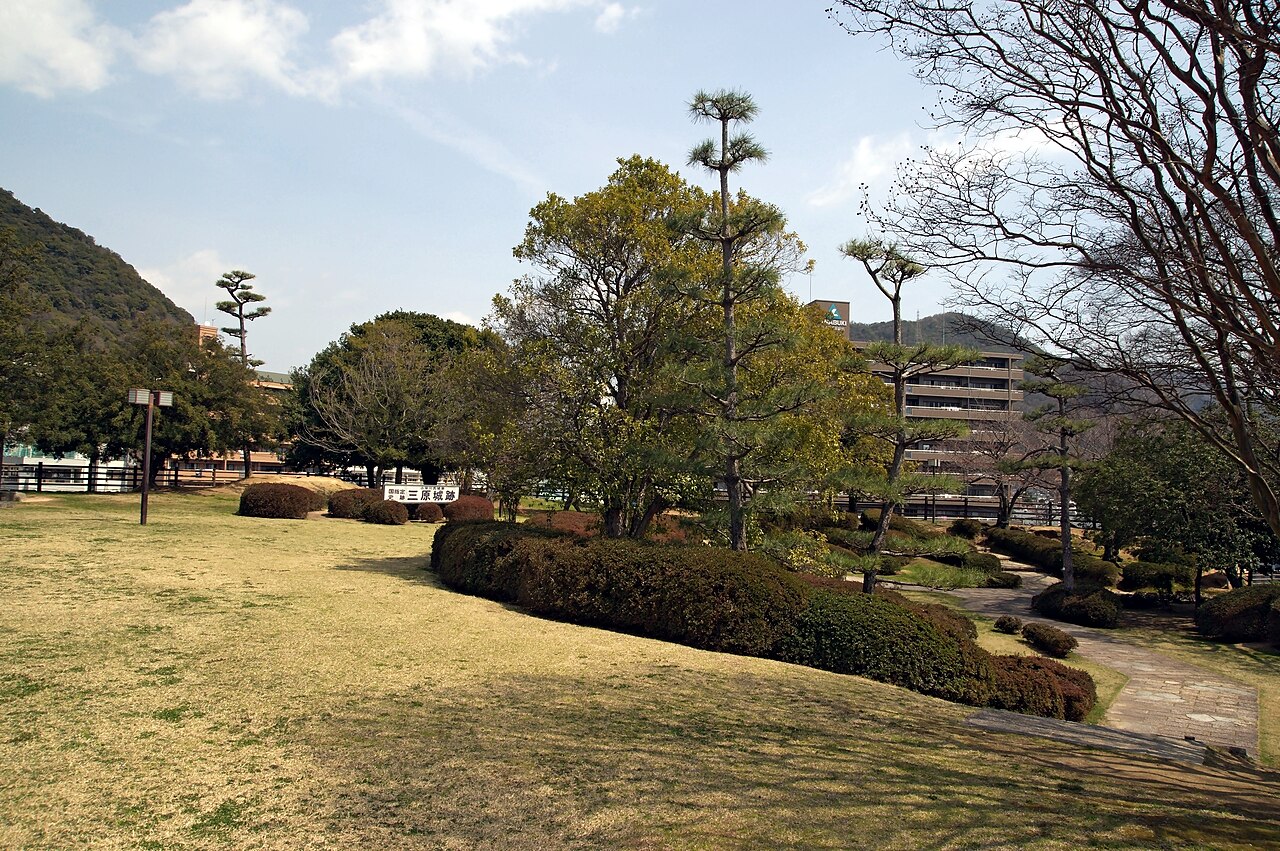
Mihara Castle (三原城, Mihara-jō) was a hirajiro-style Japanese castle located in what is today the city of Mihara in Hiroshima Prefecture. Its ruins have been protected by the central government as a National Historic Site since 1957.
In 1552, Kobayakawa Takakage relocated his seat from Takayama Castle to Niitakayama Castle. Kobayakawa Takakage was the son of Mōri Motonari and over the next 20 years, the Kobayakawa clan helped the Mōri clan defeat the Ouchi clan and the Amago clan to secure supremacy over the Chugoku region of Japan. The Mōri entrusted the Kobayakawa with the San'yo region, whereas Kobayakawa Takakage's elder brother Kikkawa Motoharu was entrusted with the San'in region, and the Kobayakawa clan had a strong navy which enabled them to dominate the Seto Inland Sea. In 1567, Takakage newly built a new castle ten kilometers downstream from Niitakayama Castle, utilizing small islands at the mouth of Nuta River, and incorporating Sakurayama Castle, an older fortification which had been constructed by the Yamana clan in the early Muromachi period.
The new Mihara Castle was initially a naval base and was needed as the harbor at Niitakayama Castle was becoming silted. From 1580 to 1588, the castle was greatly expanded and modernized with multiple concentric enclosures and numerous yagura watchtowers. As it was located directly on the seashore, it appeared to be floating on the sea at high tide, so it is also called Floating Castle (浮城, Uki-jō).
The Mōri and Kobayakawa eventually came into conflict with Oda Nobunaga, and subsequently with Toyotomi Hideyoshi. On Nobunaga's assassination in 1582, The Kobayakawa reached an accord with Hideyoshi, and Kobayakawa eventually became a vassal of Hideyoshi, who needed the Kobayakawa navy. Kobayakawa Takakage was awarded Iyo Province in Shikoku and later Chikuzen Province in Kyushu. Together with Kuroda Yoshitaka (Kanbe), he was one of Hideyoshi's most trusted military advisors. In 1595, Kobayakawa Takakage turned his estates in Chikuzen to his adopted son Hideaki, and retired to Mihara Castle. During the reconstruction of Mihara Castle, the stone walls and structures of Niitakayama Castle were gradually dismantled as building materials, and most of the jōkamachi was relocated to Mihara. The present tenshu foundation base dates from this reconstruction.
Text adapted from “Mihara Castle” on Wikipedia, CC BY-SA 4.0.
Mihara Castle ranks #3,467 of 8,134 worldwide in the atlas's castle fame ranking, and #177 of the 297 mapped in Japan. Its Wikipedia articles were opened 3,002 times in the last 60 days, more than 75% of the atlas. 2 more atlas landmarks stand within 25 km. The nearest day-trip guide is Okayama, 82 km away. See how Japan compares in the castle statistics.
View on the interactive castle map →Frequently asked questions
Where is Mihara Castle?
Mihara Castle stands in Japan, at 34.40128°, 133.08266°.
How famous is Mihara Castle?
In this atlas's fame ranking: #3,467 of 8,134 worldwide, and #177 in Japan. Fame here combines how many Wikipedia language editions cover a landmark with how many people read them.
What is the nearest castle to Mihara Castle?
Niitakayama Castle, about 10 km away.
More castles in Japan
- Yonago Castle Japan · 15th century
- Sekiyado Castle Japan · 16th century
- Kururi Castle Japan · 15th century
- Nishio Castle Japan · 16th century
More ruins
- Château de Wineck France · 13th century
- Tomburg Castle Germany · 9th century
- Château de Hohenbourg France · 12th century
- Sayn Castle Germany