 Spain · 9th century
Muslim Walls of Madrid ranks #3,211 of 9,040 worldwide in the atlas's castle fame ranking, and #121 of the 606 mapped in Spain. Founded 855, it is older than 94% of the atlas's dated landmarks, one of 85 atlas entries founded in the 9th century. Its Wikipedia articles were opened 1,522 times in the last 60 days, more than 62% of the atlas. 17 more atlas landmarks stand within 25 km. The nearest day-trip guide is Madrid, 1 km away. It is stop 20 of 28 on the Castile castle route, Valladolid to Madrid. See how Spain compares in the castle statistics.
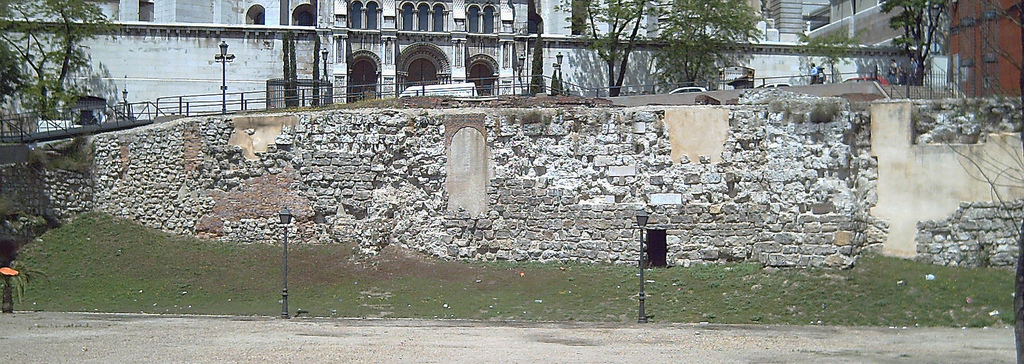
The Muslim Walls of Madrid (also known as the Arab Walls of Madrid), of which some vestiges remain, are located in the Spanish capital city of Madrid. They are probably the oldest construction extant in the city. They were built in the 9th century, during the Muslim domination of the Iberian Peninsula, on a promontory next to Manzanares river. They were part of a fortress around which developed the urban nucleus of Madrid. They were declared an Artistic-Historic Monument in 1954.
They were built in the park of Mohamed I, named in reference to Muhammad I of Córdoba, considered the founder of the city.
Along the Calle Mayor street, at number 83, next to the Viaduct that serves the Calle de Segovia, are still standing the ruins of the Tower of Narigües, which probably would have been an albarrana tower, with a separate location from the main wall itself, but connected thereto by a minor wall. Its function was to serve as a viewpoint.
In the 20th century, some remains were destroyed. Those that once existed near number 12 Calle de Bailén were lost during the construction of an apartment block, although some walls were integrated into its foundations. The remodelling of the Plaza de Oriente, completed in 1996 during the mayoral term of José María Álvarez del Manzano, led to the discovery and subsequent disappearance of numerous remains. This was not the case with the watchtower known as Tower of the Bones, whose base is on display in the underground car park of the same plaza.
Between 1999 and 2000, another section was uncovered, about 70 metres (230 ft) long, under the Plaza de la Armería, formed by the main façades of the Royal Palace and Almudena Cathedral. It was excavated during the building of the Royal Collections Gallery (to open in 2023) and may correspond to the Puerta de la Sagra, one of the gates to the walled enclosure.
Text adapted from “Muslim Walls of Madrid” on Wikipedia, CC BY-SA 4.0.
View on the interactive castle map →