 Germany · 18th century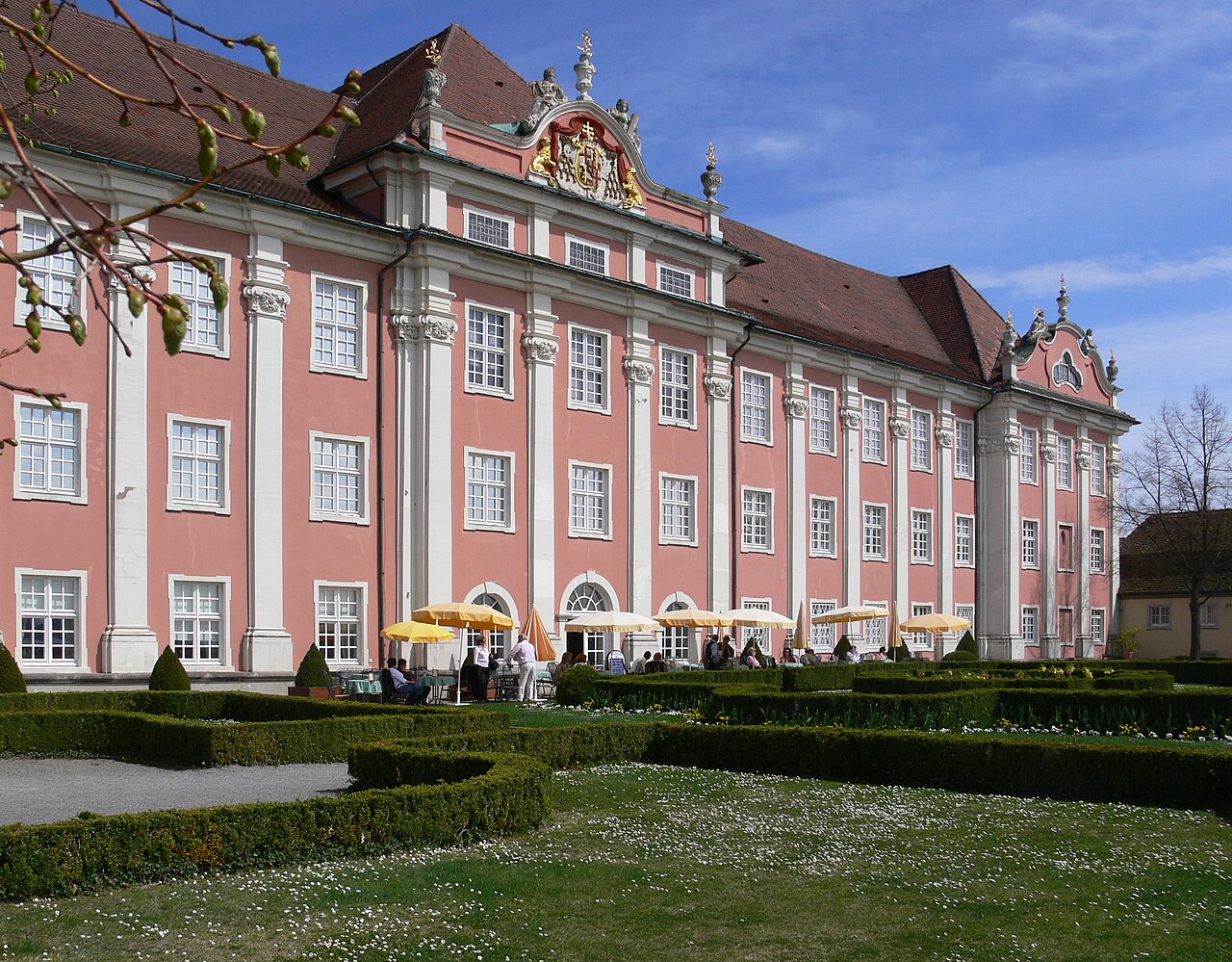
The Neues Schloss Meersburg (New Castle in Meersburg) is located in Meersburg near Lake Constance in Baden-Württemberg, Germany. From its construction in 1750 until the bishopric was dissolved in 1803 it was the seat of the Prince-Bishop of Constance.
Construction began in 1710 under Bishop Johann Franz II. von Stauffenberg, with Christoph Gessinger designing and supervising the work. It would be two years later in 1712 that the project was finished. The building was, however, a bit unfinished as a symbol of the power of the bishop. The upper story contained a number of apartments for visiting nobles and church leaders as the residence of a Prince-Bishop should, but it lacked a grand staircase and other trappings of wealth and power.
When Hugo Damian von Schönborn, who was already Bishop of Speyer and had already built Schloss Bruchsal there, took over the seat at Meersburg in 1740 he wanted to improve the Neues Schloss. He brought in the master builder Johann Georg Stahl from Bruchsal to turn the Schloss into a more impressive and elegant building. Following plans from Balthasar Neumann, Johann built an impressive staircase and decorated the castle.
From 1741 until 1743 the castle chapel was added, based on plans from Balthasar Neumann. The art and statues are the work of the fresco painter Gottfried Bernhard Göz from Augsburg (1708–1774) and the sculptor Joseph Anton Feuchtmayer (1696–1770).
By 1759 the Prince-Bishop Cardinal Franz Konrad von Rodt had the castle renovated under the direction of the master builder Franz Anton Bagnatos. The already dilapidated stairway had to be restored. The baroque facade of the castle was redone in the Rococo style, with enlarged windows, additional decoration around the windows and new gables.
The interior decoration is the work of the Mainz artist Giuseppe Appiani (c. 1705–1786) and the sculptor Carlo Luca Pozzi (1735–1803). Among the paintings by Appiani are two enormous paintings over the Grand Staircase Verherrlichung des Fürstbischofs und des Hochstift (English:Glorification of the Prince-Bishops and the Diocese) from 1761 and over the ballroom Die Verehrung der göttlichen Vorsehun (English: The worship of the divine providence) from 1762.
Due to the Secularization in 1803, the Neues Schloss was the seat of the Prince-Bishops of Constance for only about 50 years.
Text adapted from “Neues Schloss (Meersburg)” on Wikipedia, CC BY-SA 4.0.
Neues Schloss (Meersburg) ranks #3,339 of 9,035 worldwide in the atlas's castle fame ranking, and #272 of the 709 mapped in Germany. Founded 1710, it is older than 20% of the atlas's dated landmarks, one of 685 atlas entries founded in the 18th century. Its Wikipedia articles were opened 1,379 times in the last 60 days, more than 59% of the atlas. 15 more atlas landmarks stand within 25 km. The nearest day-trip guide is Winterthur, 46 km away. See how Germany compares in the castle statistics.
View on the interactive castle map →