 Austria · 16th century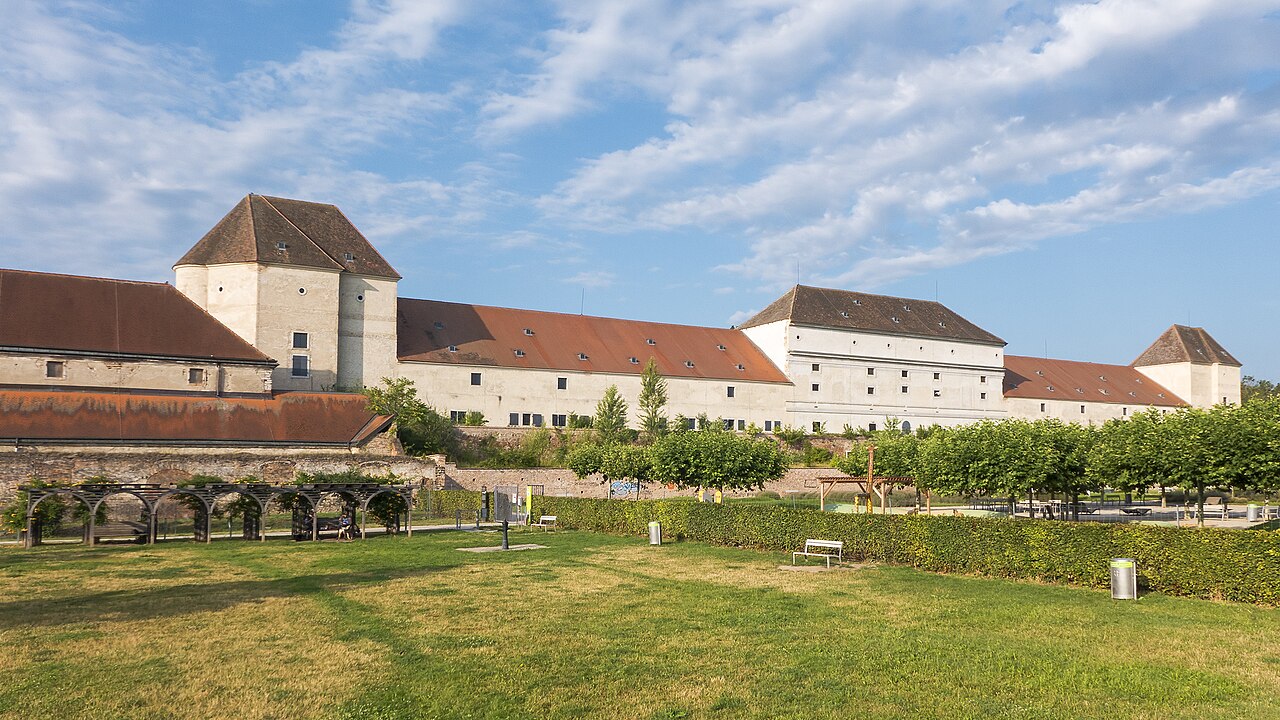
Neugebäude Palace (German: Schloss Neugebäude) is a large Mannerist castle complex in the Simmering district of Vienna, Austria. It was built from 1569 onwards at the behest of the Habsburg Emperor Maximilian II. The site of the palace is said to be where the Ottoman Sultan Suleiman the Magnificent's tent was erected during the 1529 Siege of Vienna. The palace was modeled after it.
It fell into disuse in the 17th century and today stands in ruins. Protected as a historical monument Since the 1970s, various efforts have been made to restore the site.
In 1922, Clemens Holzmeister's architectural designs for Austria's first crematorium placed Feuerhalle Simmering into the walled gardens of the derelict Schloss Neugebäude, thus putting the former palace gardens with its many ancient trees (designated natural monuments) to new use as an urn burial ground.
Text adapted from “Schloss Neugebäude” on Wikipedia, CC BY-SA 4.0.
Neugebäude Palace ranks #1,788 of 9,079 worldwide in the atlas's castle fame ranking, and #39 of the 240 mapped in Austria. Founded 1529, it is older than 41% of the atlas's dated landmarks — one of 891 atlas entries founded in the 16th century. Its Wikipedia articles were opened 2,772 times in the last 60 days, more than 76% of the atlas. 37 more atlas landmarks stand within 25 km. The nearest day-trip guide is Vienna, 7 km away. It is stop 22 of 28 on the Wachau Danube route, Melk to Vienna. See how Austria compares in the castle statistics.
View on the interactive castle map →