 Jordan · 12th century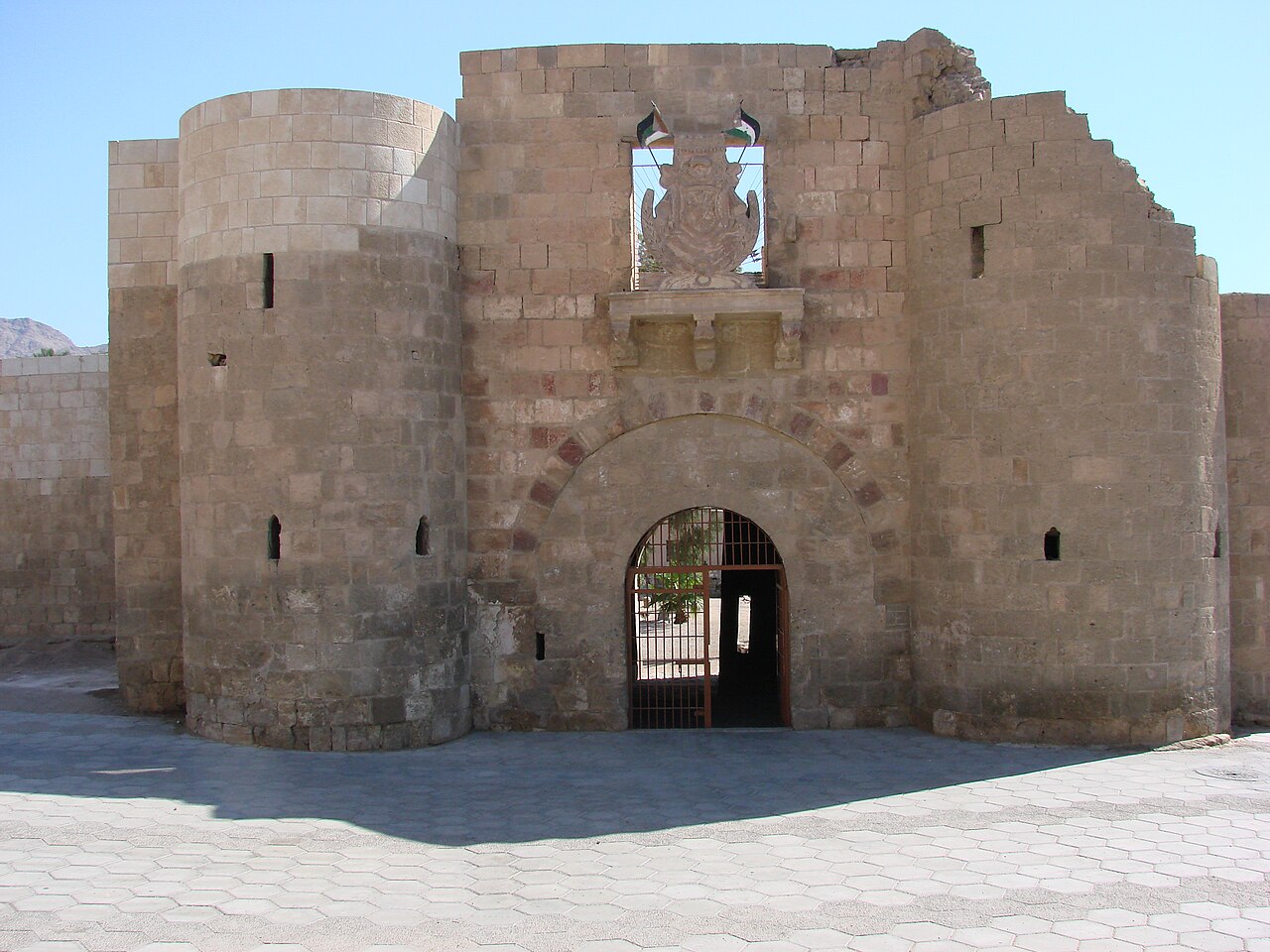
The Aqaba Castle or Aqaba Fort (Arabic: قلعة العقبة, romanized: Qalʿat al-ʿAqaba), also known as the Mamluk Castle of Aqaba, Jordan, is a Mamluk and Ottoman fortified caravanserai on the pilgrimage route to Mecca and Medina which, in its current form, dates back mainly to the 16th century. In the century preceding the First World War, it was used to a larger degree as a military stronghold.
In July 1917, the fortress was witness to a victory in the Battle of Aqaba as part of the Arab Revolt, when this heavily defended Ottoman stronghold fell to an Arab camel charge. Lawrence of Arabia rode triumphantly from here to Cairo to report the good news to General Allenby. The port of Aqaba became a major supply base for the advancing Arab Revolt.
The fort is located next to the Aqaba Flagpole, which carries the flag of the Arab revolt against the Ottomans. A building adjacent to the fort, which in 1917 served as Sharif Hussein's residence, now houses the Aqaba Archaeological Museum.
Text adapted from “Aqaba Fortress” on Wikipedia, CC BY-SA 4.0.
Aqaba Fortress ranks #2,373 of 9,079 worldwide in the atlas's castle fame ranking, and #11 of the 23 mapped in Jordan. Founded c. 1150, it is older than 80% of the atlas's dated landmarks — one of 756 atlas entries founded in the 12th century. Its Wikipedia articles were opened 1,433 times in the last 60 days, more than 60% of the atlas. 2 more atlas landmarks stand within 25 km. It is one of the 106 landmarks on the atlas's regional map of the Levant. See how Jordan compares in the castle statistics.
View on the interactive castle map →