 Belarus · 11th century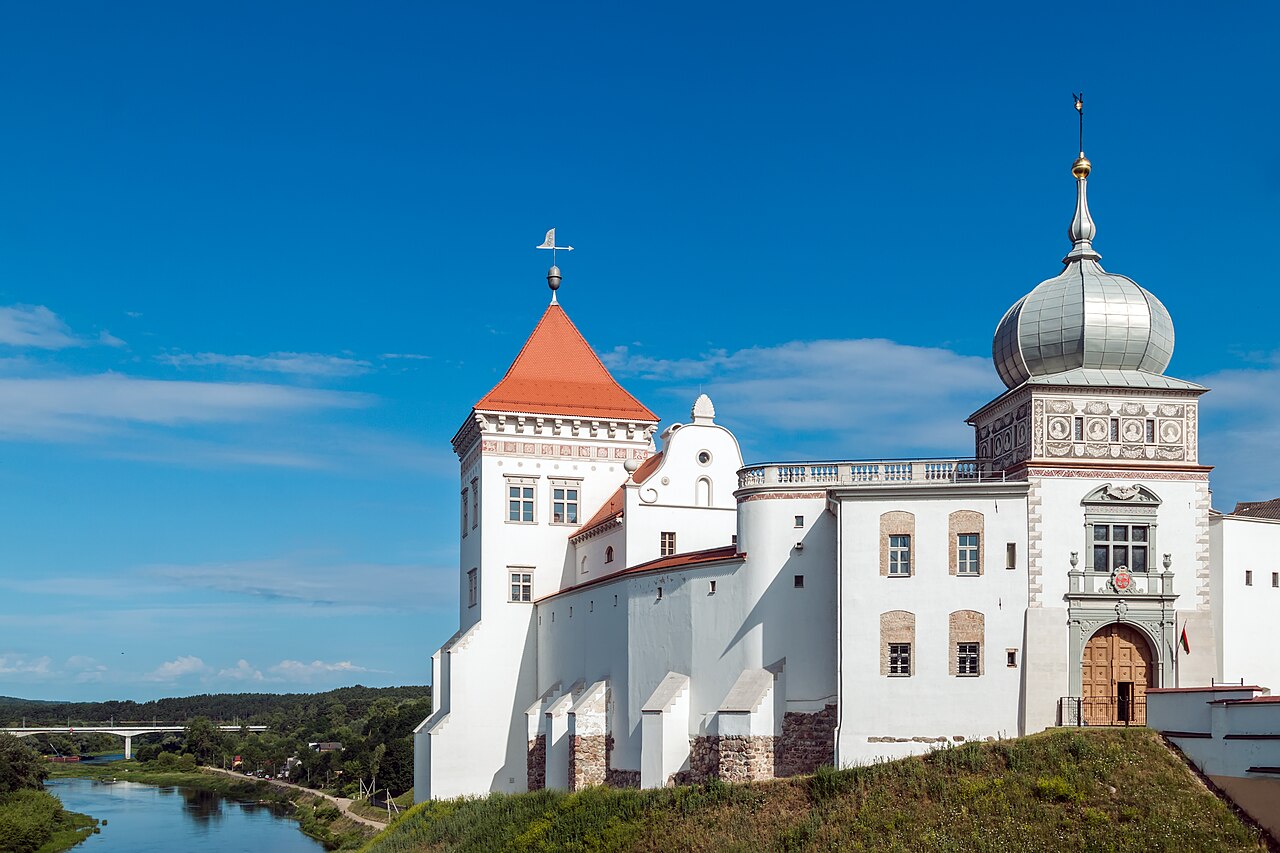
The Old Grodno Castle (Belarusian: Стары замак, romanized: Stary zamak; also known as the Grodno Upper Castle and Bathory's Castle) in Grodno, Belarus, originated in the 11th century as the seat of a dynasty of Black Ruthenian rulers, descended from a younger son of Yaroslav the Wise of Kiev.
The first wooden castle was built in the 11th century at the confluence of the Neman and the Gorodnichanka rivers.
The 13th-century keep of the castle belonged to a type of Belarusian defensive tower represented by the Tower of Kamyanyets. Vytautas the Great rebuilt the castle in stone and added five Brick Gothic towers in 1391–98, transforming it into one of his main residences. Casimir IV Jagiellon also used to reside in Grodno alongside Lithuania's official capital Vilnius. It was there that the Polish Crown was offered to him, and it was there that he died in 1492.
The next notable tenant of the castle was Stephen Báthory who envisaged Grodno as one of the main residences of his vast empire in Eastern Europe. He engaged Scotto of Parma to replace the Vytautas Castle with his own residence in the advanced Renaissance taste of Northern Italy. After Bathory's death in Grodno in 1586, his pet project was abandoned. The citadel was devastated by the Russians during the Russo-Polish War in 1655.
The castle's revival took place in 1673–1678 due to Krzysztof Zygmunt Pac who raised sufficient funds to finance the refurbishing of the royal residence. The restored castle was selected by King Michał Korybut Wiśniowiecki of Poland as the location for every third Sejm of the Polish–Lithuanian Commonwealth. The castle suffered extensive damage during the Great Northern War, forcing the royal court to move into the New Grodno Castle.
After the partitions of Poland, the castle was given over to the Russian army and housed a barracks. The authorities of interwar Poland restored the Chamber of Ambassadors and the Sejm Hall.
At present, the castle serves as a historical and archaeological museum with a collection of more than 200,000 artifacts, one of the largest in Belarus.
The newest reconstruction began in 2017. The restoration of the Old Grodno Castle was criticised for lacking historical authenticity. For instance, the contemporary viewpoint was added near the central gates.
Text adapted from “Old Grodno Castle” on Wikipedia, CC BY-SA 4.0.
Old Grodno Castle ranks #712 of 9,079 worldwide in the atlas's castle fame ranking, and #3 of the 45 mapped in Belarus. Founded c. 1050, it is older than 89% of the atlas's dated landmarks — one of 436 atlas entries founded in the 11th century. Its Wikipedia articles were opened 6,656 times in the last 60 days, more than 90% of the atlas. 2 more atlas landmarks stand within 25 km. The nearest day-trip guide is Alytus, 82 km away. See how Belarus compares in the castle statistics.
View on the interactive castle map →