 Belarus · 18th century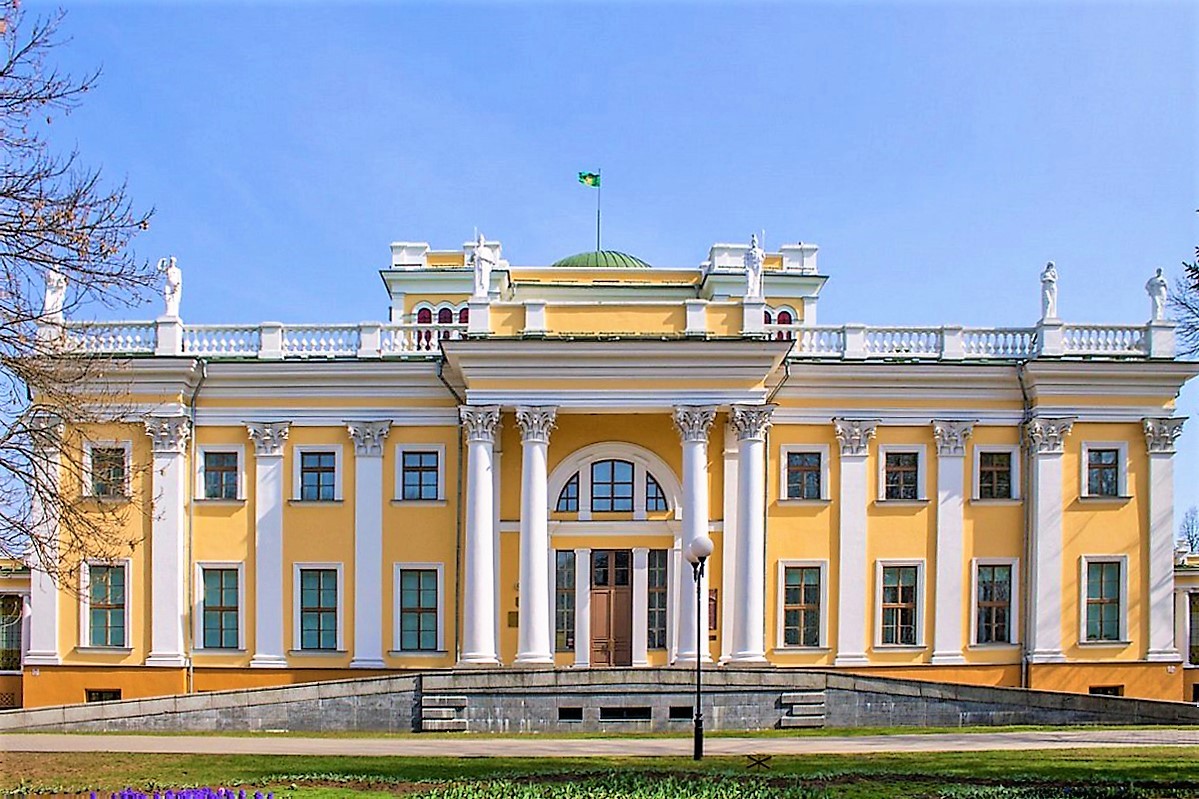
The Rumyantsev-Paskevich Residence (Belarusian: Палац Румянцавых — Паскевічаў; Russian: Дворец Румянцевых — Паскевичей) is the main place of historical importance in the city of Gomel, Belarus. The grounds of the residence stretch for 800 meters along the steep right bank of the Sozh River. An image of the residence is featured on the Belarusian 20-ruble bill.
The two-storey palace of Field Marshal Pyotr Rumyantsev was built between 1777 and 1796 to a Neoclassical design attributed to Ivan Starov. The palace replaced the ruined castle of Gomel's previous owner, Michael Frederick Czartoryski.
After Pyotr Rumyantsev's death in 1796, the grounds were slowly improved by his son Nicholas (1754–1826). His brother Sergei was the next owner. He was never interested in country housekeeping and promptly sold the palace to the crown (1834). Gomel was immediately purchased by another Field Marshal, Ivan Paskevich, who had both the palace and the park substantially renovated. He employed architect Adam Idźkowski to add a four-storey tower and a three-storey wing to the existing structure.
After the Russian Revolution the palace was nationalized to house a local museum. Paskevich's daughter-in-law Irina had to move from the palace into an ordinary flat. The buildings sustained heavy damage in the Russian Civil War and World War II. In late February and March of 2022 the palace was site of several negotiation sessions between Ukraine and Russia seeking a settlement of their ongoing war, which had begun on 22 February; these talks would come to naught.
The park contains a modern statue of Count Nikolay Rumyantsev. The original marble statues of Euripides, Venus, Athena, Ares, Bacchus, and the Nymph were lost. It was only in 2006 that the replacement statues were put in place. The Paskevich art collection also boasted several paintings by Ivan Kramskoi, Marcin Zaleski, and January Suchodolski, as well as a marble bust of Count Rumyantsev by Antonio Canova.
The bronze equestrian statue of Prince Joseph Poniatowski by Bertel Thorvaldsen, which Paskevich had brought from Warsaw as a trophy in 1842, was dismantled by the Poles during the Polish-Soviet War and transported back to Warsaw, only to be destroyed by the Germans in the 1940s.
By far the most conspicuous landmark in the park is the Neoclassical church of Sts. Peter and Paul.
Text adapted from “Gomel Palace” on Wikipedia, CC BY-SA 4.0.
Gomel Palace ranks #1,330 of 9,079 worldwide in the atlas's castle fame ranking, and #12 of the 45 mapped in Belarus. Founded 1796, it is older than 12% of the atlas's dated landmarks — one of 696 atlas entries founded in the 18th century. Its Wikipedia articles were opened 3,846 times in the last 60 days, more than 82% of the atlas. 1 more atlas landmarks stand within 25 km. See how Belarus compares in the castle statistics.
View on the interactive castle map →