Ruin
Old Summer Palace
🇨🇳 China · 19th century
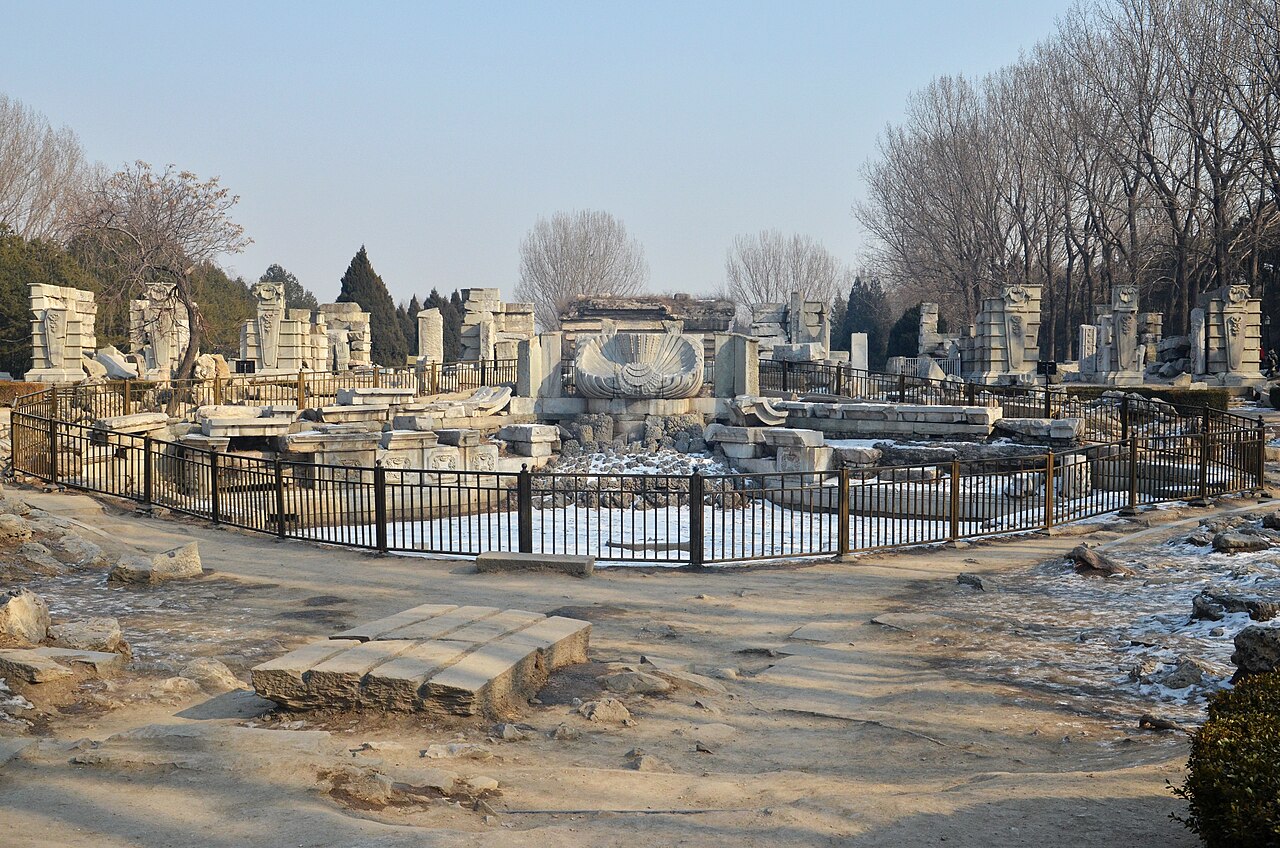
The Old Summer Palace, also known as Yuanmingyuan (traditional Chinese: 圓明園; simplified Chinese: 圆明园; pinyin: Yuánmíng Yuán; lit. 'Gardens of Perfect Brightness') or Yuanmingyuan Park, originally called the Imperial Gardens (traditional Chinese: 御園; simplified Chinese: 御园; pinyin: Yù Yuán), and sometimes called the Winter Palace, was a complex of palaces and gardens in present-day Haidian District, Beijing, China. It is 8 kilometres (5 mi) north-west of the walls of the former Imperial City section of Beijing. Widely perceived as the pinnacle work of Chinese imperial garden and palace design, the Old Summer Palace was known for its extensive collection of gardens, its building architecture and numerous art and historical treasures.
Constructed throughout the 18th and early 19th centuries, the Old Summer Palace was the main imperial residence of the Qianlong Emperor of the Qing dynasty and his successors, and where they handled state affairs; the Forbidden City was used for formal ceremonies. The Garden was reputed as the "Garden of Gardens" (simplified Chinese: 万园之园; traditional Chinese: 萬園之園; pinyin: wàn yuán zhī yuán) in its heyday was "arguably the greatest concentration of historic treasures in the world, dating and representing a full 5,000 years of an ancient civilization", according to Stuart McGee, chaplain to the British forces.
During the Second Opium War, French and British troops captured the palace on 6 October 1860, looting and destroying the imperial collections over the next few days. As news emerged that an Anglo-French delegation had been imprisoned by the Qing government, with 19 delegation members being sentenced to death, the 8th Earl of Elgin, the British High Commissioner to China, retaliated by ordering the complete destruction of the palace on 18 October, which was then carried out by troops under his command.
Text adapted from “Old Summer Palace” on Wikipedia, CC BY-SA 4.0.
Old Summer Palace ranks #147 of 8,134 worldwide in the atlas's castle fame ranking, and #5 of the 119 mapped in China. Founded c. 1825, it is older than 11% of the atlas's dated landmarks — one of 607 atlas entries founded in the 19th century. Its Wikipedia articles were opened 28,766 times in the last 60 days, more than 98% of the atlas. 16 more atlas landmarks stand within 25 km. The nearest day-trip guide is Beijing, 15 km away. See how China compares in the castle statistics.
View on the interactive castle map →Frequently asked questions
Where is Old Summer Palace?
Old Summer Palace stands in China, at 40.01205°, 116.30679°.
When was Old Summer Palace built?
The atlas dates its founding to c. 1825. Earlier structures may have stood on the site; this is the earliest documented founding year.
How famous is Old Summer Palace?
In this atlas's fame ranking: #147 of 8,134 worldwide, and #5 in China. Fame here combines how many Wikipedia language editions cover a landmark with how many people read them.
What is the nearest castle to Old Summer Palace?
Summer Palace, about 4 km away.
More castles in China
- Gaochang China · 1st century BC
- Jiayuguan China · 14th century
- Yonghe Temple China · 17th century
- Juyongguan China · 14th century
More ruins
- Chufut-Kale Ukraine · 5th century
- Devín Castle Slovakia · 8th century
- Vilcabamba Peru · 16th century
- Sarmizegetusa Regia Romania