 Germany · 8th century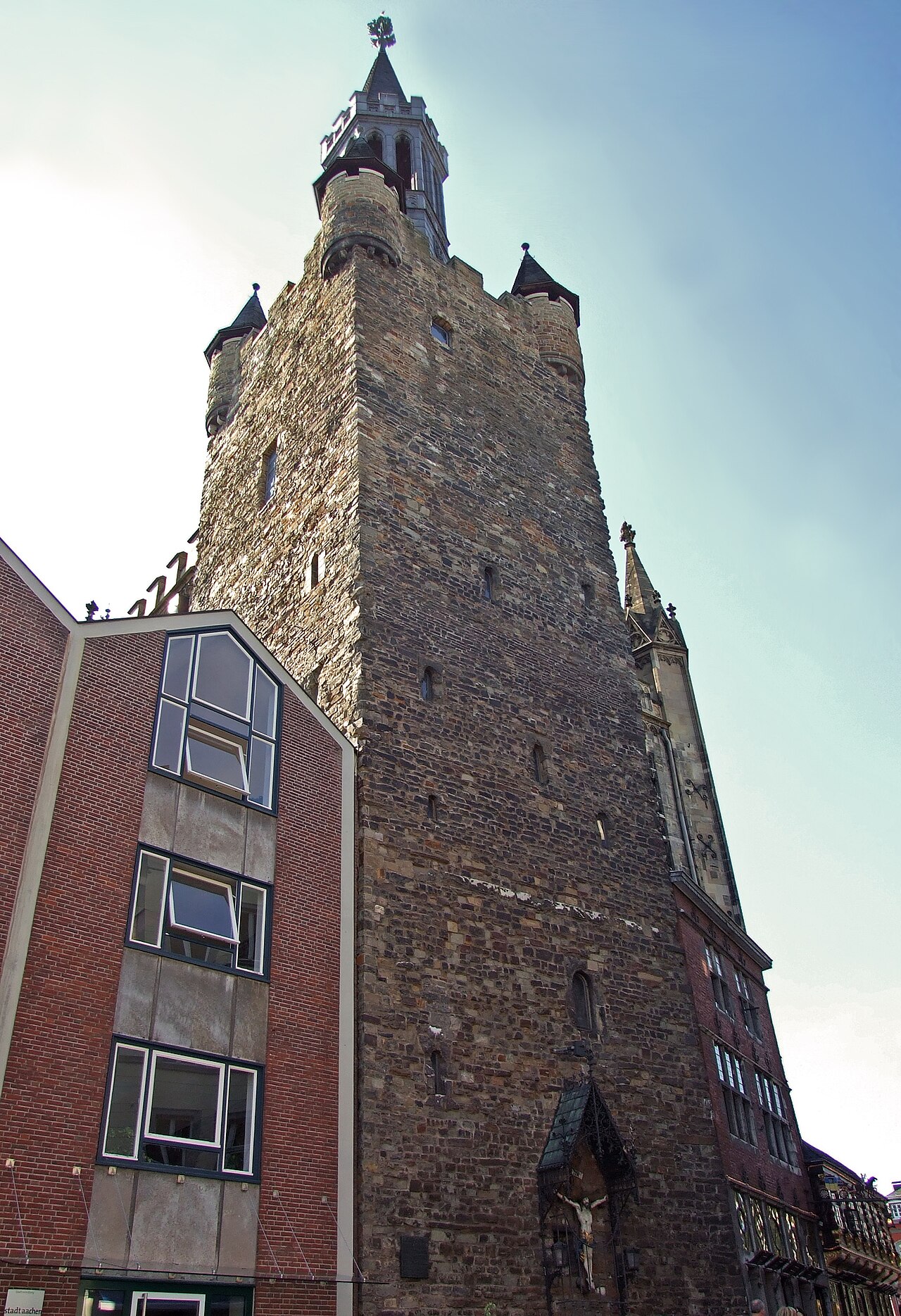
The Palace of Aachen was a group of buildings with residential, political, and religious purposes chosen by Charlemagne to be the center of power of the Carolingian Empire. The palace was located in the heart of the current city of Aachen, today in the German Land (or state) of North Rhine-Westphalia. Most of the Carolingian palace was built in the 790s but the works went on until Charlemagne's death in 814. The plans, drawn by Odo of Metz, were part of the program of renovation of the kingdom decided by the ruler. The Palatine Chapel that was part of the palace complex has been preserved and is considered a masterpiece of Carolingian architecture and a characteristic example of architecture from the Carolingian Renaissance.
Also, the foundations and lower walls of the Aula Regia (council hall) are preserved in the current town hall as are the first three stories of its square tower (so-called Granus Tower).
Text adapted from “Palace of Aachen” on Wikipedia, CC BY-SA 4.0.
Palace of Aachen ranks #464 of 9,079 worldwide in the atlas's castle fame ranking, and #38 of the 711 mapped in Germany. Founded c. 795, it is older than 95% of the atlas's dated landmarks — one of 48 atlas entries founded in the 8th century. Its Wikipedia articles were opened 12,494 times in the last 60 days, more than 95% of the atlas. 28 more atlas landmarks stand within 25 km. The nearest day-trip guide is Aachen, 1 km away. See how Germany compares in the castle statistics.
View on the interactive castle map →