 Germany · 13th century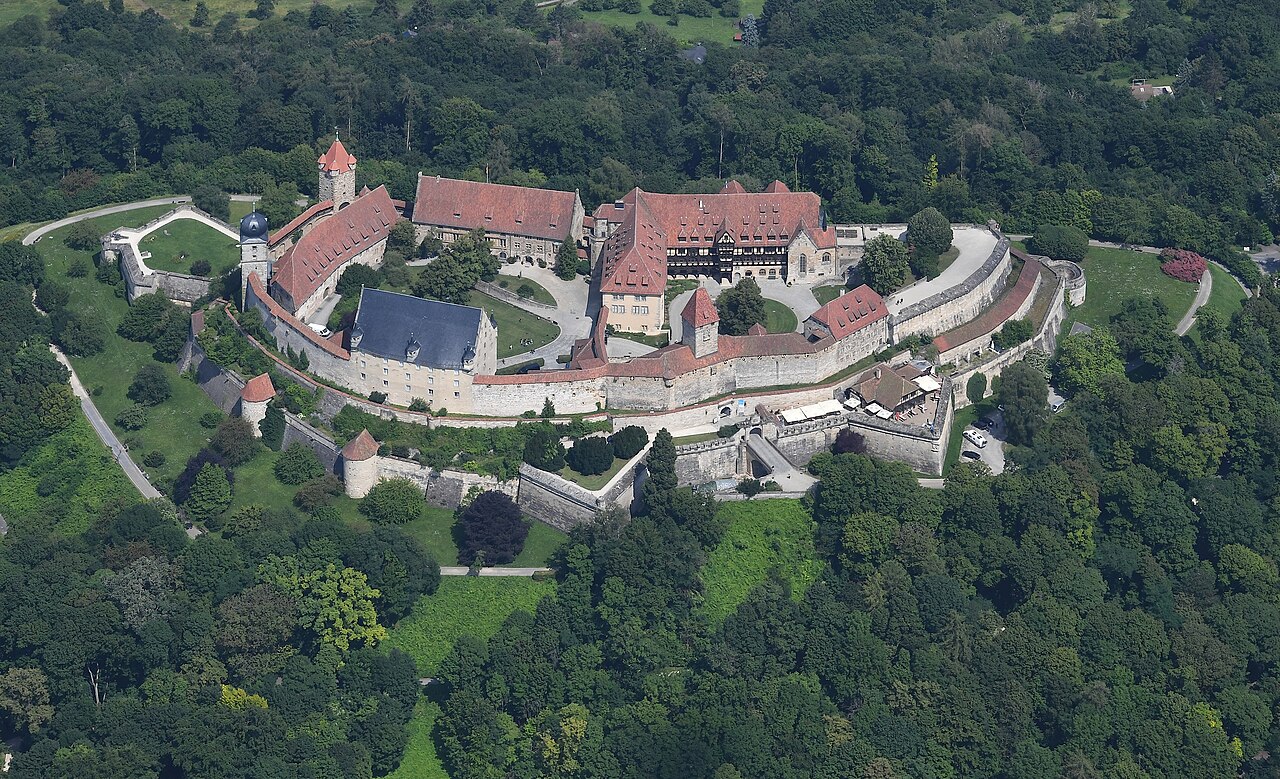
The Veste Coburg (Coburg Fortress) is one of the best-preserved medieval fortresses of Germany. It is situated on a hill above the town of Coburg, in the Upper Franconia region of Bavaria.
Veste Coburg dominates the town of Coburg on Bavaria's border with Thuringia. It is located at an altitude of 464 meters above NHN, or 167 meters above the town. Its size (around 135 meters by 260 meters) represents one of the medium fortresses in Germany.
The hill on which Veste Coburg stands had been inhabited from the Neolithic to the early Middle Ages, according to studies on results of excavations. The first documentary mention of Coburg occurs in 1056, in a gift by Richeza of Lotharingia. Richeza gave her properties to Anno II, Archbishop of Cologne, to allow the creation of Saalfeld Abbey in 1071. In 1075, a chapel dedicated to Saint Peter and Saint Paul is mentioned on the fortified Coberg. This document also refers to a Vogt named Gerhart, implying that the local possessions of the Saalfeld Benedictines were administered from the hill.
A document signed by Pope Honorius II in 1206 refers to a mons coburg, a hill settlement. In the 13th century, the hill overlooked the town of Trufalistat (Coburg's predecessor) and the important trade route from Nuremberg via Erfurt to Leipzig. A document dated from 1225 uses the term sloss (palace) for the first time. At the time, the town was controlled by the Dukes of Merania (or Meran). They were followed in 1248 by the Counts of Henneberg who ruled Coburg until 1353, save for a period from 1292-1312, when the House of Ascania (Askanien) was in charge.
In 1353, Coburg fell to Friedrich, Markgraf von Meißen of the House of Wettin. His successor, Friedrich der Streitbare was awarded the status of Elector of Saxony in 1423. Thus, Coburg – despite being in Franconia – was now referred to as "Saxony", like other properties of the House of Wettin. As a result of the Hussite Wars the fortifications of the Veste were expanded in 1430.
In 1485, in the Partition of Leipzig, Veste Coburg fell to the Ernestine branch of the family. A year later, Elector Friedrich der Weise and Johann der Beständige took over the rule of Coburg. Johann used the fortress as a residence from 1499. In 1506/07, Lucas Cranach the Elder lived and worked in the Fortress.
Text adapted from “Veste Coburg” on Wikipedia, CC BY-SA 4.0.
Veste Coburg ranks #605 of 9,079 worldwide in the atlas's castle fame ranking, and #48 of the 711 mapped in Germany. Founded 1225, it is older than 73% of the atlas's dated landmarks — one of 1080 atlas entries founded in the 13th century. Its Wikipedia articles were opened 8,860 times in the last 60 days, more than 93% of the atlas. 6 more atlas landmarks stand within 25 km. See how Germany compares in the castle statistics.
View on the interactive castle map →