Palace & château
Palácio do Freixo
🇵🇹 Portugal · 18th century
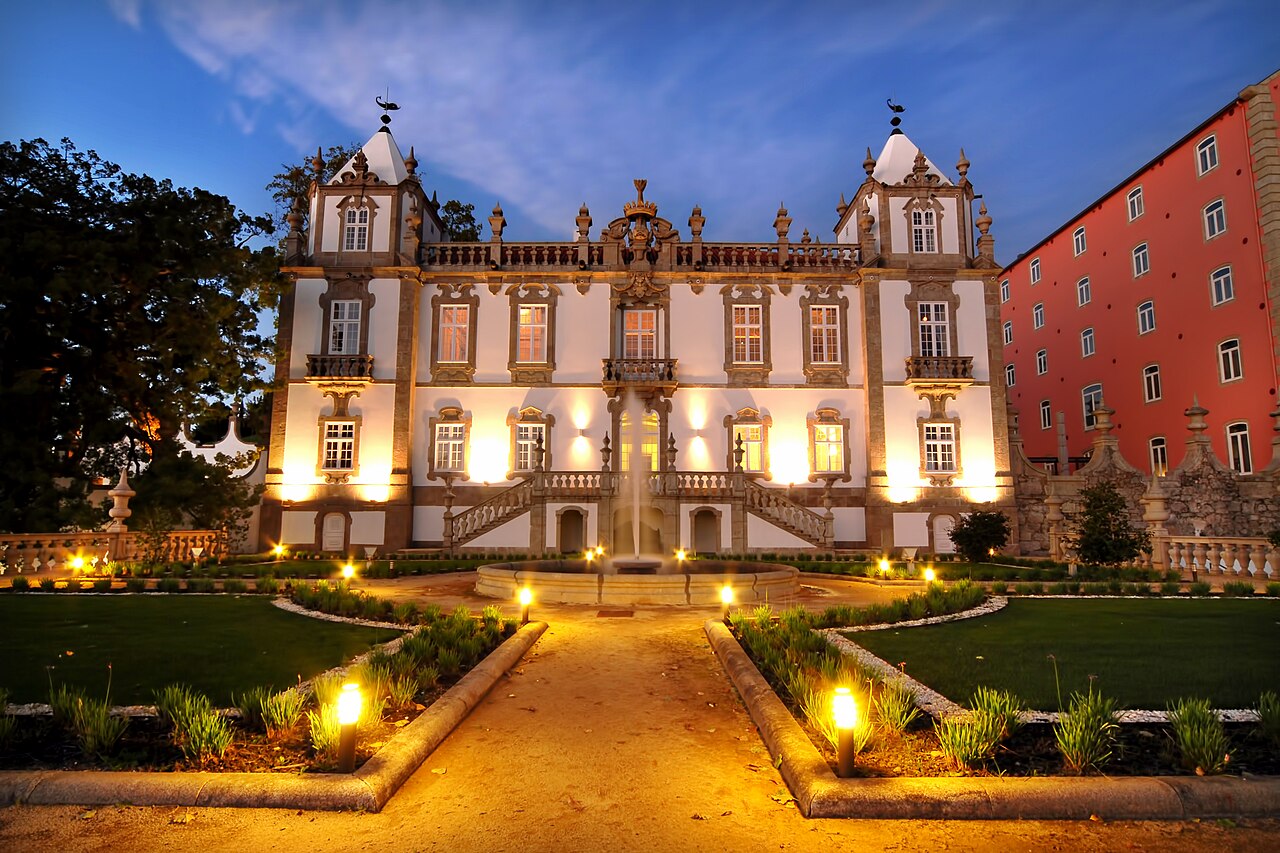
The Palace of Freixo (Portuguese: Palácio do Freixo) is a former-residence in the civil parish of Campanhã, in the northern Portuguese city of Porto.
The residence was order constructed in the middle of the 18th century, by Nicolau Nasoni, by orders of the Canon Jerónimo de Távora, a man of great wealth, from a noble family of Cernaches.
At the end of the 18th century, the Viscounts of Azurara purchased the residence, after its original sale to the merchant António Afonso, who had constructed alongside the building a soap factory.
In 1850, the palace and estate was sold to António Afonso Velado, who by 1866 had received the title of Baron of Freixo. By 1870, his success had put him in line for the title of Viscount of Freixo, resulting in his need to substitute the Tavira coat-of-arms on the old building and complete renovations. Part of the changes included large murals on mortar within the structure, and attributable to this period. The coat-of-arms of the Tavora decorated many parts of the building, but were later destroyed by the Marquis of Pombal, following the attempted Regicide of King D. Joseph. The gardens, a Nasonian inspiration, were divided by architectonic alleys of with balustrades and small villages of allegorical sculptures, while along the river there ran a balcony.
In the 20th century, an industrial purchased the building, installing in the gardens a milling factory, and later a 45 metres (148 ft) silo. Within the palace this entrepreneur established his administration in building. By 1870, tile and ceramics were installed in the building, ostensibly as a provisional solution to hide damage to the building. Following a 1909 flood, the varanda was destroyed.
But, it was only in 1947 that recuperation of the building was undertaken, under the leadership of its occupant Companhia de Moagens Harmonia (Harmony Milling Company), of the União Fabril. A new silo was also constructed within the next few years to increase production at site.
In 1983, by decree (344-A/83), it was determined that the SEOP would begin the acquisition of the property: the process was completed on 30 November 1984, by the Ministério do Trabalho (Ministry of Work). A limited public tender was executed in 1985 to complete emergency repairs, but on 6 June 1985 there was a fire.
Text adapted from “Palácio do Freixo” on Wikipedia, CC BY-SA 4.0.
Palácio do Freixo ranks #4,614 of 8,764 worldwide in the atlas's castle fame ranking, and #62 of the 211 mapped in Portugal. Founded c. 1750, it is older than 18% of the atlas's dated landmarks — one of 638 atlas entries founded in the 18th century. 4 more atlas landmarks stand within 25 km. The nearest day-trip guide is Paredes, 21 km away. See how Portugal compares in the castle statistics.
View on the interactive castle map →Frequently asked questions
Where is Palácio do Freixo?
Palácio do Freixo stands in Portugal, at 41.14252°, -8.57479°.
When was Palácio do Freixo built?
The atlas dates its founding to c. 1750. Earlier structures may have stood on the site; this is the earliest documented founding year.
How famous is Palácio do Freixo?
In this atlas's fame ranking: #4,614 of 8,764 worldwide, and #62 in Portugal. Fame here combines how many Wikipedia language editions cover a landmark with how many people read them.
What is the nearest castle to Palácio do Freixo?
City walls of Porto, about 3 km away.
More castles in Portugal
- Fortress of Cacela Portugal · 18th century
- Castle of Castelo Rodrigo Portugal · 6th century
- Castle of Lousa Portugal
- Castle of Senhora da Luz Portugal · 16th century
More palaces & châteaux
- Baroque Palace in Oradea Romania · 18th century
- Baroque Palace, Timișoara Romania
- Alexandrino Manor Russia · 18th century
- Chesme Palace Russia · 18th century