 Egypt · 19th century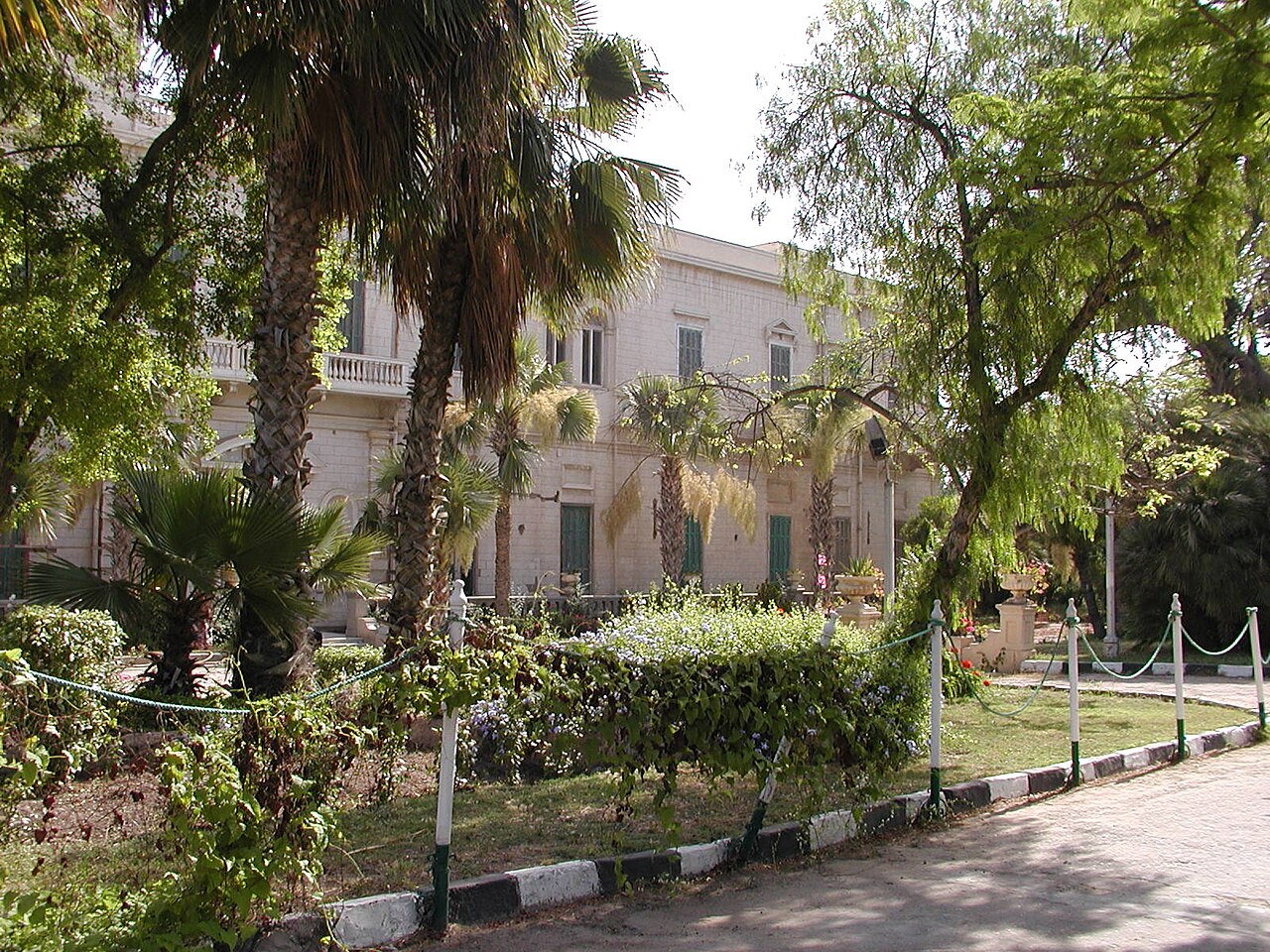
The Palais d'Antoniadis is a palace in Alexandria, Egypt, named after Sir John Antoniadis (1818–1895), who was an Alexandrian Greek. He was born in Lemnos and received French citizenship when he began to conduct business in Marseille. He was also president of the Greek Community in Alexandria and consul general of Belgium. He was knighted by Queen Victoria.
Situated near the Mahmoudia Canal at the southern entrance of Alexandria, the palace is surrounded by some 48 hectares (120 acres) of greenery, divided into several sections. They include the Antoniadis Garden, the Flower Garden, the Zoological and Botanical Gardens, and the Nouzaba Garden.
The Nouzaba (Nuzha) Municipal Garden was a residential suburb once inhabited by Callimachus (310–240 BC), a prominent scholar at the ancient Library of Alexandria.
In 168 BCE, the Roman envoy Gaius Pompillius Laenas met Antiochus IV Epiphanes, king of the Seleucid Empire, at the site of the modern palace, which was at the time known as Eleusis. In the so-called 'Day of Eleusis', Laenas delivered an ultimatum to Antiochus: withdraw your armies from Egypt and Cyprus or face war with Rome. When the king replied that he would consider what Laenas' had said, the Roman refused to accept such an answer. Using his cane, he drew a circle around Antiochus in the sand and told him that he must give Rome an answer before he stepped out of the circle: Peace or war? Antiochus acquiesced to Rome's demands and withdrew.
In 640 CE, the cavalry of the Arab conqueror Amr ibn al-As pitched camp at the site before entering the city.
The area was purchased by Sir John Antoniadis from Muhammad Ali's family.
The Antoniadis Palace and its park are constructed as a miniature version of the Palace of Versaille. The villa and its garden date back to the 19th century, and are mainly used to house a collection of statues sculpted in the Greek style and owned by Sir John Antoniadis. It consists of a basement level of 434 square meters, a ground floor of 1,085 square meters, a second floor of 860 meters and a roof area of 480 square meters, for a total area of 2,859 square metres (30,770 sq ft). The ground and second floors include 15 rooms each. There are several archaeological remains, including a tomb and a cistern.
Text adapted from “Palais d'Antoniadis” on Wikipedia, CC BY-SA 4.0.
Palais d’Antoniadis ranks #3,090 of 9,035 worldwide in the atlas's castle fame ranking, and #17 of the 36 mapped in Egypt. Founded 1860, it is older than 7% of the atlas's dated landmarks, one of 705 atlas entries founded in the 19th century. Its Wikipedia articles were opened 1,046 times in the last 60 days, more than 52% of the atlas. 4 more atlas landmarks stand within 25 km. See how Egypt compares in the castle statistics.
View on the interactive castle map →