Palace & château
Palazzo Biscari
🇮🇹 Italy · 18th century
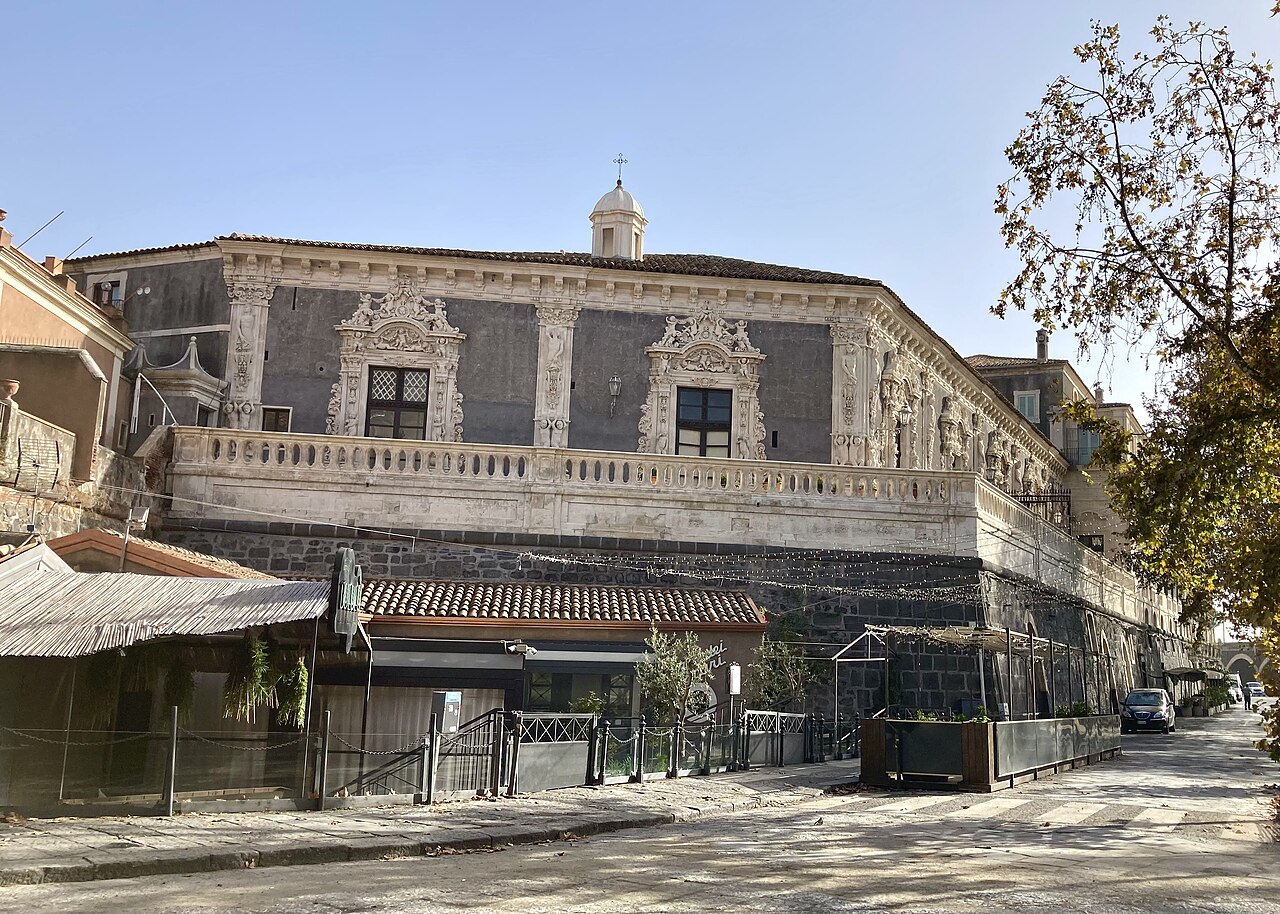
The Palazzo Paternò Castello di Biscari is a monumental private palace located in Catania, Italy. The highly decorative interiors are open for guided tours, and used for social and cultural events.
After the devastations of the 1693 Sicily earthquake, the Prince of Biscari, Ignazio Paternò Castello, 3rd Prince of Biscari, obtained the permission to build this palace. At the time the building stood against the French king Charles V's walls of the town. After Ignazio's death in 1699, his son Vincenzo (1685-1749) and later his nephew Ignazio Paternò Castello (1714-1786), the fifth Prince of Biscari extended and completed the decoration. This latter prince complimented the work with a museum space to display his large collection of mainly archeologic and numismatic collections, now on display in the Museo Civico Castello Ursino.
The oldest section was built under Ignazio, the third prince of Biscari, who commissioned the design from the architect Alonzo Di Benedetto. Ignazio's son, Vincenzo, commissioned the elaborate decoration of the seven large second-storey windows facing the seaside, on the southwest corner of the palace on Via Cardinale Dusmet, by the Messinese sculptor Antonino Amato. The final additions eastward were designed by Giuseppe Palazzotto and, later, by Francesco Battaglia. The building was finished in 1763 and inaugurated with big celebrations.
The outer facade on Via Museo Biscari appears somewhat dilapidated; the entrance is through a grand stone portal, decorated with facial cartouches and brackets as well as the coat of arms of the Biscari. It leads to a large inner courtyard, which features a large double outdoor entrance staircase. The Rococo interiors are elaborately frescoed and decorated with stucco. The large octagonal ballroom has a complex decoration of mirrors, stuccoes and frescos painted by Matteo Desiderato and Sebastiano Lo Monaco. A small dome has a balcony designed to contain an orchestra. The dome fresco is meant to depict the glory of the Paternò Castello di Biscari family. It is accessed through a staircase decorated in stucco within the gallery facing the sea.
Among the other rooms are the "Fief Room", featuring large canvasses of the Biscari feudataries; the "Princess Apartments", built by Ignazio V of Biscari for his wife, with pavements of ancient Roman marbles; the "Birds Gallery" and the "Don Quixote Room".
Text adapted from “Palazzo Biscari” on Wikipedia, CC BY-SA 4.0.
Palazzo Biscari ranks #2,584 of 8,134 worldwide in the atlas's castle fame ranking, and #206 of the 487 mapped in Italy. Founded 1758, it is older than 17% of the atlas's dated landmarks — one of 556 atlas entries founded in the 18th century. Its Wikipedia articles were opened 2,140 times in the last 60 days, more than 68% of the atlas. 5 more atlas landmarks stand within 25 km. It is one of the 23 landmarks on the atlas's regional map of Sicily. See how Italy compares in the castle statistics.
View on the interactive castle map →Frequently asked questions
Where is Palazzo Biscari?
Palazzo Biscari stands in Italy, at 37.50222°, 15.09028°.
When was Palazzo Biscari built?
The atlas dates its founding to 1758. Earlier structures may have stood on the site; this is the earliest documented founding year.
How famous is Palazzo Biscari?
In this atlas's fame ranking: #2,584 of 8,134 worldwide, and #206 in Italy. Fame here combines how many Wikipedia language editions cover a landmark with how many people read them.
What is the nearest castle to Palazzo Biscari?
Palazzo degli Elefanti, about 1 km away.
More castles in Italy
- Palazzo Orsini di Gravina Italy · 16th century
- Palazzo Venezia (Naples) Italy · 15th century
- Palazzo Venier dei Leoni Italy · 18th century
- Palazzo Altieri Italy
More palaces & châteaux
- Sikandar Bagh India · 2nd century
- Tiradentes Palace Brazil · 20th century
- Prinzessinnenpalais Germany · 18th century
- Catete Palace Brazil · 19th century