 Italy · 17th century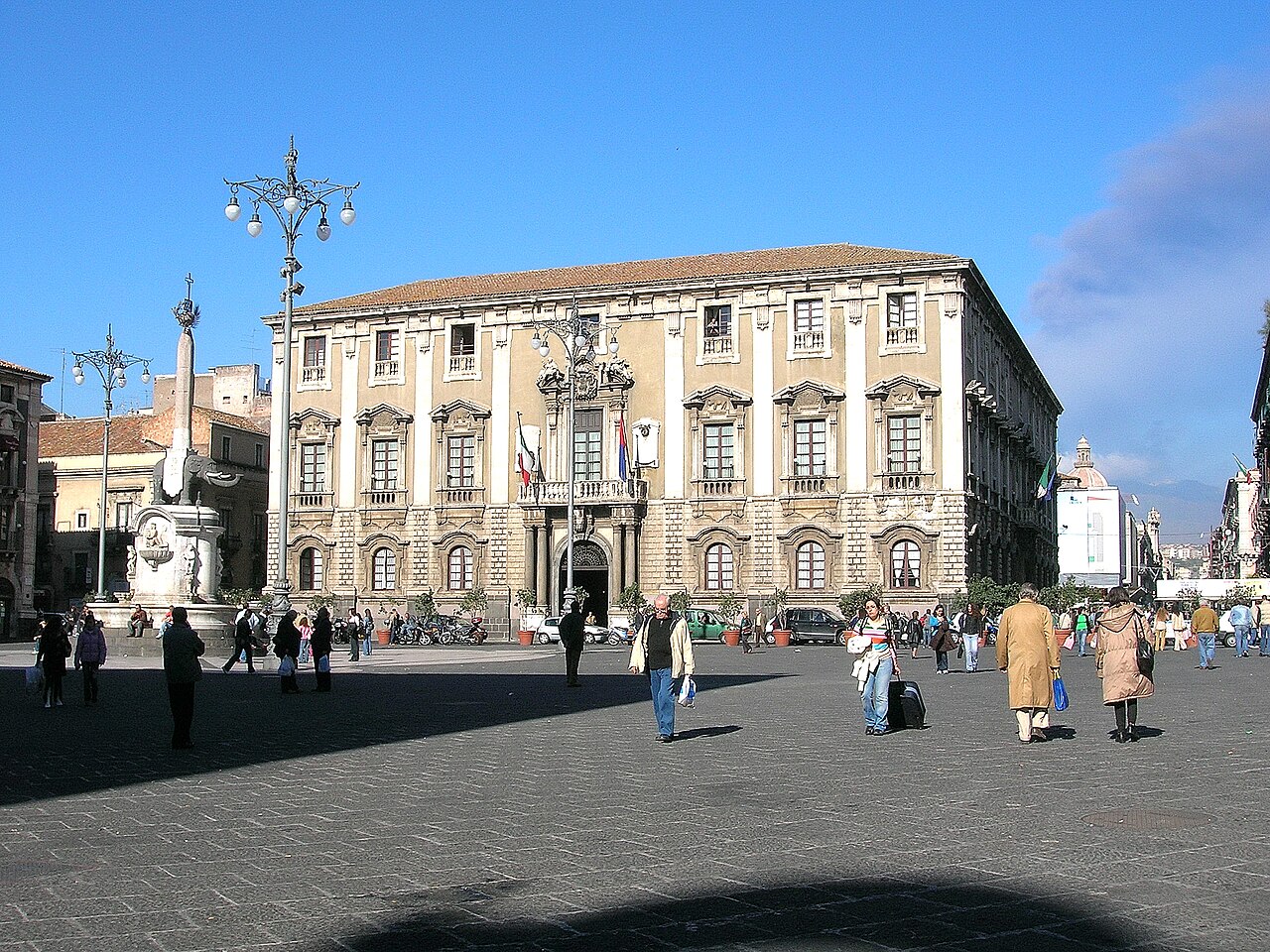
Palazzo degli Elefanti (English: "Elephants Palace") is a historical building in Catania, region of Sicily, southern Italy. It currently houses the city's Town Hall. In the past, the prior building was also known as the Palazzo Senatorio or Loggia Senatoria.
The main facade of the palace, faces the northern side of the rectangular Piazza del Duomo; while across the square, on the southern end stands the Palazzo del Seminario dei Chierici. The Palazzo degli Elefanti was begun in 1696 after the devastating earthquake of 1693. Construction was begun using the designs of Giovanni Battista Longobardo. The eastern, southern, and western façades were however designed at a later stage by Giovan Battista Vaccarini, a highly prolific architect of Catania during its urban reconstruction in the 18th-century, while the northern one was by Carmelo Battaglia.
The staircase opening to the inner court with four porticoes was added in the late 18th century by Stefano Ittar. In the second floor are a series of large historical and one religious oil paintings by the Sicilian artist Giuseppe Sciuti, painted circa 1900.
In 1736 in the center of Piazza del Duomo, Vaccarini erected a fountain with an ancient black lava stone statue of an elephant carrying on its back an Egyptian red granite obelisk, marked with hieroglyphs. It is not known how the obelisk originally came to Catania, but it was suspected to be a decoration of some ancient Roman hippodrome. Until 1620 the obelisk had served as an architrave to an arch at the episcopal palace. In 1677, it had been erected standing (sans elephant) in the courtyard of the Palazzo degli Elefanti, but like nearly everything else in town, it was toppled in 1693. The base of the fountain has two reliefs depicting allegorical images of the two rivers that once coursed through Catania: the Simeto and Amenano.
The arrangement by Vaccarini of the Elephant Fountain was almost certainly inspired by Bernini's 1667 Elephant and Obelisk in Rome. The elephant (u Liotru), however, has been for centuries a symbol of the city.
Text adapted from “Palazzo degli Elefanti” on Wikipedia, CC BY-SA 4.0.
Palazzo degli Elefanti ranks #3,455 of 9,079 worldwide in the atlas's castle fame ranking, and #268 of the 560 mapped in Italy. Founded 1696, it is older than 22% of the atlas's dated landmarks — one of 721 atlas entries founded in the 17th century. Its Wikipedia articles were opened 1,295 times in the last 60 days, more than 57% of the atlas. 5 more atlas landmarks stand within 25 km. It is one of the 32 landmarks on the atlas's regional map of Sicily. See how Italy compares in the castle statistics.
View on the interactive castle map →