 Italy · 17th century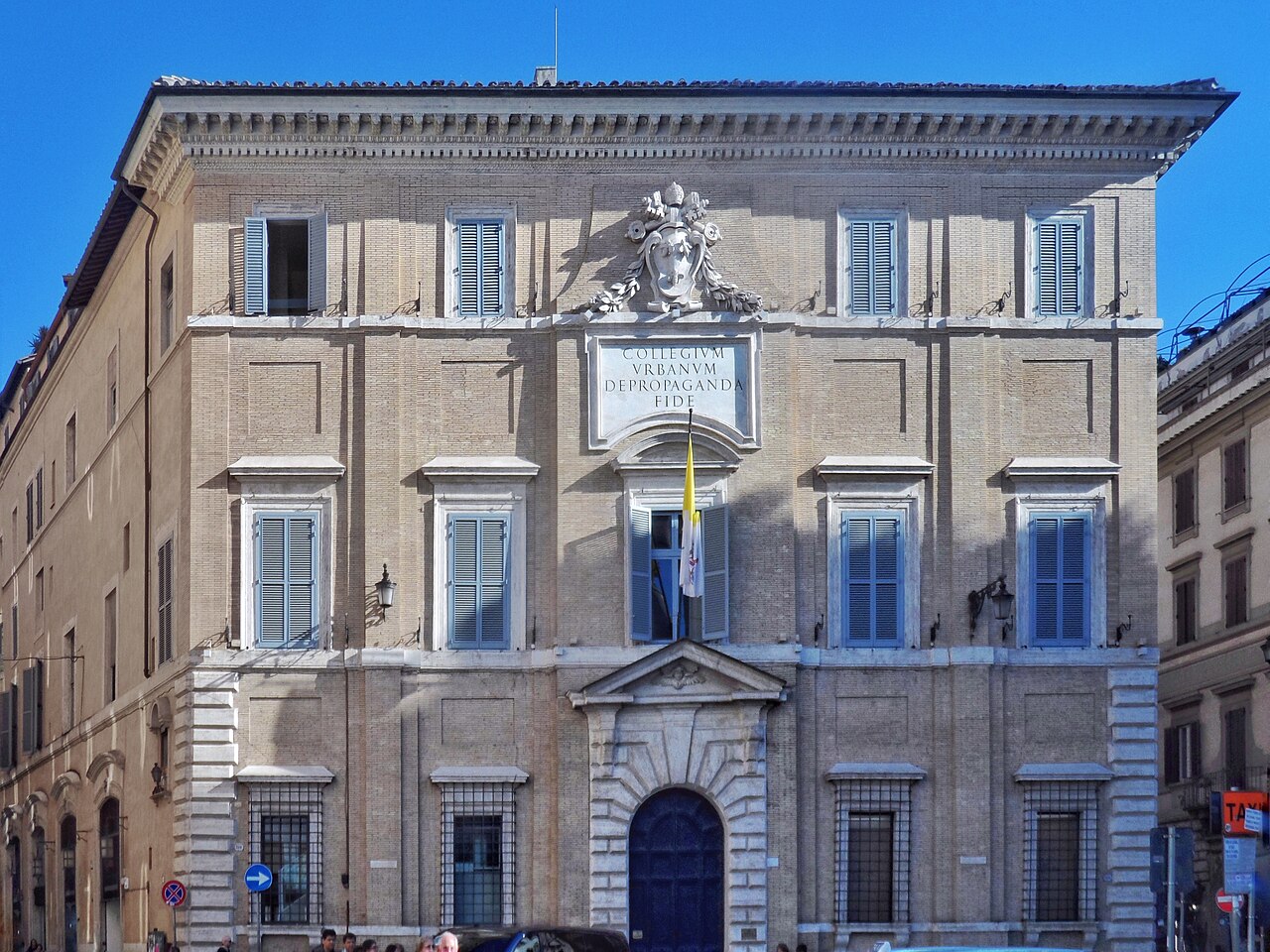
The Palazzo di Propaganda Fide (in English: Palace of the Propagation of the Faith) is a palace located in Rome, designed by Gian Lorenzo Bernini, then Francesco Borromini. Since 1626, it has housed the Congregation for the Evangelization of Peoples and since 1929 is an extraterritorial property of the Holy See. The complex includes a dormitory and chapel as well.
The building is located in the Rione Colonna, at the southern end of piazza di Spagna. Its southern facade is in front of the basilica Sant'Andrea delle Fratte, whose cupola and the bell were the work of Borromini. The main facade was created by Bernini (1644), and the front side of the via di Propaganda by Borromini (1646). This setting aside of Bernini's work was a request of Pope Innocent X, who preferred Borromini's style. The work was completed in 1667.
The palace is still devoted to its original purpose, but the ground floor has been converted to shops. The building houses the Museo Missionario di Propaganda Fide, highlighting 400 years of missionary work.
The facade over the Piazza di Spagna is by Bernini. A plaque above the doorway displays the coat of arms of Urban VIII, with Barberini bees, Papal tiara and keys.
The façade facing via di Propaganda, that Borromini completed in 1662 is a masterpiece of Baroque architecture. Composed of pilasters, and alternating concave and convex curves in the windows design, it is one of the most famous examples of Italian Baroque architecture.
His first designs for the façade on the Via di Propaganda Fide had five bays but he expanded this to seven. The central bay is a concave curve and accommodates the main entry into the college courtyard and complex, with the entrance to the chapel to the left and to the college to the right. The façade is dominated by the giant pilasters that originally supported a balustrade above the narrow entablature but later extensions obliterated the balustrade. The central bay of the façade is a concave curve with angled pilasters at its edges, perhaps in recognition that this façade would always be seen at an oblique angle because of the narrowness of the street. On the outside, a ridge marks the separation between the ground floor and piano nobile.
Text adapted from “Palazzo di Propaganda Fide” on Wikipedia, CC BY-SA 4.0.
Palazzo di Propaganda Fide ranks #1,828 of 9,079 worldwide in the atlas's castle fame ranking, and #135 of the 560 mapped in Italy. Founded 1667, it is older than 24% of the atlas's dated landmarks — one of 721 atlas entries founded in the 17th century. Its Wikipedia articles were opened 2,265 times in the last 60 days, more than 72% of the atlas. 65 more atlas landmarks stand within 25 km. The nearest day-trip guide is Rome, 1 km away. See how Italy compares in the castle statistics.
View on the interactive castle map →