 Germany · 16th century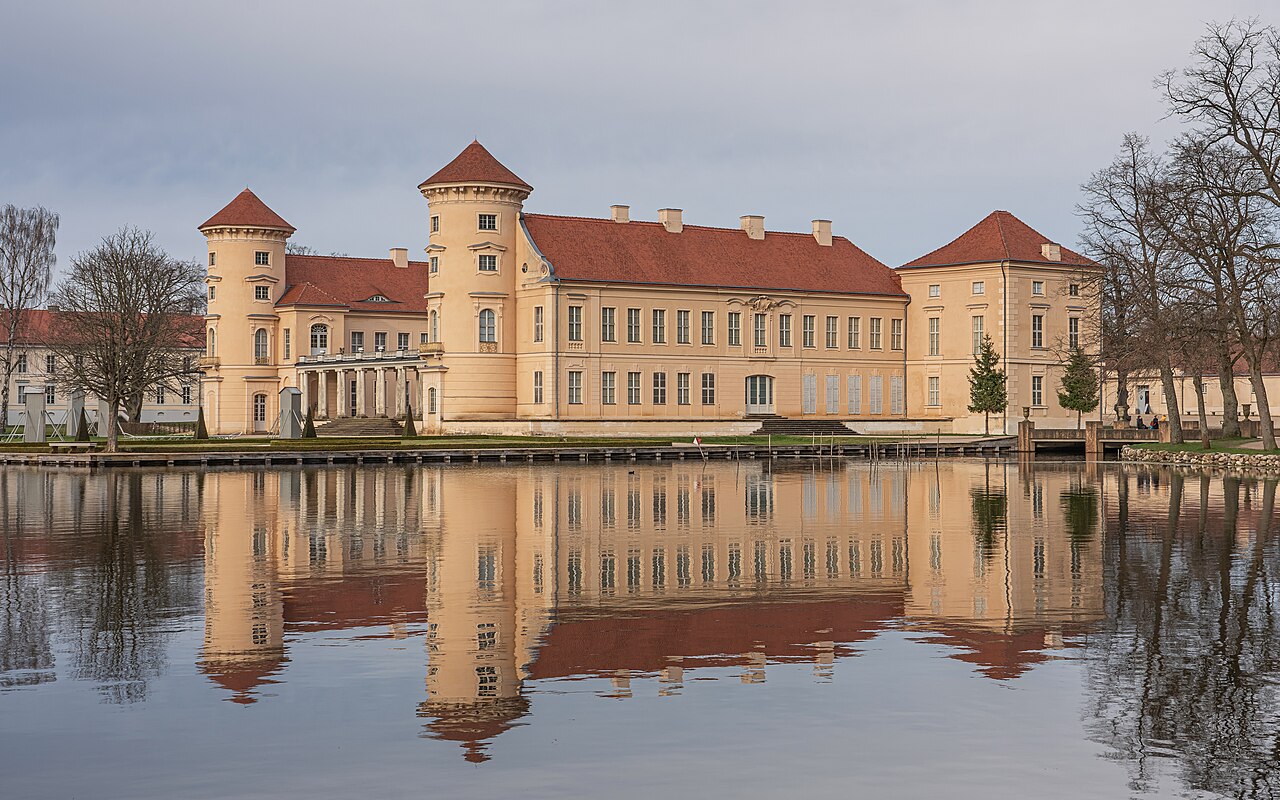
Rheinsberg Palace (German: Schloss Rheinsberg) lies in the municipality of Rheinsberg, about 100 kilometres (62 mi) northwest of Berlin in the German district of Ostprignitz-Ruppin.
The palace on the eastern shore of the Grienericksee is a classic example of the so-called Frederician Rococo architecture style and served as a basis for Sanssouci Palace.
In the Middle Ages a moated castle stood on the site of Rheinsberg Palace. The von Bredow family had acquired the lordship of Rheinsberg through marriage in 1464 from the von Platen and had a water castle built on this spot in 1566 in Renaissance style. It was badly damaged during the Thirty Years' War. In 1618, was sold to Kuno von Lochow. When his line died out, the castle went to Prince-Elector Frederick William, who gifted it to his General, Franz du Hamel. With the permission of the elector, he sold it to Benjamin Chevenix de Beville. He sold it in March 1734 for 75,000 thalers to the Prussian king, Frederick William I.
Frederick William in turn gave it to his son, Crown Prince Frederick, later King Frederick the Great for his loyalty. In 1736 he moved with his wife, Princess Elisabeth Christine to the southern wing of the castle. In the years up to 1740 Frederick had the castle considerably extended and improved by the architects Johann Gottfried Kemmeter and Georg Wenzeslaus von Knobelsdorff, who learned his architectural craft from Kemmeter. An upper floor was added to the single-storey building and the East Wing extended by 25 metres.
Frederick himself always described his years at Rheinsberg Palace as the "happiest of his life". His time in Rheinsberg ended in 1740 with his accession to the throne.
Four years later he gave it to his younger brother Henry, who moved there in 1752 with his wife, Princess Wilhelmina of Hesse-Kassel. The king also had a grand palace built for him in Berlin between 1748 and 1753 which now houses the main building of Humboldt University. The art-loving prince went on to extend and embellish the castle and its adjoining park. In 1786, Georg Friedrich von Boumann and Carl Gotthard Langhans completed the palace to its original plans.
Langhans stayed in Rheinsberg for a few weeks in 1766, and had made plans for Prince Henry, which were implemented in subsequent years by his building director, Carl Wilhelm Hennert.
Text adapted from “Rheinsberg Palace” on Wikipedia, CC BY-SA 4.0.
Rheinsberg Palace ranks #1,071 of 9,079 worldwide in the atlas's castle fame ranking, and #83 of the 711 mapped in Germany. Founded 1566, it is older than 36% of the atlas's dated landmarks — one of 891 atlas entries founded in the 16th century. Its Wikipedia articles were opened 7,363 times in the last 60 days, more than 91% of the atlas. 1 more atlas landmarks stand within 25 km. The nearest day-trip guide is Berlin, 73 km away. See how Germany compares in the castle statistics.
View on the interactive castle map →