 Latvia · 14th century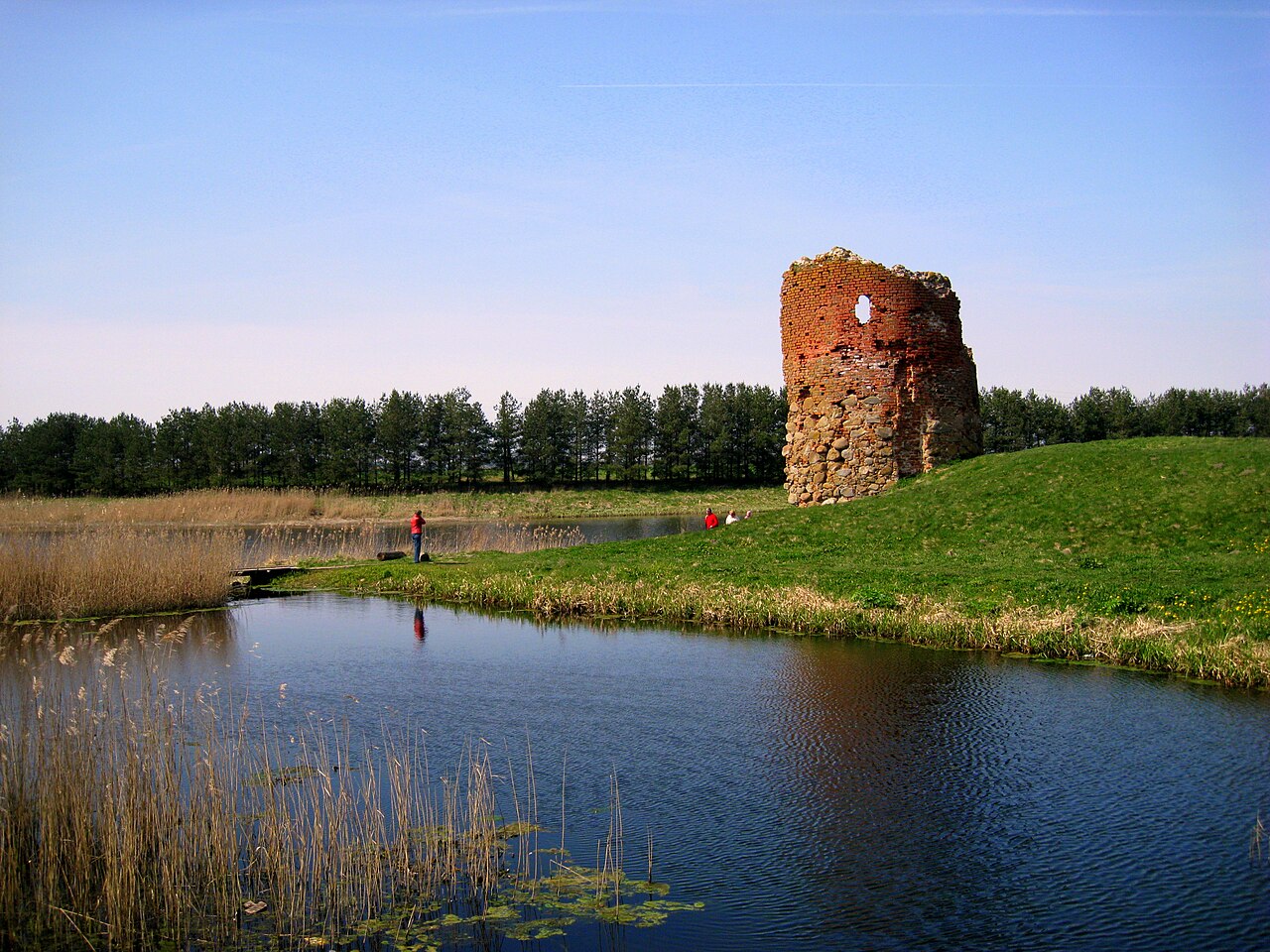
Piltene Castle is a Bishopric of Courland castle in the town of Piltene in the historical region of Courland, in western Latvia. Until the 16th century it served as a capital of Bishopric of Courland.
As part of the Northern crusades, the region was awarded the Livonian Brothers of the Sword in 1230 in the first Treaty with Curonian King. Between 1242 and 1247, the region was again subjugated by the Teutonic Order into which the Order of the Sword Brothers had merged after the defeat at the Battle of Saule. The eternal peace was established only in 1267, when master of the order Otto von Lutterberg pacified the region and concluded treaty with the Curonians.
At the division of Courland the Order received the area on the left bank of Venta (Windau) river and the diocese of Courland the area on the left bank with Pilten. Bishop Edmund von Werd (1263 to 1299) resided in Memel castle, while Amboten castle served him as a residence in northern Kurland. Castle Amboten was left during a temporary absence of the bishop in 1290 the Order of National Defense. Pilten Castle was probably built only after this time, possibly Pilten Castle was built as the new seat of the bishop, the bishop's chancery and the penman under Emund's successor, Bishop Burchard (1300-1311).
The castle itself was first documented in 1309, when the bishop of Kurland was forced to leave his land and fortresses for the rest of his life and leave the country.
During the Livonian War the last bishop of Kurland, Johann von Münchhausen, Pilten and the whole monastery 1559 sold to the King of Denmark, who gave it to his brother, Duke Magnus of Holstein, who was appointed King of Livonia by Tsar Ivan the Terrible. After a contract of subjugation between the King of Poland and Duke Gotthard Kettler of November 1561, the monastery of Pilten was to reach the Duchy even then. However, the congregations did not want to submit to either Poland or the Kurland dependent on it, but asked King Frederick II of Denmark to protect the monastery. The big tower of the castle was blown up so that it would not serve the Poles as a target during a siege.
In the spring of 1583 there was a fierce petty war between Poland and the monastery, with Amboten castle and Neuhausen (Valtaiki) occupied by Poland, while Pilten remained in the hands of the monks. Magnus died on 18 March 1583 at Pilten Castle.
Text adapted from “Piltene Castle” on Wikipedia, CC BY-SA 4.0.
Piltene Castle ranks #5,474 of 9,035 worldwide in the atlas's castle fame ranking, and #30 of the 47 mapped in Latvia. Founded 1309, it is older than 60% of the atlas's dated landmarks, one of 757 atlas entries founded in the 14th century. 2 more atlas landmarks stand within 25 km. See how Latvia compares in the castle statistics.
View on the interactive castle map →