 Finland · 19th century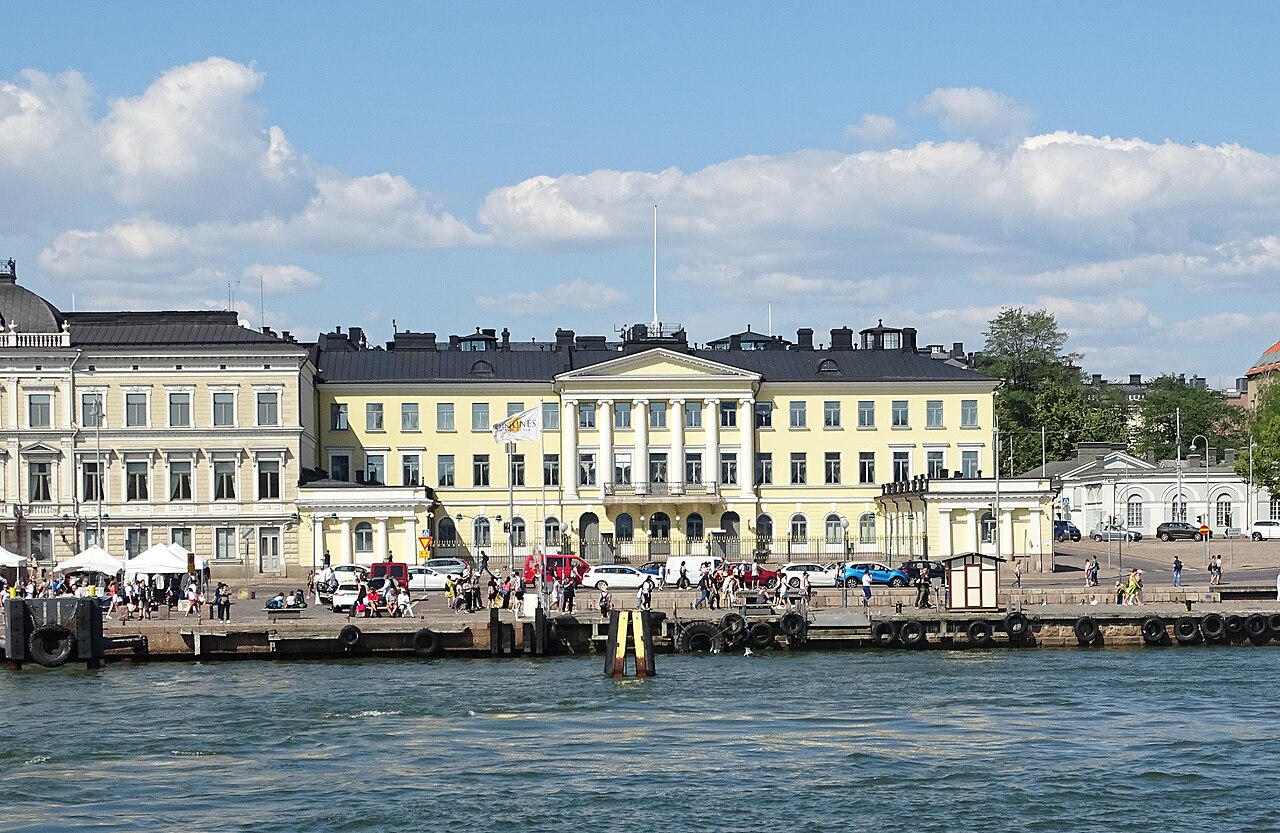
The Presidential Palace (Finnish: Presidentinlinna, Swedish: Presidentens slott) is one of the three official residences of the president of the Republic of Finland. It is situated in Helsinki, on the north side of Esplanadi, overlooking Market Square.
In the early 19th century, a salt storehouse stood on the site where one of Helsinki's most prominent merchants, Johan Henrik Heidenstrauch, would soon build his stately home. He purchased the entire lot and between 1816 and 1820 a stately residence designed by architect Pehr Granstedt was built. Upon its completion, the Heidenstrauch residence was astonishingly grand, resembling a palace more than a merchant's home. With its two wings and a central section featuring a hall with a stately column-lined and framed beam ceiling, the house was a masterful work of proportion and design.
In 1837, the Heidenstrauch's residence was purchased for the price of 170 000 rubles to be converted into a residence for the Governor-General of Finland. However, Nicholas I desired that it should become the official residence in Helsinki of the Emperor of Russia, the Grand Duke of Finland, and so the building became the Imperial Palace in Helsinki.
The necessary rebuilding and furnishing work, carried out between 1843 and 1845, was directed by architect Carl Ludvig Engel, the creator of neoclassical Helsinki and, after his death, by his son, Carl Alexander. Giacomo Quarenghi also looked over the plans. All the timber storehouses behind were torn down and a new wing added. This wing, built along the north of the courtyard, contained on the second floor the chapel (the present library), ballroom, banquet hall in direct connection with the earlier reception floor of the main building, as well as a kitchen.
The palace was completed in 1845, though repairs had to be made from time to time as mostly it stood empty and was not regularly heated. It was visited for the first time by a member of the Imperial family nine years later, in February 1854, when Emperor Nicholas I's younger son, Grand Duke Constantine, stayed there for a month. His brother Nicholas stayed there in June of the following year, after Nicholas I's death. In 1856, the palace was also visited by the new Emperor's three oldest sons – Nicholas, Alexander, and Vladimir. It was during the reign of their father, Alexander II, that the palace had its most brilliant time.
Text adapted from “Presidential Palace, Helsinki” on Wikipedia, CC BY-SA 4.0.
Presidential Palace (Helsinki) ranks #723 of 9,079 worldwide in the atlas's castle fame ranking, and #5 of the 27 mapped in Finland. Founded 1813, it is older than 11% of the atlas's dated landmarks — one of 717 atlas entries founded in the 19th century. Its Wikipedia articles were opened 5,359 times in the last 60 days, more than 87% of the atlas. 2 more atlas landmarks stand within 25 km. The nearest day-trip guide is Helsinki, 1 km away. See how Finland compares in the castle statistics.
View on the interactive castle map →