 Turkey · 5th century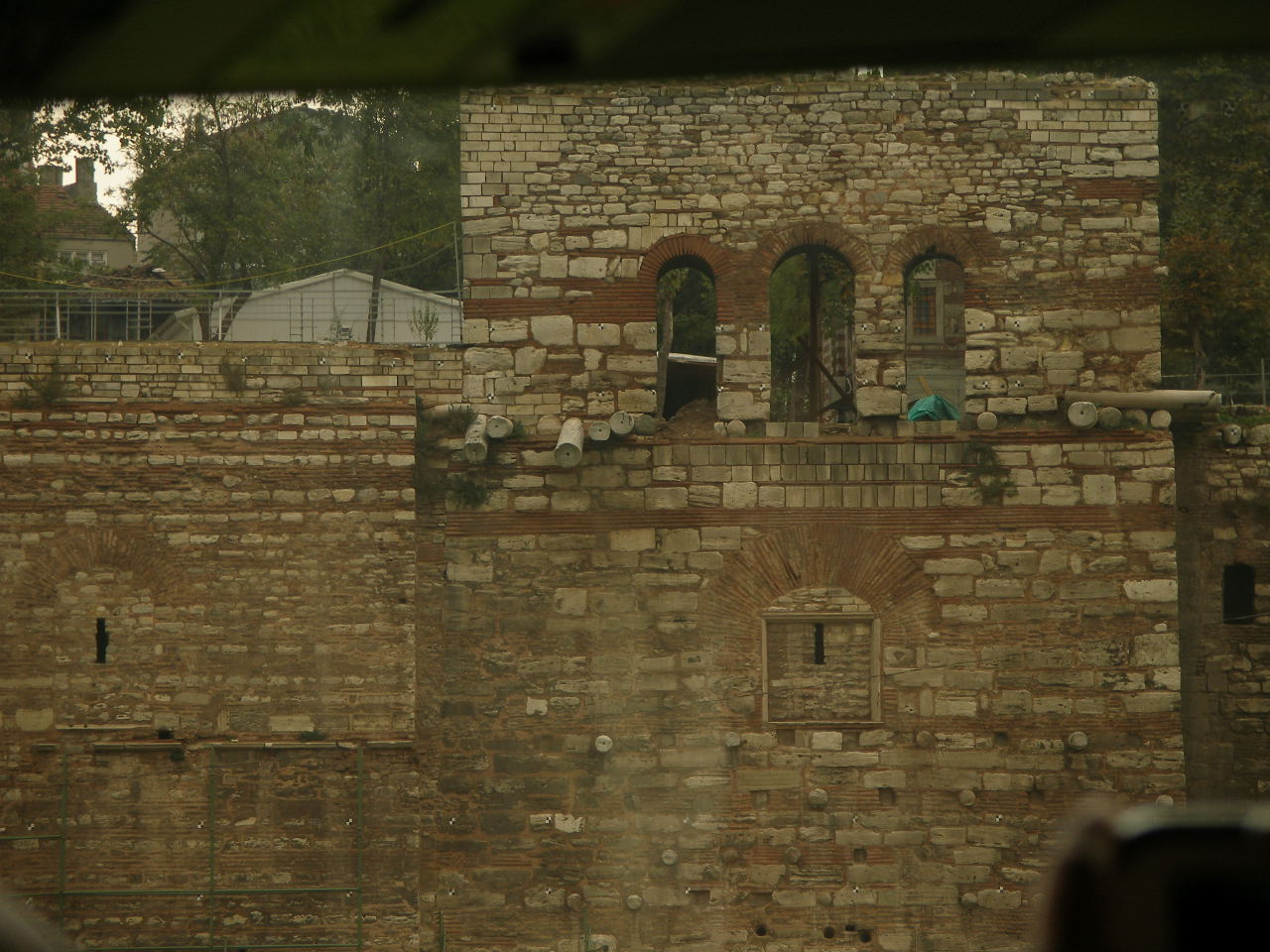
The Palace of Blachernae (Greek: τὸ ἐν Βλαχέρναις Παλάτιον) was an imperial Byzantine residence in the suburb of Blachernae, located in the northwestern section of Constantinople (today located in the quarter of Ayvansaray in Fatih, Istanbul, Turkey). The area of the palace is now mostly overbuilt, and only literary sources are available as to its description.
The Palace of Blachernae was constructed on the northern slopes of the Sixth Hill of the city in circa 500. The hill itself was partially remodelled, particularly in later times, and a number of terraces created to support the various buildings comprising the palace complex.
Although the main imperial residence during the 4th–11th centuries was the Great Palace at the eastern end of the city, the Blachernae palace was used at times, and is attested in the ceremonial protocols contained in the 10th-century De Ceremoniis, or Explanation of the Order of the Palace, Chapters I.27, I.34, II.9, II.12) of Emperor Constantine VII Porphyrogenitos (r. 913–959). At that time, it included several structures: the hall (triklinos) of Anastasius or Anastasiakos (Τρίκλινος Ἀναστασιακός), named after Emperor Anastasius I (r. 491–518) who built it, the hall of the Ocean or Okeanos (Τρίκλινος Ὠκεανός), the portico of Joseph or Iosephiakos (Πόρτικας Ἰωσηφιακός), and the hall of the Danube or Danoubios (Τρίκλινος Δανουβιός).
The latter communicated with the nearby shrine of the Greek Orthodox Church of St. Mary of Blachernae through a series of staircases.
It was here that in the late 11th century the Emperor Alexios I Komnenos (r. 1081–1118) moved his main residence, and he and his grandson Manuel I Komnenos (r. 1143–1180) undertook great works there, fortifying the palace precinct and erecting new halls. Manuel I, in particular, is credited with the construction of an elaborate outer wall, and of several splendid new halls, such as the Hall of Irene (named after Empress Irene of Hungary) and the Polytimos Oikos ("Precious Hall").
During the Second Crusade, this was the residence at which Emperor Manuel welcomed Louis VII of France and his Queen, Eleanor of Aquitaine. At this time the palace complex became known as the "New Palace". Among the structures of the time, only the so-called Prison of Anemas, which formed part of the palace's substructure, still survives.
Text adapted from “Palace of Blachernae” on Wikipedia, CC BY-SA 4.0.
Palace of Blachernae ranks #556 of 9,079 worldwide in the atlas's castle fame ranking, and #16 of the 129 mapped in Turkey. Founded c. 500, it is older than 97% of the atlas's dated landmarks — one of 37 atlas entries founded in the 5th century. Its Wikipedia articles were opened 7,830 times in the last 60 days, more than 92% of the atlas. 24 more atlas landmarks stand within 25 km. The nearest day-trip guide is Istanbul, 3 km away. See how Turkey compares in the castle statistics.
View on the interactive castle map →