 Scotland · 15th century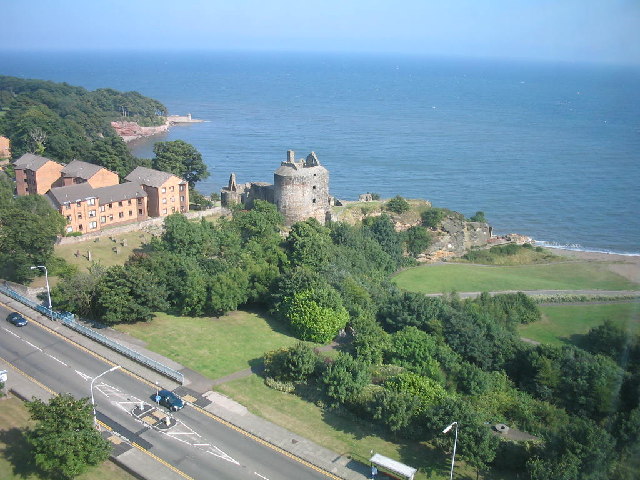
Ravenscraig Castle is a ruined castle located in Kirkcaldy which dates from around 1460. The castle is an early example of artillery defence in Scotland.
The construction of Ravenscraig Castle by the mason Henry Merlion and the master carpenter Friar Andres Lesouris was ordered by King James II (reigned 1437–1460) as a home for his wife, Mary of Guelders. The castle is considered one of the first—perhaps the very first—in Scotland to be built to withstand cannon fire and provide for artillery defence. The king was an artillery enthusiast and was involved with the planning but, ironically, was killed when one of his cannon exploded at the Siege of Roxburgh Castle in the Scottish Borders.
Construction was commenced around 1460 by his widow, Mary of Guelders, as a memorial to him and as a dower house. She continued the construction work until her death in December 1463, when the east tower and the basement of the central section was probably built for her by the master mason Henry Merlioun. The site was supervised by the master of works, David Boys. Andrew Balfour, a servant of the royal wardrobe, organised the supply of timber joists in 1461, the timber was boated down the Allan Water and shipped to Fife from Stirling. During this period her steward Henry Kinghorn and other members of the household were able to live in completed accommodation.
Ownership passed to her son James III (reigned 1460–1488). In 1471 he gave the castle to William Sinclair, Earl of Orkney and Caithness in exchange for the Earldom of Orkney and associated lands which James annexed from Norway to the Scottish Crown. The castle was completed by the Sinclairs, who also had an interest in artillery fortifications.
James V and Mary of Guise came to Ravenscraig on 9 April 1540 on their way to Falkland Palace. They arrived in two galleys rowed from Kinghorn. The Duke of Holstein came to the castle with William Schaw in 1598.
During the 1650–51 invasion of Scotland by English forces under Oliver Cromwell, Ravenscraig was invaded, attacked and damaged. The castle remained in the ownership of the Sinclairs, who built nearby Dysart House (1755–1756) on the estate, and later passed to the St Clair-Erskines, Earls of Rosslyn. The estate and castle remained in the family until sold in 1896, by the 5th Earl, to linoleum magnate Sir Michael Nairn who lived in Dysart House.
Text adapted from “Ravenscraig Castle” on Wikipedia, CC BY-SA 4.0.
Ravenscraig Castle ranks #4,083 of 9,079 worldwide in the atlas's castle fame ranking, and #143 of the 226 mapped in Scotland. Founded 1460, it is older than 46% of the atlas's dated landmarks — one of 554 atlas entries founded in the 15th century. Its Wikipedia articles were opened 1,111 times in the last 60 days, more than 53% of the atlas. 18 more atlas landmarks stand within 25 km. The nearest day-trip guide is Edinburgh, 19 km away. See how Scotland compares in the castle statistics.
View on the interactive castle map →