Fortress
Recinto abaluartado de Badajoz
🇪🇸 Spain · 17th century
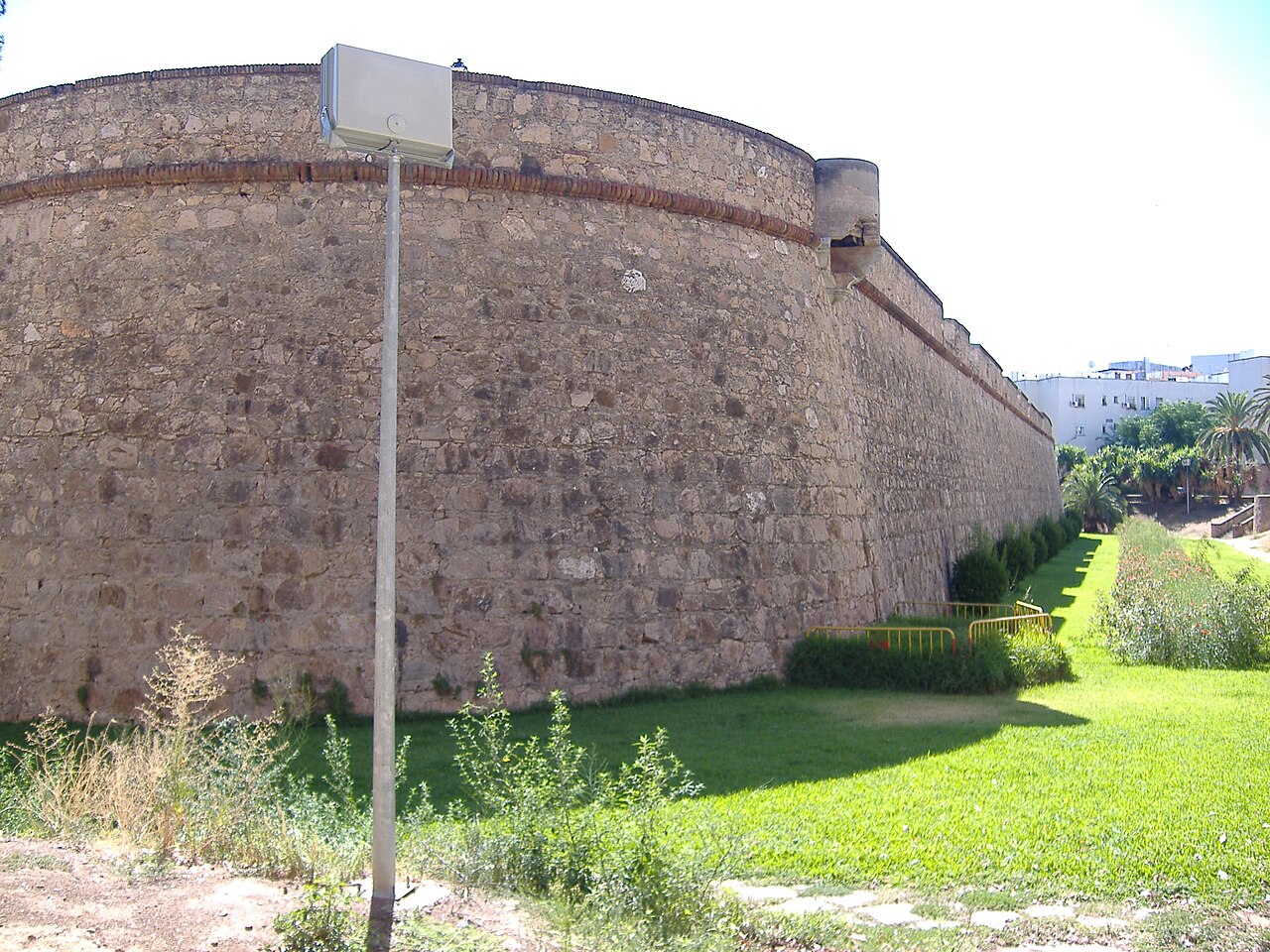
The bastioned system of the Spanish city of Badajoz consists of a military fortification formed by a set of defensive walls, city gates, bridges, forts, towers, bastions, hornworks, moats, tunnels, and ravelins, among other defensive elements. It was built during the 17th and 18th centuries, following the defensive construction theories popularized by the French military engineer Marquis de Vauban, as an extension of a previous defensive enclosure that protected the Portugal–Spain border city.
From its founding by Ibn Marwan—over an earlier Visigothic settlement, as Badajoz has been inhabited since prehistoric times—the city maintained a stronghold character up to the 20th century. Its strategic location at the crossroads of two major routes: one from Castile to Andalusia, and the other to Lisbon, along with its status as a border city with Portugal, has led to both advantages for Badajoz's development and numerous conflicts involving various armies over the centuries. Consequently, the city has been protected by several defensive enclosures.
The first fortifications were carried out by Ibn Marwan, who ordered the erection of mortar walls. This was followed by restoration work undertaken by Abd Allah Ibn Muhammad Ibn Abd al-Rahman, the founder's grandson, in 913 and by Abdallah ibn Al-Aftas, the first Aftasid king of the Taifa of Badajoz, in 1030. In 1169, the Alcazaba was built, closely resembling the present structure, with some elements dating back to the Almohad period. The final Muslim restoration was commissioned by Abu Yahya Ibn Abi Sinan at the beginning of the 13th century.
After the conflicts between Castile and Portugal in the 14th century, relations between the two regions were normalized, leading to a period of peace that lasted nearly two and a half centuries.
Text adapted from “Badajoz bastioned enclosure” on Wikipedia, CC BY-SA 4.0.
Recinto abaluartado de Badajoz ranks #4,846 of 8,134 worldwide in the atlas's castle fame ranking, and #216 of the 602 mapped in Spain. Founded c. 1700, it is older than 22% of the atlas's dated landmarks — one of 626 atlas entries founded in the 17th century. 8 more atlas landmarks stand within 25 km. The nearest day-trip guide is Évora, 88 km away. See how Spain compares in the castle statistics.
View on the interactive castle map →Frequently asked questions
Where is Recinto abaluartado de Badajoz?
Recinto abaluartado de Badajoz stands in Spain, at 38.88191°, -6.96899°.
When was Recinto abaluartado de Badajoz built?
The atlas dates its founding to c. 1700. Earlier structures may have stood on the site; this is the earliest documented founding year.
How famous is Recinto abaluartado de Badajoz?
In this atlas's fame ranking: #4,846 of 8,134 worldwide, and #216 in Spain. Fame here combines how many Wikipedia language editions cover a landmark with how many people read them.
What is the nearest castle to Recinto abaluartado de Badajoz?
Alcazaba of Badajoz, about 1 km away.
More castles in Spain
- Puerta de Felipe V Spain
- Palacio de Altamira Spain · 15th century
- Seville Royal Shipyard Spain
- Gate of Sevilla Spain
More fortresses
- Barrage Vauban France · 17th century
- Château Royal de Collioure France · 7th century
- Fort Médoc France · 17th century
- Fort Mahon France · 17th century