Castle
Rockingham Castle
ENG England · 10th century
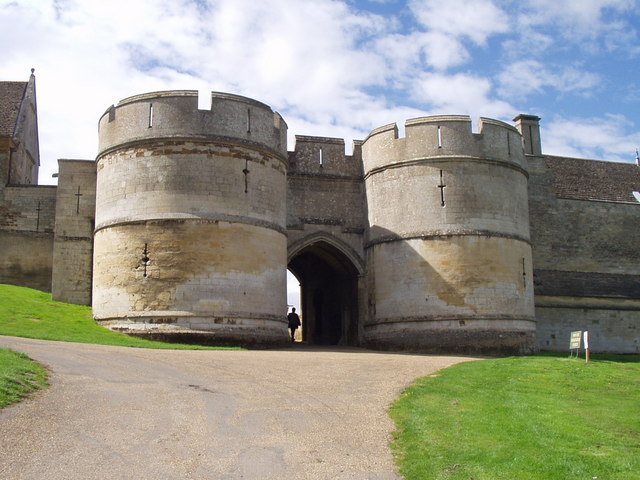
Rockingham Castle is a former royal castle and hunting lodge in Rockingham Forest, approximately two miles from the town centre of Corby, Northamptonshire, England.
The site on which the castle stands was used in the Iron Age, in the Roman period, by the Saxons, Normans, Tudors and also in the medieval period. This is because its position on elevated ground provides clear views of the Welland Valley from a strong defensible location.
William the Conqueror ordered the construction of a wooden Motte-and-bailey at Rockingham in the 11th century shortly after the Norman conquest of England. Within three decades, William II replaced it with a stone castle. A stone keep was added to the large motte and the outer bailey was enclosed by a curtain wall. The castle was then used as a royal retreat throughout the Norman and Plantagenet periods. Nearby Rockingham Forest was especially good for hunting wild boar and deer.
A church/state council was held at the castle in 1095 to address the issue of episcopal appointments. It was attended by William II and Anselm, Archbishop of Canterbury, but failed to reach a resolution.
In 1270 Henry III strengthened the castle with the addition of a twin D-tower gatehouse. But less than a century later Edward III became the last monarch to visit the castle while it was possessed by the Crown.
By the late 15th century Rockingham Castle had fallen into disrepair. Sir Edward Watson, founder of the Watson dynasty, acquired the lease of the castle from Henry VIII. Parts of the castle were later replaced with a Tudor house with gardens. The former royal castle became a hunting lodge for the nobility. Watson's grandson Lewis Watson acquired the freehold of the castle and lands from the Crown. Watson was successively a knight, baronet and baron.
In the 1640s, during the English Civil War, Rockingham was garrisoned by royalist troops. They fought several small skirmishes with Parliamentary forces. In 1643 Rockingham was captured by Parliamentarian general Henry Grey, 1st Earl of Stamford and Lewis Watson was temporarily forced to leave. Its remaining walls were slighted in 1646. In the latter 17th and 18th centuries, Rockingham returned to being a civil residence.
Lewis' grandson, also Lewis, already Baron Rockingham, was created Earl of Rockingham and Viscount Sondes in 1714.
Text adapted from “Rockingham Castle” on Wikipedia, CC BY-SA 4.0.
Rockingham Castle ranks #2,458 of 8,134 worldwide in the atlas's castle fame ranking, and #165 of the 333 mapped in England. Founded c. 1000, it is older than 92% of the atlas's dated landmarks — one of 138 atlas entries founded in the 10th century. Its Wikipedia articles were opened 2,444 times in the last 60 days, more than 71% of the atlas. 3 more atlas landmarks stand within 25 km. The nearest day-trip guide is Milton Keynes, 53 km away. See how England compares in the castle statistics.
View on the interactive castle map →Frequently asked questions
Where is Rockingham Castle?
Rockingham Castle stands in England, at 52.5129°, -0.724°.
When was Rockingham Castle built?
The atlas dates its founding to c. 1000. Earlier structures may have stood on the site; this is the earliest documented founding year.
How famous is Rockingham Castle?
In this atlas's fame ranking: #2,458 of 8,134 worldwide, and #165 in England. Fame here combines how many Wikipedia language editions cover a landmark with how many people read them.
What is the nearest castle to Rockingham Castle?
Oakham Castle, about 18 km away.
More castles in England
- Lydford Castle England · 12th century
- Morpeth Castle England · 11th century
- Affeton Castle England · 15th century
- Spofforth Castle England · 14th century
More castles
- Duns Castle Scotland · 14th century
- Culcreuch Castle Scotland · 13th century
- Pickering Castle England · 12th century
- Picton Castle Wales · 13th century