 Germany · 19th century
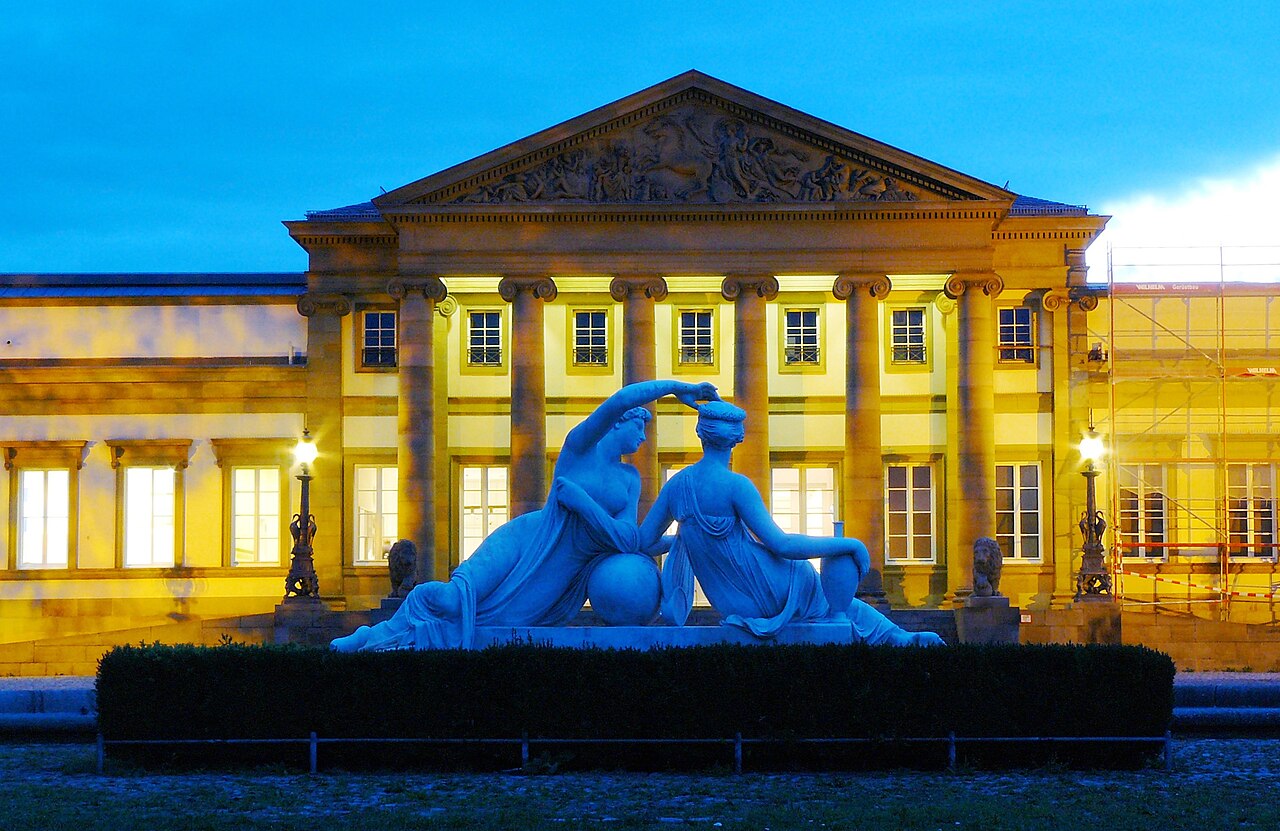
Rosenstein Castle (German: Schloss Rosenstein) is a palace in Stuttgart, Germany. It was designed in the classical style by the architect and court builder Giovanni Salucci (1769–1845) as the summer palace for King Wilhelm I of Württemberg, and was built between 1822 and 1830.
Today, the building houses that part of the State Museum of Natural History Stuttgart dealing with extant lifeforms.
Artists who participated in the construction and decoration of the palace were as listed below. Key to the abbreviations:
Before the construction of the palace, the hill Rosenstein Castle stands on was called Kahlenstein (German: Bald Rock) as it was bare of trees. Afterwards, it became known as Rosenstein (German: Rose Rock) because of the rose garden southeast of the palace.
Directly under Rosenstein Castle is Württemberg's first railroad tunnel. Constructed between July 1844 and July 1846, the tunnel is 326 metres (1,070 ft) long and was used until a new tunnel, located further east and not passing under the castle, was completed in 1915.
Text adapted from “Rosenstein Palace” on Wikipedia, CC BY-SA 4.0.
Rosenstein Castle ranks #3,199 of 9,035 worldwide in the atlas's castle fame ranking, and #259 of the 709 mapped in Germany. Founded 1824, it is older than 10% of the atlas's dated landmarks, one of 705 atlas entries founded in the 19th century. Its Wikipedia articles were opened 1,532 times in the last 60 days, more than 62% of the atlas. 10 more atlas landmarks stand within 25 km. The nearest day-trip guide is Stuttgart, 3 km away. See how Germany compares in the castle statistics.
View on the interactive castle map →