 Germany · 18th century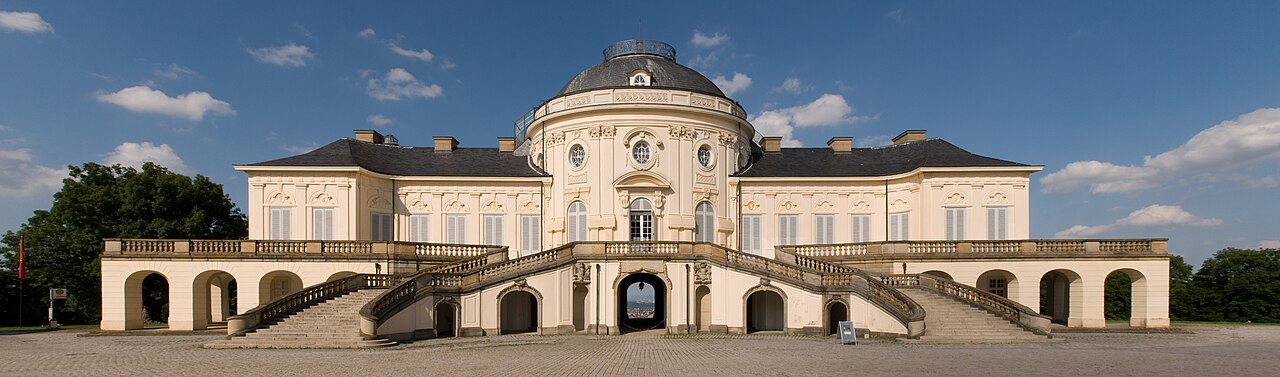
Solitude Palace (German: Schloss Solitude) is a Rococo schloss and hunting retreat commissioned by Charles Eugene, Duke of Württemberg. It was designed by Johann Friedrich Weyhing and Philippe de La Guêpière, and constructed from 1764 to 1769. It is located on an elongated ridge between the towns of Leonberg, Gerlingen and Stuttgart in Baden-Württemberg.
Charles Eugene von Württemberg succeeded his father Charles Alexander as Duke of Württemberg in 1737, when he was only nine. The Duchy of Württemberg was ruled by a regency council until 1744, when Charles Eugene reached the age of majority at 16. His reign would be marked by economic difficulty, political strife, and extravagance.
By the 1760s, Charles Eugene's policies and ambitions had met with failure. He had failed to achieve increased rank and prestige from the War of the Austrian Succession or the Seven Years' War, and had diplomatically isolated Württemberg because of his jostling and means of acquiring war funds. He had repeatedly withdrawn funding from the construction of his palaces, one of which was Monrepos, in Ludwigsburg. Charles Eugene turned his attention back to Stuttgart and, in 1763, he hired of architects led by Philippe de La Guêpière to plan a new palace that received the name "Solitude". Friedrich Christoph Hemmerling was named head gardener and charged with its design and creation.
Priority during construction went towards the two wings next to the palatial building until they were completed in 1766. It was from these that the Duke closely monitored construction.
La Guêpière departed from Württemberg for his native Paris in 1768. He was succeeded as court architect and as director of construction at Solitude by his student, Reinhard Heinrich Ferdinand Fischer.
In 1770, Charles Eugene established the Hohe Karlsschule on the grounds of Solitude Palace. It was at this school that Friedrich Schiller studied in his youth and wrote The Robbers. The school moved into Stuttgart in 1775, the same year the Duke himself shifted his attention to nearby Hohenheim Palace in 1775. The last grand function held at Solitude took place in 1782, after which maintenance of the grounds ceased. From the 1830s, however, King Charles I renovated the palace, while Queen Olga met with her relatives in the palace.
Text adapted from “Solitude Palace” on Wikipedia, CC BY-SA 4.0.
Solitude Palace ranks #1,238 of 9,079 worldwide in the atlas's castle fame ranking, and #100 of the 711 mapped in Germany. Founded 1769, it is older than 15% of the atlas's dated landmarks — one of 696 atlas entries founded in the 18th century. Its Wikipedia articles were opened 4,425 times in the last 60 days, more than 85% of the atlas. 10 more atlas landmarks stand within 25 km. The nearest day-trip guide is Stuttgart, 7 km away. See how Germany compares in the castle statistics.
View on the interactive castle map →