 Scotland · 12th century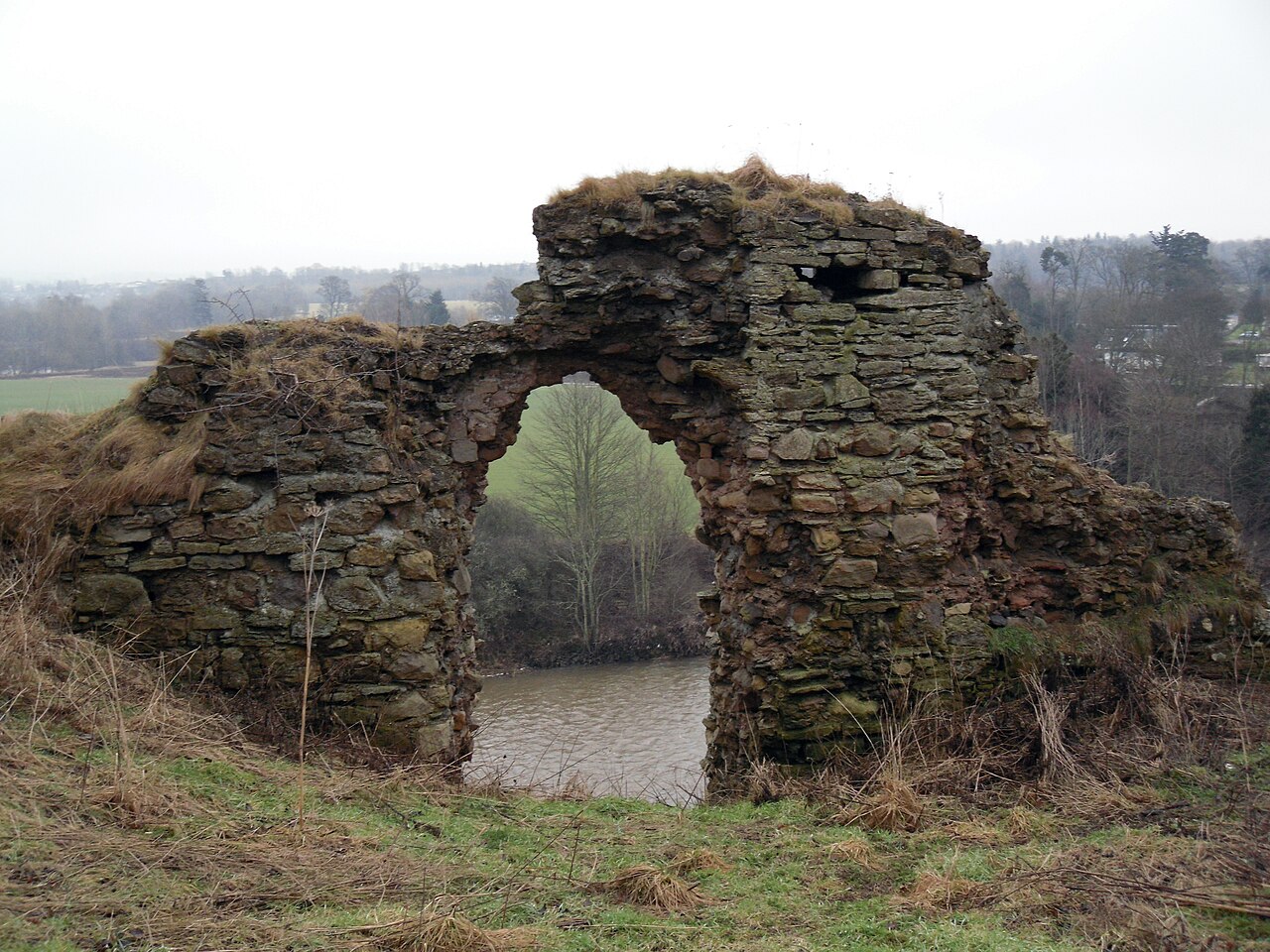
Roxburgh Castle is a ruined royal castle that overlooks the junction of the rivers Tweed and Teviot, in the Borders region of Scotland. The town and castle developed into the royal burgh of Roxburgh, which the Scots destroyed along with the castle after capturing it in 1460. Today the ruins stand in the grounds of Floors Castle, the seat of the Duke of Roxburghe, across the river from Kelso.
Tradition states that King David I founded the castle; it is first recorded in c.1128 during his reign. In 1174, it was surrendered to England after the capture of William I at Alnwick, and was often in English hands thereafter. The Scots made many attempts to regain the fortress. King Edward I of England imprisoned Mary Bruce in a cage hung outside the castle from 1306 to 1310. On 19 February 1314, it was retaken by Sir James Douglas (the "Black Douglas"), in a night attack. His men clothed in black cloaks were apparently mistaken for cattle. They then used rope and board ladders to climb the walls. King Robert the Bruce ordered the castle demolished by his brother Edward Bruce, Earl of Carrick, and in the words of the Lanercost Chronicle "all that beautiful castle the Scots pulled down to the ground, like the other castles that they had succeeded in capturing, lest the English should ever again rule the land by holding the castles."
The castle was captured by the forces of Edward III of England in 1334. Alexander Ramsay and his men recaptured Roxburgh Castle for the Scots on 30 March 1342 by means of a daring night escalade. It was retaken by the English shortly after the Battle of Neville's Cross in October 1346. A Scottish siege in 1417 necessitated repairs.
In August 1436, King James I of Scotland planned to conduct a siege of the castle. The king had gathered a huge army, sporting “...fine, large guns, both cannons and mortars”, manned by German gun crews under the command of Johannes Paule “Master of the King’s engines”. There was also a substantial contingent of Highlanders and Islesmen and archers brought by Alexander of Islay, Earl of Ross (who brought 3,000 men to the siege), as well as men-at-arms from the Lowlands, including the forces of Archibald, Earl of Douglas and his distant kin and rival, William, Earl of Angus (head of the Red Douglases of Tantallon).
Text adapted from “Roxburgh Castle” on Wikipedia, CC BY-SA 4.0.
Roxburgh Castle ranks #1,507 of 9,079 worldwide in the atlas's castle fame ranking, and #50 of the 226 mapped in Scotland. Founded c. 1150, it is older than 80% of the atlas's dated landmarks — one of 756 atlas entries founded in the 12th century. Its Wikipedia articles were opened 7,409 times in the last 60 days, more than 91% of the atlas. 12 more atlas landmarks stand within 25 km. The nearest day-trip guide is Edinburgh, 61 km away. See how Scotland compares in the castle statistics.
View on the interactive castle map →