 Italy · 13th century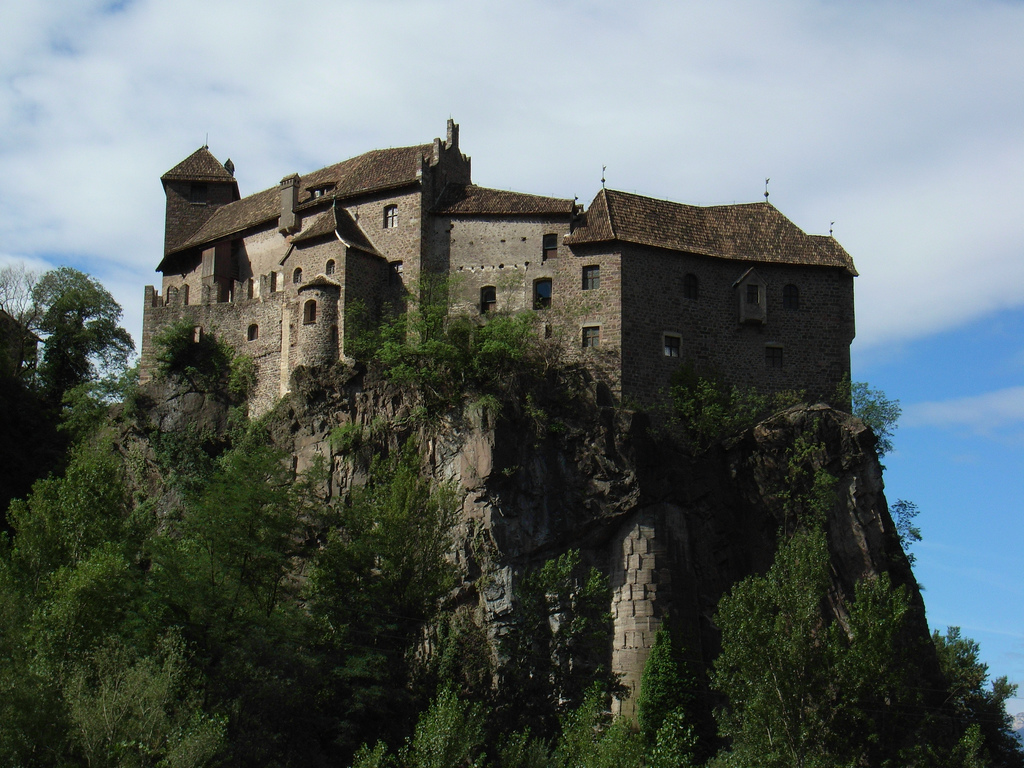
Runkelstein Castle (German: Schloss Runkelstein; Italian: Castel Roncolo) is a medieval fortification on a rocky spur in the territory of Ritten, near the city of Bolzano in South Tyrol, Italy. In 1237 Alderich, Prince-Bishop of Trent, gave the brothers Friedrich and Beral, Lords of Wangen, permission to construct a castle on the rock then called Runchenstayn.
In 1277 it was damaged during a siege by Meinhard II of Tirol who, after winning the war against Heinrich Prince-Bishop of Trent, entrusted the castle to Gottschalk Knoger of Bozen. In 1385 Niklaus and Franz Vintler, wealthy merchant brothers from Bozen, bought the castle. Niklaus was counselor and financier of the Count of Tyrol, Leopold III, Duke of Austria, which allowed them to buy the castle, a type of residence unfitting – in those times – for people of their rank. The brothers Vintler commissioned a vast restructuring of the castle: a new defence wall, moat, a cistern and more rooms were built. In 1390 the construction of the Summer House began.
The house was painted with frescos, for which the castle is most famous today, inside and outside. The frescos' topics were of a literary nature, depicting for example King Arthur and his knights, Tristan and Isolde, and Dietrich von Bern. The family also commissioned the frescoes in the Western and Eastern Palace. They were created by an unknown master and some of them depict scenes from Pleier′s romance Garel.
In 1407 the monetary conflict between Frederick IV, Duke of Austria "mit der leeren Tasche" (with empty pocket), Count of Tyrol and wealthy Tyrolean noble families resulted in open war. The Vintlers were drawn into these disputes and Runkelstein was besieged. Niklaus, who had allied himself with the nobles in the "Hawk League" lost all his wealth and possessions. His brother Franz, who had allied with the Duke remained owner of the Castle until Sigismund, Archduke of Austria "der Münzreiche" (rich with coins) acquired it.
The Habsburg family owned the castle until 1530. Holy Roman Emperor Maximilian I gave orders to renovate the castle. He furnished his apartment and commissioned a restoration of the frescos. He also ordered his Coat of Arms to be prominently displayed in the castle. Around 1500 Maximilian gave the castle to his vassal Georg von Frundsberg, famous "Father of the Landsknechte".
Text adapted from “Runkelstein Castle” on Wikipedia, CC BY-SA 4.0.
Runkelstein Castle ranks #2,152 of 9,035 worldwide in the atlas's castle fame ranking, and #157 of the 555 mapped in Italy. Founded 1237, it is older than 72% of the atlas's dated landmarks, one of 1090 atlas entries founded in the 13th century. Its Wikipedia articles were opened 3,280 times in the last 60 days, more than 80% of the atlas. Wikidata records about 43,000 visitors in 2022. 14 more atlas landmarks stand within 25 km. The nearest day-trip guide is Innsbruck, 84 km away. It is one of the 30 landmarks on the atlas's regional map of South Tyrol. See how Italy compares in the castle statistics.
View on the interactive castle map →