 Poland · 16th century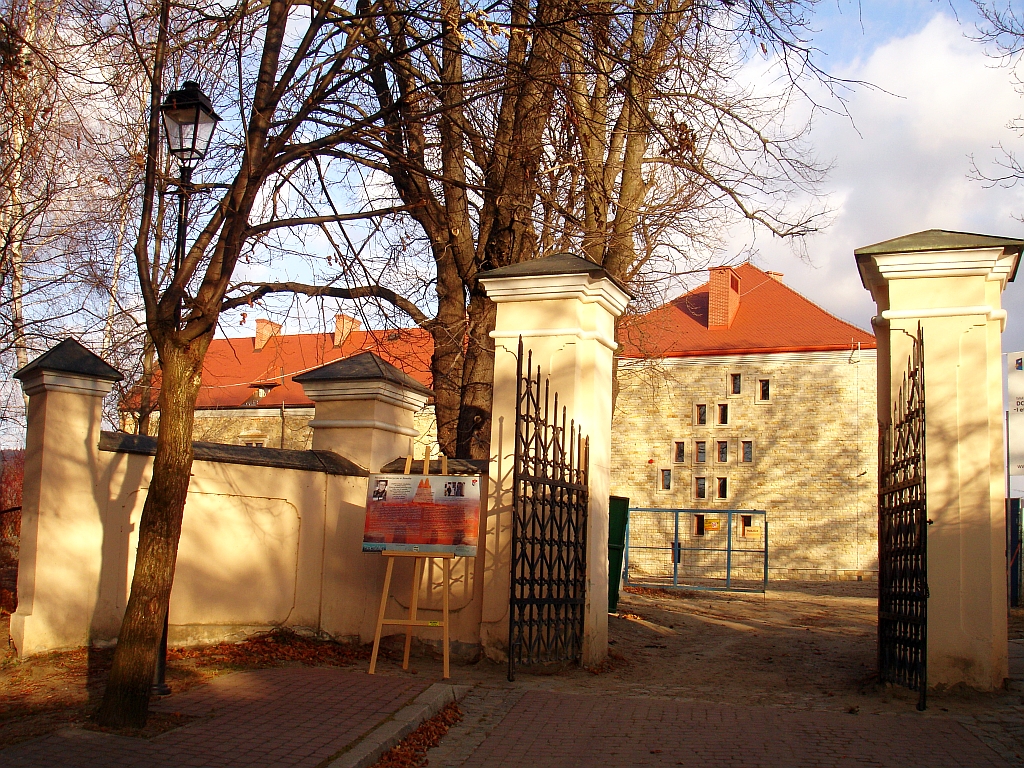
The Sanok Royal Castle was built in the late 14th century in Sanok, Poland. The castle is situated on a steep slope, at 317 m above sea level, overlooking the San River. Today it is the seat of the Sanok Historical Museum.
The first mention of Sanok is found in 12th-century chronicles. The stronghold was destroyed in the 13th century during the Tatar invasion in 1241. In the 14th century the town of Sanok became fortified and a defensive castle was built.
The earliest mention of the stronghold comes from 1150 and was written in the Hypatian Codex. The Ruthenian chronicler describes the expedition of King Géza II of Hungary to Ruthenia and the capture of the towns of Przemyśl and Sanok. In the time of the Piast dynasty, after the recovery of the Red Ruthenia by King Casimir III the Great, the royal palace surrounded by a defensive wall was built on the hilltop.
During the reign of King Władysław Jagiełło, his wedding with Elisabeth of Pilica took place at the castle on May 2, 1417. The town and district authorities with a castellan at the top had their seat at the Sanok castle. In 1425, it was established the Higher Court of German law at the Sanok Castle. It was also a residence of the King's fourth wife Sophia of Halshany until her death in 1461. Queen Bona Sforza ordered the rebuilding of the Gothic castle in the Renaissance style between 1523 and 1548. In 1555 and 1556, the castle was the seat of Isabella Jagiellon, Queen of Hungary, after her escape from Transylvania.
At the end of the 16th century, the castle underwent further expansion: the south wing was built at that time. At the turn of the 18th century the north wing was added. During the Napoleonic Wars, the castle was successfully defended against the Austrian forces by General Franciszek Ksawery Krasicki, who was the leader of the anti-Austrian uprising in the Sanok Region.
In 1915, after the Russian invasion, the south wing was demolished. In the interwar period the castle served as the Museum of Sanok. The museum, established in 1934 by the Society of Friends of the Region of Sanok, had at first collections of the Sanok region, weapons and arms — the history of the town and castle of Sanok, furniture, artistic craftsmanship.
With the beginning of World War II in September 1939, the castle was ransacked.
Text adapted from “Sanok Castle” on Wikipedia, CC BY-SA 4.0.
Sanok Castle ranks #2,029 of 9,079 worldwide in the atlas's castle fame ranking, and #71 of the 398 mapped in Poland. Founded 1523, it is older than 41% of the atlas's dated landmarks — one of 891 atlas entries founded in the 16th century. Its Wikipedia articles were opened 1,831 times in the last 60 days, more than 67% of the atlas. 3 more atlas landmarks stand within 25 km. The nearest day-trip guide is Prešov, 94 km away. See how Poland compares in the castle statistics.
View on the interactive castle map →