 Germany · 16th century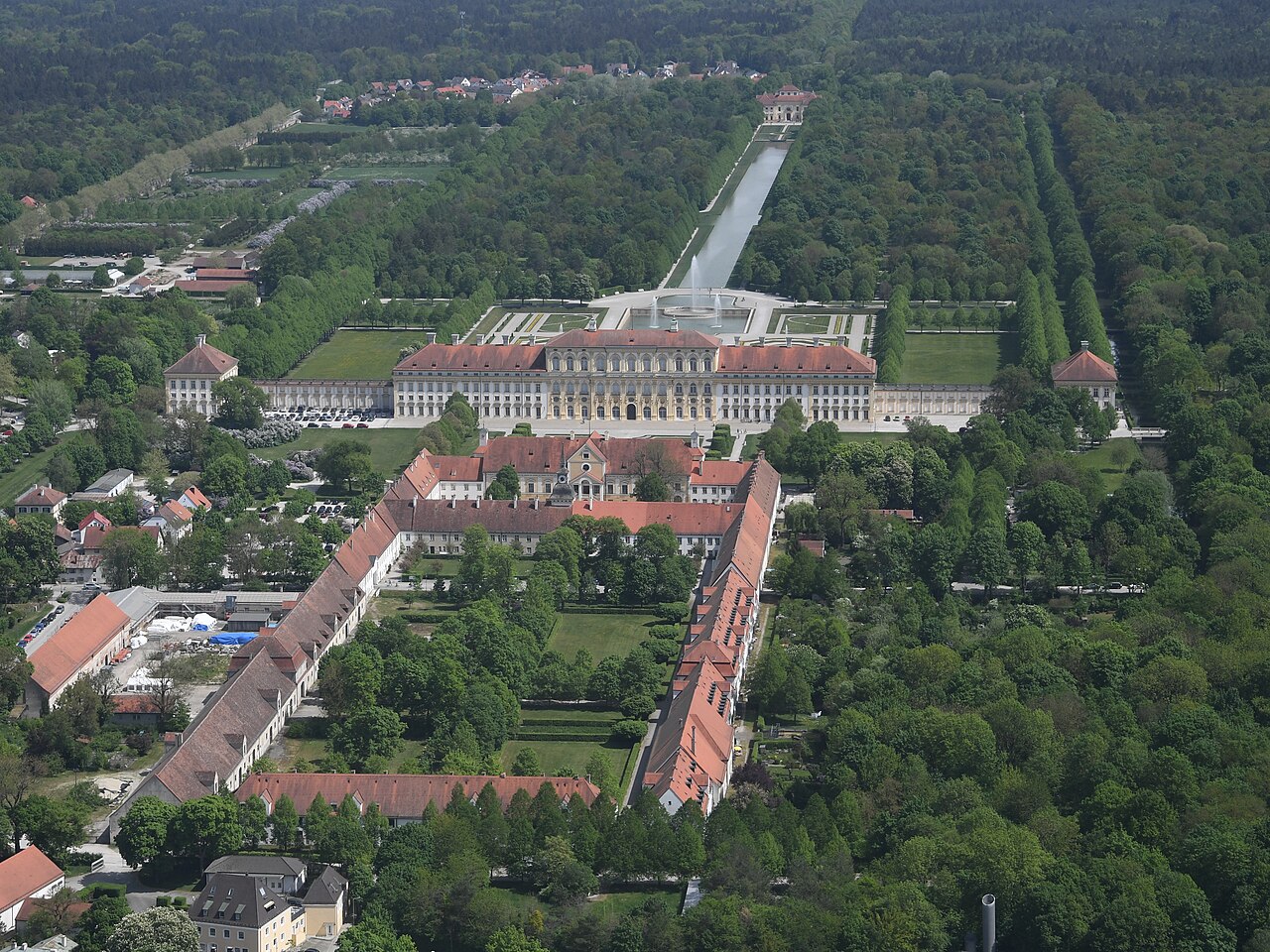
The Schleißheim Palace (German: Schloss Schleißheim) is a complex of three individual palaces – the Old, Lustheim, and New – in a grand Baroque park in the village of Oberschleißheim, a suburb of Munich, Bavaria, Germany. The palace was a summer residence of the Bavarian rulers of the House of Wittelsbach.
The history of Schleißheim Palace started with a Renaissance country house (1598) and hermitage founded by William V close to Dachau Palace. The central gate and clock tower between both courtyards both date back to the first building period. The inner courtyard is called Maximilianshof, the outer one Wilhelmshof. Under William's son Maximilian I the buildings were extended between 1617 and 1623 by Heinrich Schön and Hans Krumpper to form the so-called Old Palace. This plan is typologically similar to the castle of Laufzorn in Oberhaching begun by Maximilian's brother Albert the year before. There, too, a free staircase leads up to the first floor, which is used as a mansion. The building, which was designed in the style of Andrea Palladio in the late Renaissance, was completed in 1623.
The rooms were decorated by Peter Candid. Maximilian's son and successor Ferdinand Maria died here in 1679. After heavy destruction in the Second World War the palace with its spacious buildings was reconstructed. Most of the stucco decoration of the chapel Wilhelmskapelle has been preserved. The Old Schleißheim Palace houses today two exhibitions, one on religious culture, the other the history of Prussia. The Grand Hall in the middle of the main building today serves as foyer for the museums.
In the garden of the Old Palace is a memorial to the Royal Bavarian Air Force, who served during World War I at the airfield next to the palace grounds.
Then Enrico Zuccalli built Lustheim Palace as a garden villa in Italian style in 1684–1688 for Maximilian II Emanuel and his first wife, the Austrian princess Maria Antonia.
Lustheim lies on a circular island and forms as a point de vue the conclusion of the baroque court garden. The floor plan of manor reminiscent of a stylized H, to the central main building will be followed by two wing-like avant-corps. The brick built and plastered building has two storeys, the middle section is dominated by a belvedere, which provides a wide view of the surrounding countryside.
Text adapted from “Schleissheim Palace” on Wikipedia, CC BY-SA 4.0.
Schleißheim palace complex ranks #370 of 9,079 worldwide in the atlas's castle fame ranking, and #34 of the 711 mapped in Germany. Founded 1598, it is older than 32% of the atlas's dated landmarks — one of 891 atlas entries founded in the 16th century. Its Wikipedia articles were opened 10,825 times in the last 60 days, more than 94% of the atlas. 12 more atlas landmarks stand within 25 km. The nearest day-trip guide is Munich, 12 km away. See how Germany compares in the castle statistics.
View on the interactive castle map →