 Germany · 18th century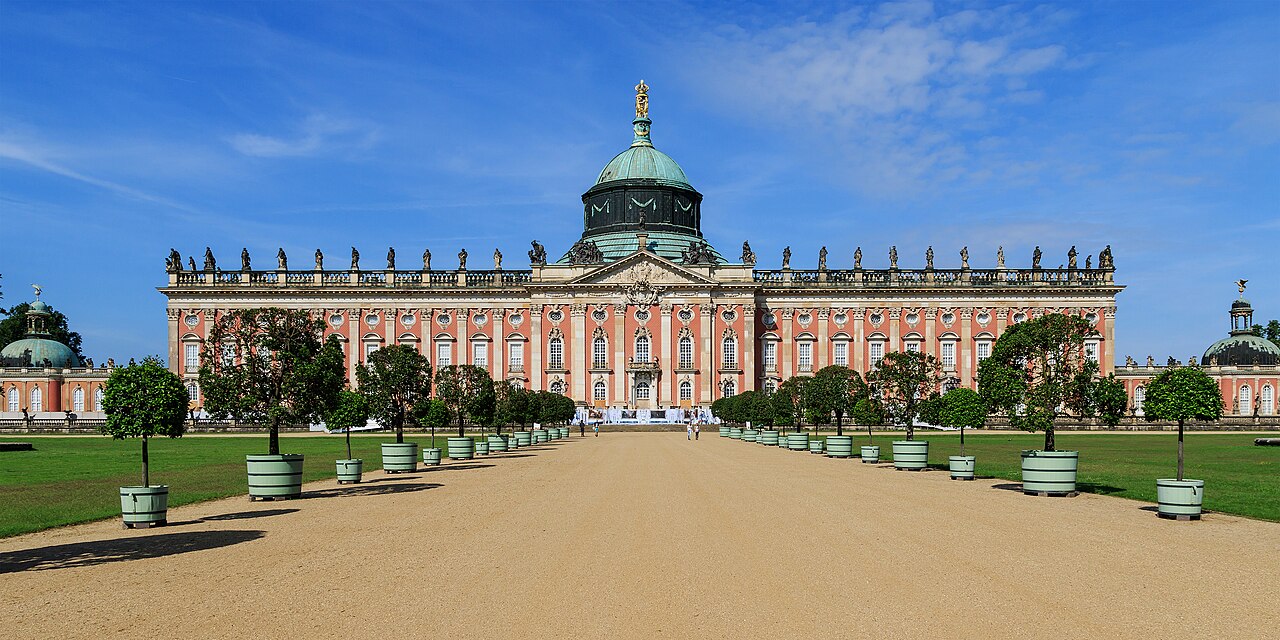
The New Palace (German: Neues Palais) is a palace situated on the western side of the Sanssouci park in Potsdam, Germany. The building was begun in 1763, after the end of the Seven Years' War, under King Friedrich II (Frederick the Great) and was completed in 1769. It is considered to be the last great Prussian Baroque palace.
The building of the palace commenced at the end of the Seven Years' War, to celebrate Prussia's success. The war is also variably referred to as the Third Silesian War, owing to the dispute over Silesia. In an architectural form, Frederick the Great sought to demonstrate the power and glories of Prussia attributing it as fanfaronade, an excess of splendor in marble, stone and gilt.
For the King, the New Palace was not a principal residence, but a display for the reception of important royals and dignitaries. Of the over 200 rooms, four principal gathering rooms and a theater were available for royal functions, balls and state occasions. During his occasional stays at the palace, Frederick occupied a suite of rooms at the southern end of the building, composed of two antechambers, a study, a concert room, a dining salon and a bedroom, among others. While Frederician Rococo was established at Sanssouci, Frederick the Great had the New Palace built in varying forms of Baroque architecture and decoration, with some deviations.
The King preferred Rococo and Baroque to the Neoclassical style that was already taking hold of Europe at the time as the preference of many monarchs. Architect Johann Gottfried Büring, with the aid of Heinrich Ludwig Manger, was assigned with the task of planning the New Palace and had already demonstrated success with the completion of the Chinese Teahouse and the Picture Gallery in the Sanssouci royal park.After disagreements over the design of the palace, in 1764 the design of the palace was totally vested in the architect Carl von Gontard. The three-story façade had already begun to rise around unfinished interiors, as construction had steadily been underway, with 220 metre east and west façades. Between the pilasters, what appears to be brick is actually a painted effect, leaving only the King's south wing with exposed brick.
Text adapted from “New Palace, Potsdam” on Wikipedia, CC BY-SA 4.0.
New Palace (Potsdam) ranks #321 of 9,079 worldwide in the atlas's castle fame ranking, and #31 of the 711 mapped in Germany. Founded c. 1760, it is older than 15% of the atlas's dated landmarks — one of 696 atlas entries founded in the 18th century. Its Wikipedia articles were opened 14,253 times in the last 60 days, more than 96% of the atlas. 16 more atlas landmarks stand within 25 km. The nearest day-trip guide is Berlin, 28 km away. See how Germany compares in the castle statistics.
View on the interactive castle map →