Palace & château
Schloss Seehof
🇩🇪 Germany · 17th century
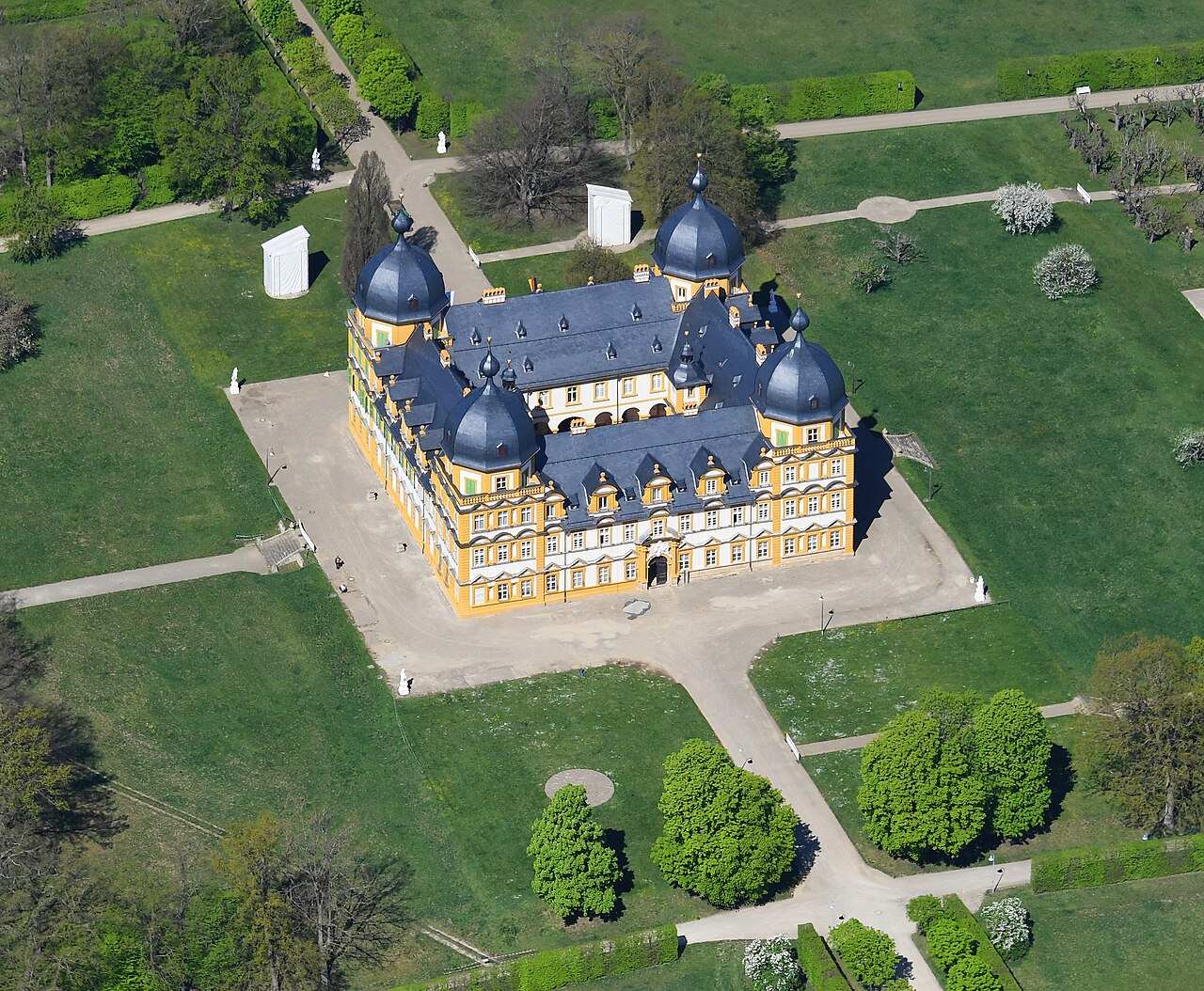
Schloss Seehof is a Schloss (palace) in Memmelsdorf, Bamberg, Germany. It was built from 1684 to 1695 as a summer residence and hunting lodge for Marquard Sebastian Schenk von Stauffenberg, Prince-bishop of Bamberg.
Schloss Seehof is located outside of Memmelsdorf in the district of Bamberg, around 5 kilometers northeast of the town of Bamberg in the Upper Franconia region of Bavaria, Germany.
Marquard Sebastian Schenk von Stauffenberg, Prince-bishop of Bamberg, enjoyed the rural area around Memmelsdorf. He thus asked Antonio Petrini to replace a local estate from the late 15th century with an early Baroque palace. This was built between 1684 and 1695.
Later redesigns included the White Hall in the west wing, created during the reign of Johann Philipp Anton von Franckenstein in the 1750s.
The palace is located in a large park and stands on a square plan, much like Schloss Johannisburg at Aschaffenburg. The four corner pavilions are topped by squat octagonal towers with prominent slate roof hoods featuring pierced ball ornaments. The facades are heavily segmented by large windows (with triangular gables on the ground floor and arches on the upper floor). Each row of windows is supported by a cornice. The inner court features two small clock towers and an arcade that surrounds it on the ground floor on all four sides.
The interior mostly dates from the 1730s. Balthasar Neumann and J.J.M. Küchel were involved in the designs. The palace chapel on the ground floor contains a Rococo altar that was made out of stucco by Antonio Bossi based on a drawing by Küchel. The altar painting is Die Heiligen drei Könige (the Three Magi) by Johann Rottenhammer (c. 1600). The centre part of the upper floor is occupied by a Baroque flight of rooms with the Rokokosaal in the middle. Its walls were covered by gypsum "marble" and reliefs painted by F.A. Decourt. The ceiling has a painting by Giuseppe Appiani, showing the goddess of the dawn (1752).
The park is today quite different in appearance than originally, when it was laid out during the reign of Lothar Franz von Schönborn in the early 18th century, since the ponds, cascades and fountains were all drained in 1803-6, after the water pipe from the Stammberg had been cut.
Text adapted from “Schloss Seehof” on Wikipedia, CC BY-SA 4.0.
Schloss Seehof ranks #2,522 of 8,764 worldwide in the atlas's castle fame ranking, and #190 of the 618 mapped in Germany. Founded 1684, it is older than 24% of the atlas's dated landmarks — one of 672 atlas entries founded in the 17th century. Its Wikipedia articles were opened 3,263 times in the last 60 days, more than 78% of the atlas. 3 more atlas landmarks stand within 25 km. See how Germany compares in the castle statistics.
View on the interactive castle map →Frequently asked questions
Where is Schloss Seehof?
Schloss Seehof stands in Germany, at 49.92697°, 10.94764°.
When was Schloss Seehof built?
The atlas dates its founding to 1684. Earlier structures may have stood on the site; this is the earliest documented founding year.
How famous is Schloss Seehof?
In this atlas's fame ranking: #2,522 of 8,764 worldwide, and #190 in Germany. Fame here combines how many Wikipedia language editions cover a landmark with how many people read them.
What is the nearest castle to Schloss Seehof?
New Residence, Bamberg, about 6 km away.
More castles in Germany
- Pyrmont Castle Germany · 13th century
- Burg Stolpen Germany · 12th century
- Kiel Castle Germany
- Schwarzenburg (Breisgau) Germany
More palaces & châteaux
- Dzików Castle Poland
- Château de la Verrerie France · 15th century
- Château de Puyguilhem France · 16th century
- Castle Blühnbach Austria · 15th century