 Germany · 12th century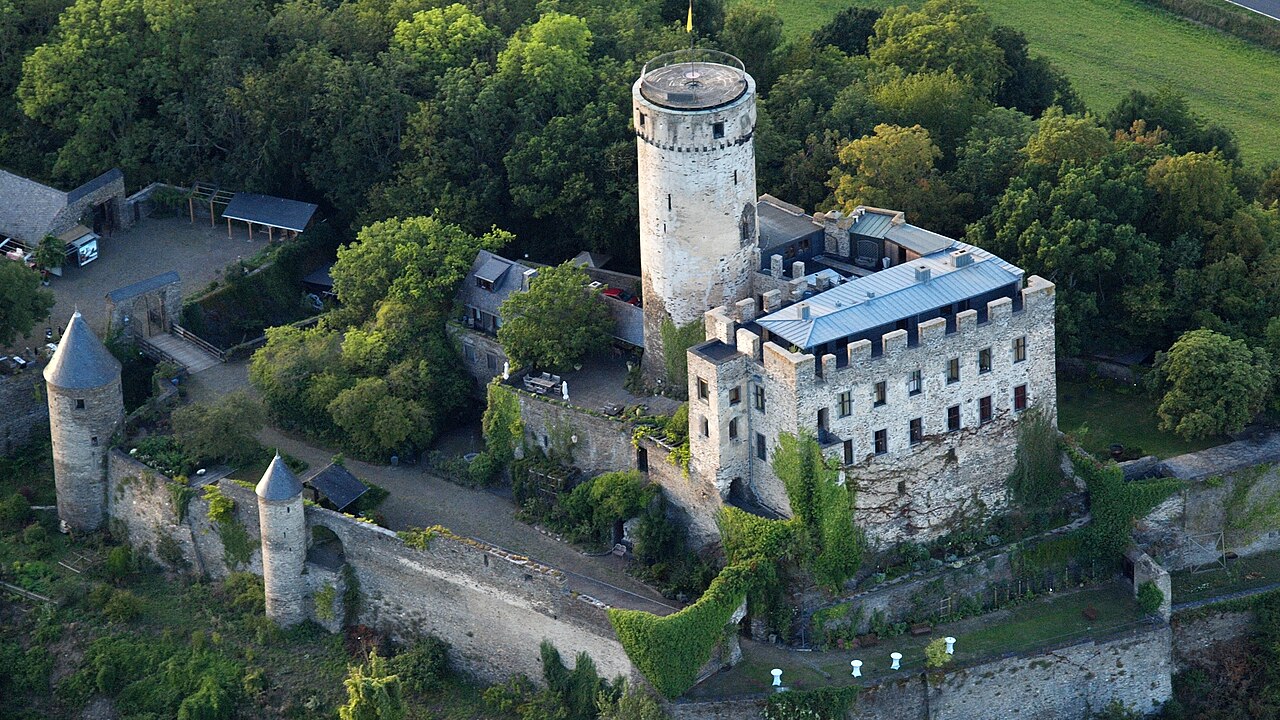
Pyrmont Castle (German: Burg Pyrmont) stands west of Münstermaifeld near Roes and Pillig on a slate rock outcrop above a waterfall on the Elzbach in the southern Eifel mountains in Germany. It is in the municipality of Roes in the district of Cochem-Zell.
The rock castle was built at the end of the 12th century on count palatine territory by Cuno of Schönburg, whose son Cuno II called himself "Lord of Pyrmont", the first member of his family to use the title. The castle was first recorded in 1225.
In 1441, Cuno VI of Pyrmont laid down by his will and testament how his inheritance (and thus also Pyrmont Castle) should be divided between his three quarrelsome sons, Henry VI, John and Frederick, in order to protect the ancestral seat of the dynasty from division by inheritance. But this did not prevent the squabblers from fighting over the castle after their father's death. Henry VI of Pyrmont had the Reichsacht imposed on him as a result of the inheritance dispute and the administration of his share of the castle was transferred to his brother Frederick.
The castle did not witness more peaceful times until the second half of the 15th century, when Emperor Maximilian I elevated Henry IV, Lord of Pyrmont, to the status of a Freiherr. Although his marriages resulted in two sons, his daughter, Elisabeth, was eventually to inherit the Pyrmont estate. Since she married Philip of Eltz, the castle fell to this important comital dynasty.
However, even the Eltz family did not always agree on the distribution of their inheritance. In 1652, one of the Eltz heiresses sold her share to members of the family of Waldbott of Bassenheim because of the ongoing disputes who, two years later, were appointed imperial Freiherren thanks to their ownership of this estate.
In 1695, another Eltz share in Pyrmont Castle went to the Electorate of Trier and was also acquired by the Waldbott of Bassenheim family in 1710.
In 1712, the Waldbotts began to convert the medieval castle into a prestigious Schloss. For example, the palas was increased in height to three storeys and fitted with large windows. The present perron, on the south side of the castle, dates to this period.
In 1789, during the French Revolution, the owners fled from French troops to their estates on the right bank of the Rhine, and just five years later the castle was seized as French national property.
Text adapted from “Pyrmont Castle” on Wikipedia, CC BY-SA 4.0.
Pyrmont Castle ranks #3,924 of 9,035 worldwide in the atlas's castle fame ranking, and #322 of the 709 mapped in Germany. Founded c. 1190, it is older than 77% of the atlas's dated landmarks, one of 763 atlas entries founded in the 12th century. Its Wikipedia articles were opened 1,210 times in the last 60 days, more than 56% of the atlas. 25 more atlas landmarks stand within 25 km. The nearest day-trip guide is Koblenz, 26 km away. It is one of the 51 landmarks on the atlas's regional map of the Moselle. It is stop 15 of 36 on the Moselle castle route, Trier to Koblenz. See how Germany compares in the castle statistics.
View on the interactive castle map →