Palace
Schloss Wolfegg
 Germany · 16th century
- Founded
- c. 1578
- Heritage status
- Kulturdenkmal
- Location
- Wolfegg
- Coordinates
- 47.82292°, 9.79168°
- Open data
- Wikidata Q1649788
Description
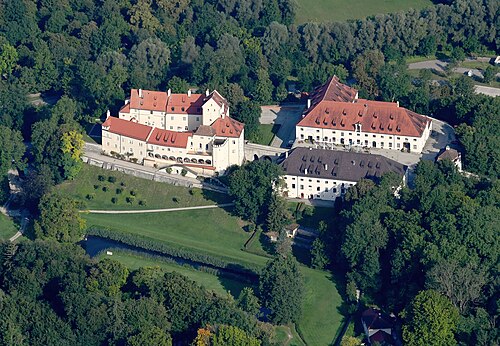
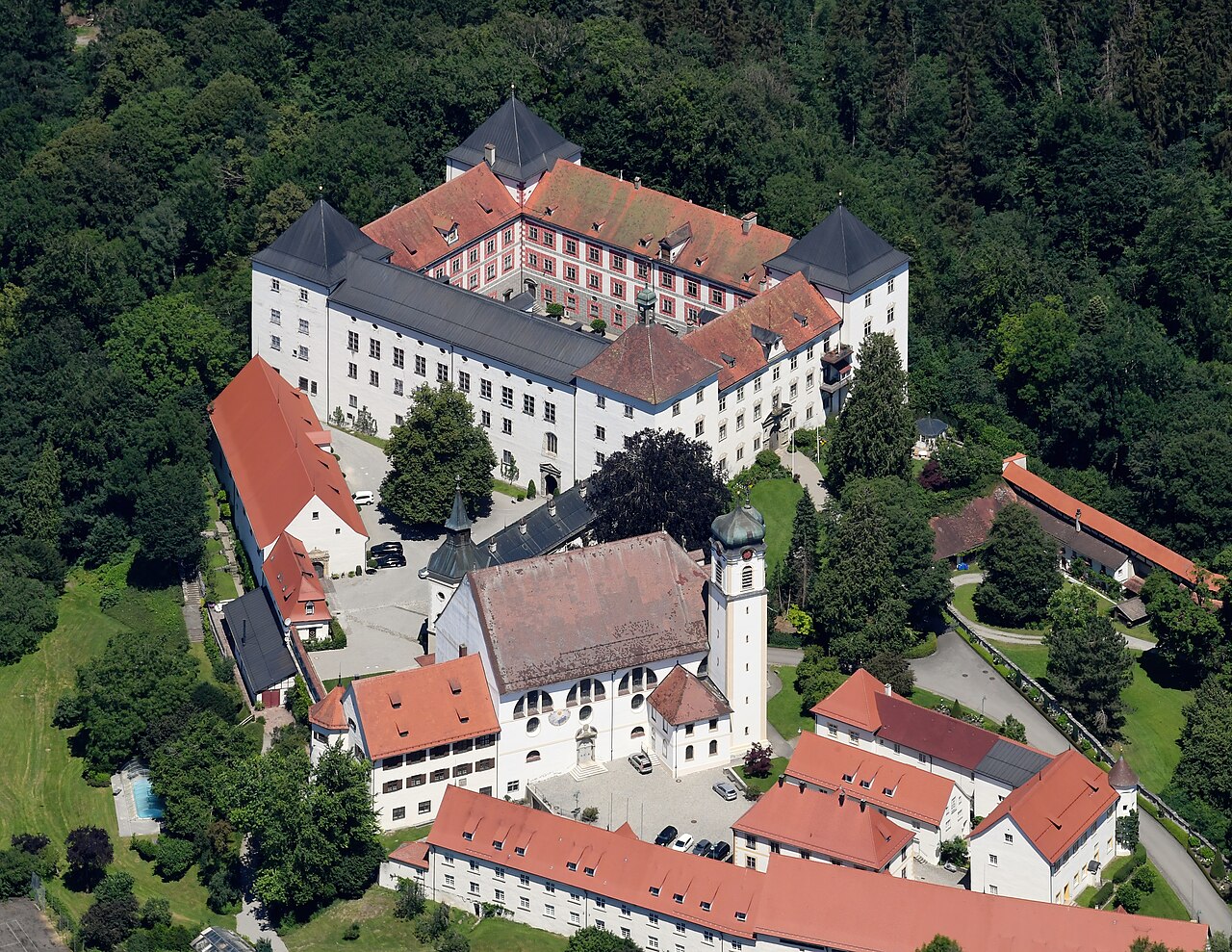
Schloss Wolfegg is a Renaissance castle next to the town of Wolfegg in Upper Swabia (Germany). The castle is the ancestral seat of the family of Waldburg-Wolfegg, which still owns it today.
The main building of the castle consists of four wings arranged in the shape of a rectangle with towers in the corners. Its exterior design and layout dates back to Truchsess Jakob II. of Waldburg (1546–1589) and his wife Johanna (1548–1613). After a fire in 1578 destroyed an older building, they built a new castle. Parts of it however were destroyed in 1646, when Swedish troops under Carl Gustaf Wrangel ransacked the place near the end of the Thirty Years' War and laid fire to it.
Since the owner Maximilian Willibald of Waldburg-Wolfegg was short of funds, the restoration of the castle was delayed until 1651. From 1691 to 1700 the sculptor and plasterer Balthasar Kimmer of Wangen (1653–1702) redesigned the interior of the rooms with official and representative functions. In the 18th century some of the guest rooms were decorated in Rococo style. Towards the end of the 19th century the castle was extensively renovated again. The dining rooms received a new interior design and the castle's chapel was remodeled in a Neo-Gothic fashion.
The castle, which is still occupied by members of the Waldburg-Wolfegg family, is usually not accessible to the public. However once or twice a year public concerts are performed within the castle during which concert visitors can see some of the castle's inner room, in particular the Rittersaal (knights' hall). The Rittersaal is a large hall decorated in Baroque style featuring 24 life-sized wood sculptures and large ceiling mirrors. It is considered to be one of the most original room designs of the Baroque period in Germany. In addition to those rooms being used for concerts guided tours through other parts of the castle might be offered at that occasion.
In May 2016 the Denkmalstiftung Baden-Württemberg, a foundation for the preservation of historical monuments in Baden-Württemberg, designated the Rittersaal as the historic monument of the month.
The castle also hosts the Wolfegger Kabinett, a large collection of graphic art from the late Middle Ages and the Renaissance periods.
Text adapted from “Schloss Wolfegg” on Wikipedia, CC BY-SA 4.0.
In the rankings
Schloss Wolfegg ranks #4,878 of 9,040 worldwide in the atlas's castle fame ranking, and #407 of the 714 mapped in Germany. Founded c. 1578, it is older than 34% of the atlas's dated landmarks, one of 887 atlas entries founded in the 16th century. Its Wikipedia articles were opened 1,599 times in the last 60 days, more than 64% of the atlas. 1 more atlas landmarks stand within 25 km. The nearest day-trip guide is Winterthur, 88 km away. See how Germany compares in the castle statistics.
Castles nearby
- Tettnang Castle23 km · Germany
- Schloss Heiligenberg (Heiligenberg)36 km · Germany
- Fürstäbtliche Residenz40 km · Germany
- Heuneburg41 km · Germany
More castles in Germany
- Schloss WrangelsburgGermany · 19th century
- Schloss WurzenGermany · 15th century
- Schloss SteinhöfelGermany · 18th century
- Seefeld CastleGermany · 14th century