 Germany · 19th century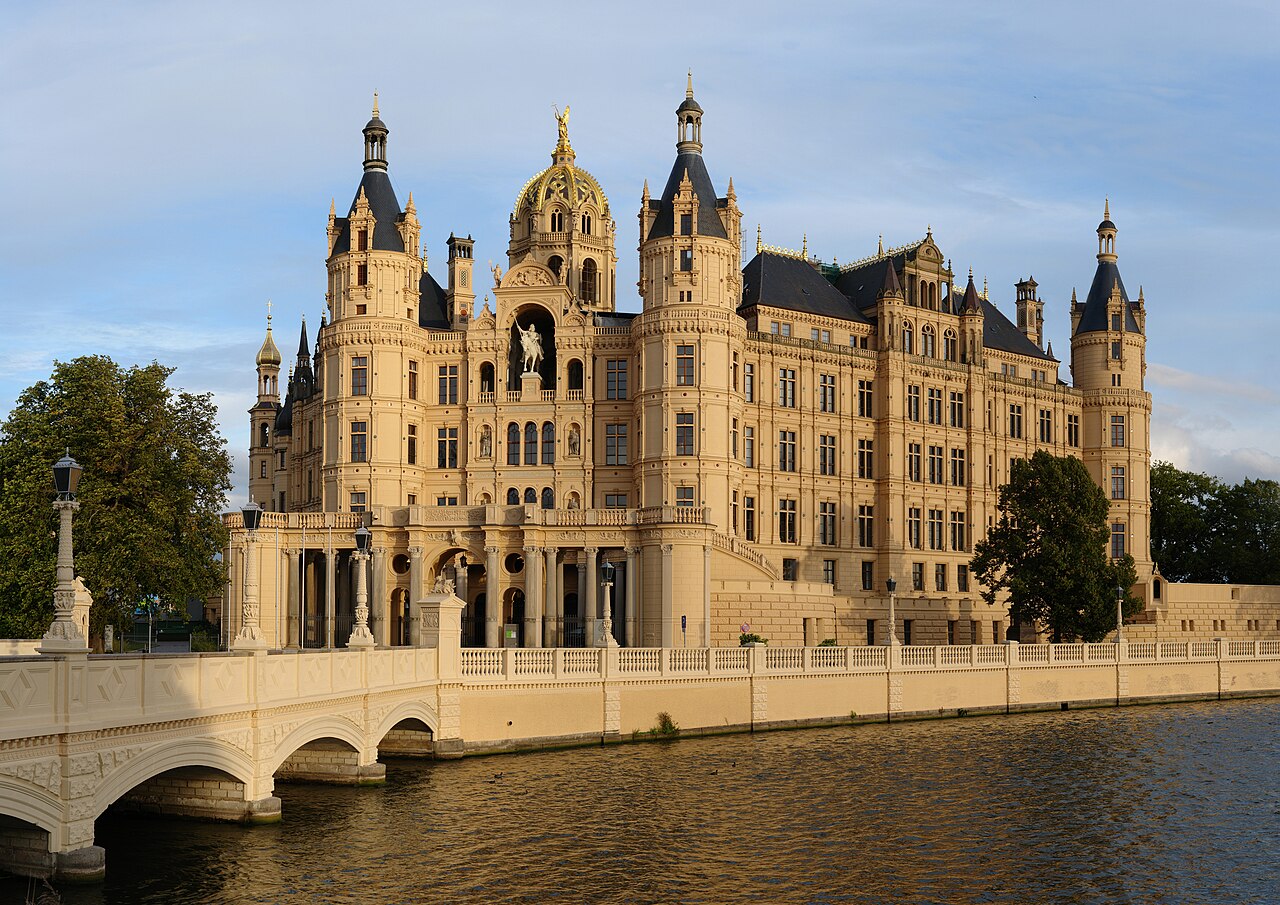
Schwerin Castle (German: Schweriner Schloss, German pronunciation: [ʃveˈʁiːnɐ ˈʃlɔs] also known as Schwerin Palace, (German: [ʃveˈʁiːn] or German pronunciation: [ʃvɛˈʁiːn]) is a 19th-century Schloss built in the historicist style located in the city of Schwerin, the capital of Mecklenburg-Vorpommern state, Germany. It is situated on an island in the city's main lake, Lake Schwerin.
For centuries, the castle on the present site was the home of the dukes and grand dukes of Mecklenburg and later Mecklenburg-Schwerin, although few parts of the pre-19th-century castle have survived. Today, parts of the castle serve as the residence of the Mecklenburg-Vorpommern state parliament (German: Landtag) while other parts are used for the palace museum, a restaurant, and cultural events, like open-air theatre in the courtyard.
Significant parts of the current palace were built between 1845 and 1857 as a collaboration between the eminent historicist architects Gottfried Semper, Friedrich August Stüler, Georg Adolf Demmler, and Ernst Friedrich Zwirner. The castle is regarded as one of the most important works of Romantic historicism in Europe, and is nicknamed the "Neuschwanstein of the North".
In 2024, Schwerin Castle was added to the UNESCO World Heritage List.
Text adapted from “Schwerin Castle” on Wikipedia, CC BY-SA 4.0.
Schwerin Castle ranks #115 of 9,079 worldwide in the atlas's castle fame ranking, and #12 of the 711 mapped in Germany. Founded 1845, it is older than 9% of the atlas's dated landmarks — one of 717 atlas entries founded in the 19th century. Its Wikipedia articles were opened 25,253 times in the last 60 days, more than 98% of the atlas. 2 more atlas landmarks stand within 25 km. See how Germany compares in the castle statistics.
View on the interactive castle map →