 Germany · 19th century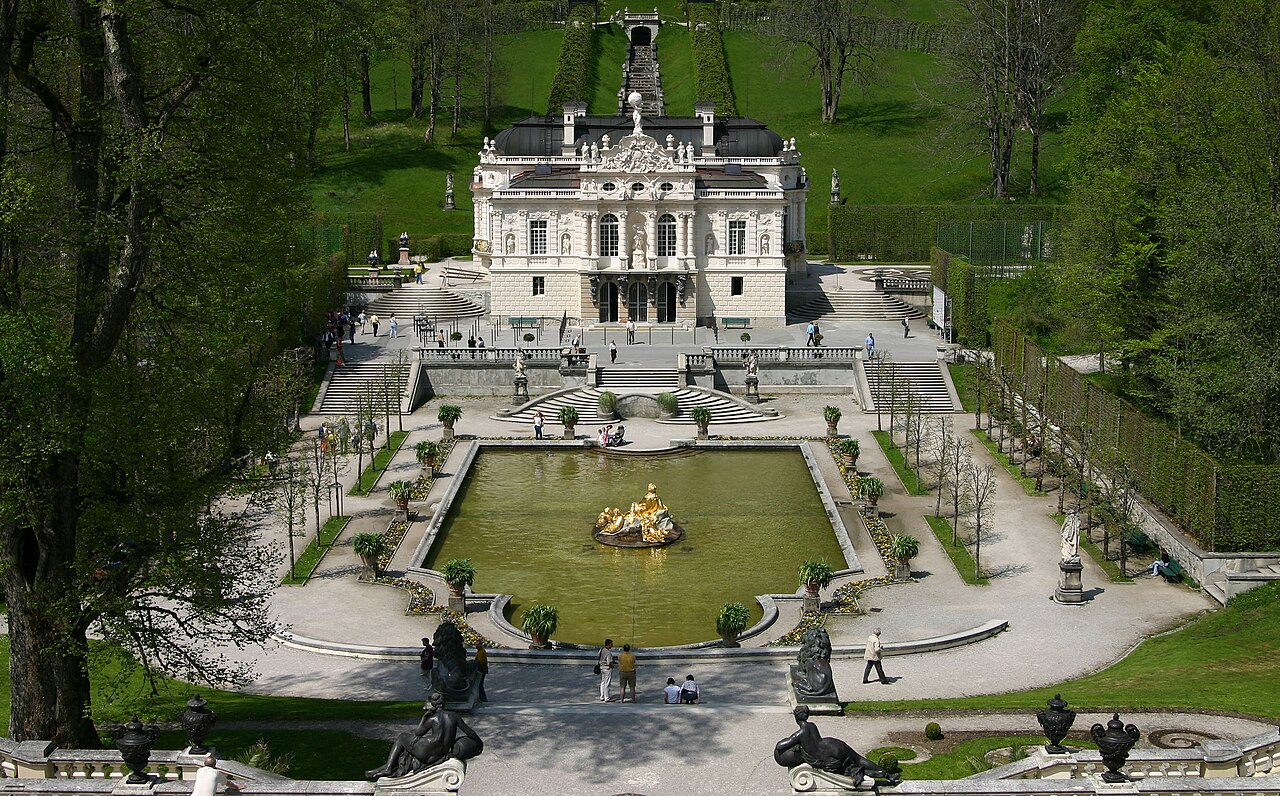
Linderhof Palace (German: Schloss Linderhof) is a schloss in Germany, 10 km west of the village of Ettal in southwest Bavaria. It is the smallest of the three palaces built by King Ludwig II of Bavaria and the only one which was actually completed and that he lived in most of the time from 1876 onward.
Ludwig already knew the area around Linderhof from his youth when he had accompanied his father King Maximilian II of Bavaria on his hunting trips in the Bavarian Alps. When Ludwig II became King in 1864, he inherited a hunting lodge, the so-called Königshäuschen ("King's little house") from his father, and in 1869 began enlarging the building. In 1874, he decided to tear down the Königshäuschen and rebuild it in its present-day location in the park. At the same time three new rooms and the staircase were added to the remaining U-shaped complex, and the previous wooden exterior was clad with stone façades. The building was designed in the style of the second rococo-period. Between 1863 and 1886, a total of 8,460,937 marks was spent constructing Linderhof.
In 2025, the palace was designated as a World Heritage Site by UNESCO.
Although Linderhof is much smaller than Versailles, it is evident that the palace of the French Sun-King Louis XIV (who was an idol for Ludwig) was its inspiration. The staircase, for example, is a reduction of the famous Ambassador's staircase in Versailles, which would be copied in full in Herrenchiemsee, another palace project by Ludwig that was designed less as a residential building than as a homage to the Sun-King.
Stylistically, however, the building and its decor take their cues from the mid-18th century Rococo of Louis XV, and the small palace in the Graswang valley was more directly based on that king's Petit Trianon on the Versailles grounds. The symbol of the sun that can be found everywhere in the decoration of the rooms represents the French notion of absolutism that, for Ludwig, was the perfect incorporation of his ideal of a God-given monarchy with total royal power. Such a monarchy could no longer be realised in Europe in the second half of the nineteenth century. In the Kingdom of Bavaria, the monarch was constitutionally severely restricted, quite apart from Ludwig's incompetence and disinterest in really taking care of state affairs and political power struggles.
Text adapted from “Linderhof Palace” on Wikipedia, CC BY-SA 4.0.
Linderhof Palace ranks #97 of 9,079 worldwide in the atlas's castle fame ranking, and #9 of the 711 mapped in Germany. Founded 1870, it is older than 6% of the atlas's dated landmarks — one of 717 atlas entries founded in the 19th century. Its Wikipedia articles were opened 33,922 times in the last 60 days, more than 99% of the atlas. 4 more atlas landmarks stand within 25 km. The nearest day-trip guide is Innsbruck, 47 km away. It is stop 4 of 6 on Ludwig II’s castles, Hohenschwangau to Herrenchiemsee. See how Germany compares in the castle statistics.
View on the interactive castle map →