 Azerbaijan · 18th century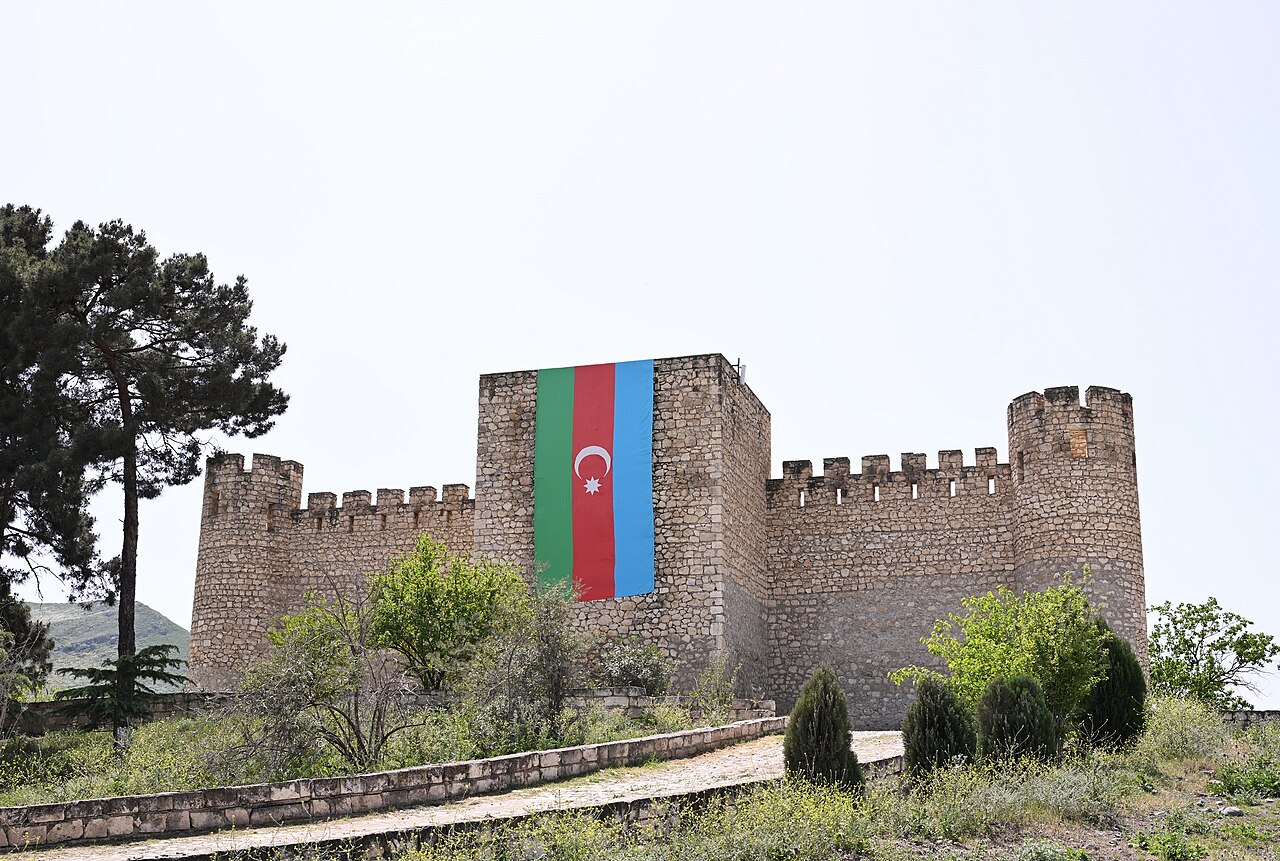
Shahbulag Castle (Azerbaijani: Şahbulaq qalası, Persian: قلعه شاهبولاگ; literally "Spring of the Shah") is an 18th-century fortress near Aghdam in Azerbaijan, built by the Karabakh Khan Panah Ali.
The castle was named Shahbulag ('Shah's spring', also Shah-Bulaghi) after a nearby spring bearing the same name located around the lower part of the Khachinchay (Khachen) River. Before the construction of the castle, the area around it was known as Tarnagyut, which, according to Armenian archaeologist Hamlet Petrosyan, is a corruption of Tigranakert, the ruined ancient city which lies nearby the castle. Some historians in the late 18th and 19th centuries still called the castle "Tarnakut" or "Tarnavut", such as Abd al-Razzaq Beg Donboli (died 1827/28) and Abbasgulu Bakikhanov (died 1847).
Following the assassination of the Iranian shah (king) Nader Shah (r. 1736–1747) in 1747, internal chaos erupted in Iran, particularly in the South Caucasus, where semi-autonomous khanates emerged as a result of the lack of a centralized government. Amongst them was the Karabakh Khanate, established by Panah Ali Khan of the Javanshir tribe. Before Panah Ali Khan had Shahbulag Castle constructed, he fought and defeated the inhabitants of the Melikdom of Khachen, as they were hostile towards him and lived near the area that Shahbulag would be constructed. In 1752, the construction of Shahbulag Castle was complete at the base of a mountain in Tarnavut district.
Panah Ali Khan relocated everyone from Bayat Castle to Shahbulag, which brought him within close proximity of the highlands ruled by the five Armenian melikdoms. Following the construction of Panahabad fortress in Shusha, Panah Ali Khan relocated the notables, dignitaries, and tribal leaders there.
In May 1805, Panah Ali Khan's son and successor Ibrahim Khalil Khan signed the Treaty of Kurekchay, which granted Russia full authority over Karabakh's external affairs in exchange for a yearly payment. On July 6, an Iranian force defeated a Russian force at Shahbulag, subsequently taking control over the castle.
The complex, which included mosques, houses, baths and a market, was built in 1751–52. During construction, limestone and dimension stone were used. Only the castle itself and the mosque on its northwestern end have survived.
Text adapted from “Shahbulag Castle” on Wikipedia, CC BY-SA 4.0.
Shahbulag Castle ranks #2,714 of 9,079 worldwide in the atlas's castle fame ranking, and #7 of the 46 mapped in Azerbaijan. Founded 1752, it is older than 16% of the atlas's dated landmarks — one of 696 atlas entries founded in the 18th century. 3 more atlas landmarks stand within 25 km. The nearest day-trip guide is Ganja, 82 km away. See how Azerbaijan compares in the castle statistics.
View on the interactive castle map →