 United Arab Emirates · 20th century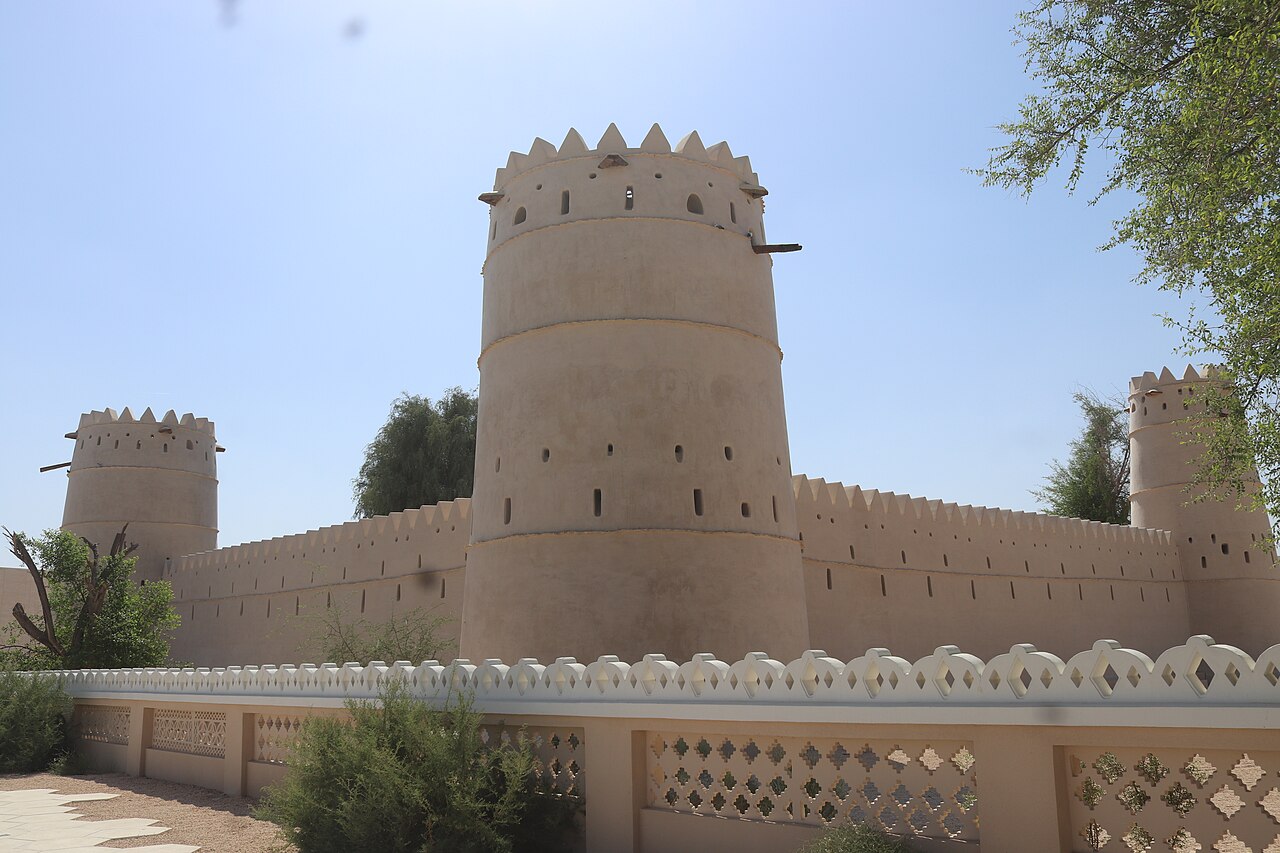
The Sheikh Sultan bin Zayed Fort is in the city of Al Ain, in the Emirate of Abu Dhabi in the United Arab Emirates. The fort was built by Sheikh Sultan bin Zayed the Elder in 1907 in the centre of Al Ain. It was the seat of the ruler of the Eastern Region before he took over the rule of the Emirate of Abu Dhabi in the period from 1922 to 1926; official meetings were held and foreign delegations received there. It then became the seat of the Al Nahyan sheikhs who ruled the emirate's Eastern Region in the following years, until Sheikh Zayed bin Sultan Al Nahyan chose it in 1971 to house the city's first museum. The fort is square, each side about 30 metres long, with a single entrance on the south side projecting from the walls.
This only entrance has a rectangular door, above which are three square openings and then four round ones (loopholes), known in the local dialect as al-marma, that is, shooting openings.
The four round openings were probably used for rifles, while the square openings were used for shooting arrows. The door of the fort was made of thick wood reinforced with heavy iron spikes, to give the gate as much protection as possible if it came under attack.
The star of good fortune shone on the house of glory, a glory that endures in spite of its enemies.
Sultan bin Zayed built the house of rule; history dawned on a happy day.
The fort was built to suit desert architecture, so that it resists the intense heat, thanks to building materials such as mud, stone, wood and palm trunks.
Machine-translated from “قلعة الشيخ سلطان بن زايد” on the Arabic Wikipedia, CC BY-SA 4.0.
Sheikh Sultan Bin Zayed Fort (Al Ain) ranks #8,650 of 9,079 worldwide in the atlas's castle fame ranking, and #14 of the 19 mapped in United Arab Emirates. Founded 1907 — one of 169 atlas entries founded in the 20th century. 4 more atlas landmarks stand within 25 km. The nearest day-trip guide is Al Ain, 3 km away. See how United Arab Emirates compares in the castle statistics.
View on the interactive castle map →