 Czech Republic · 14th century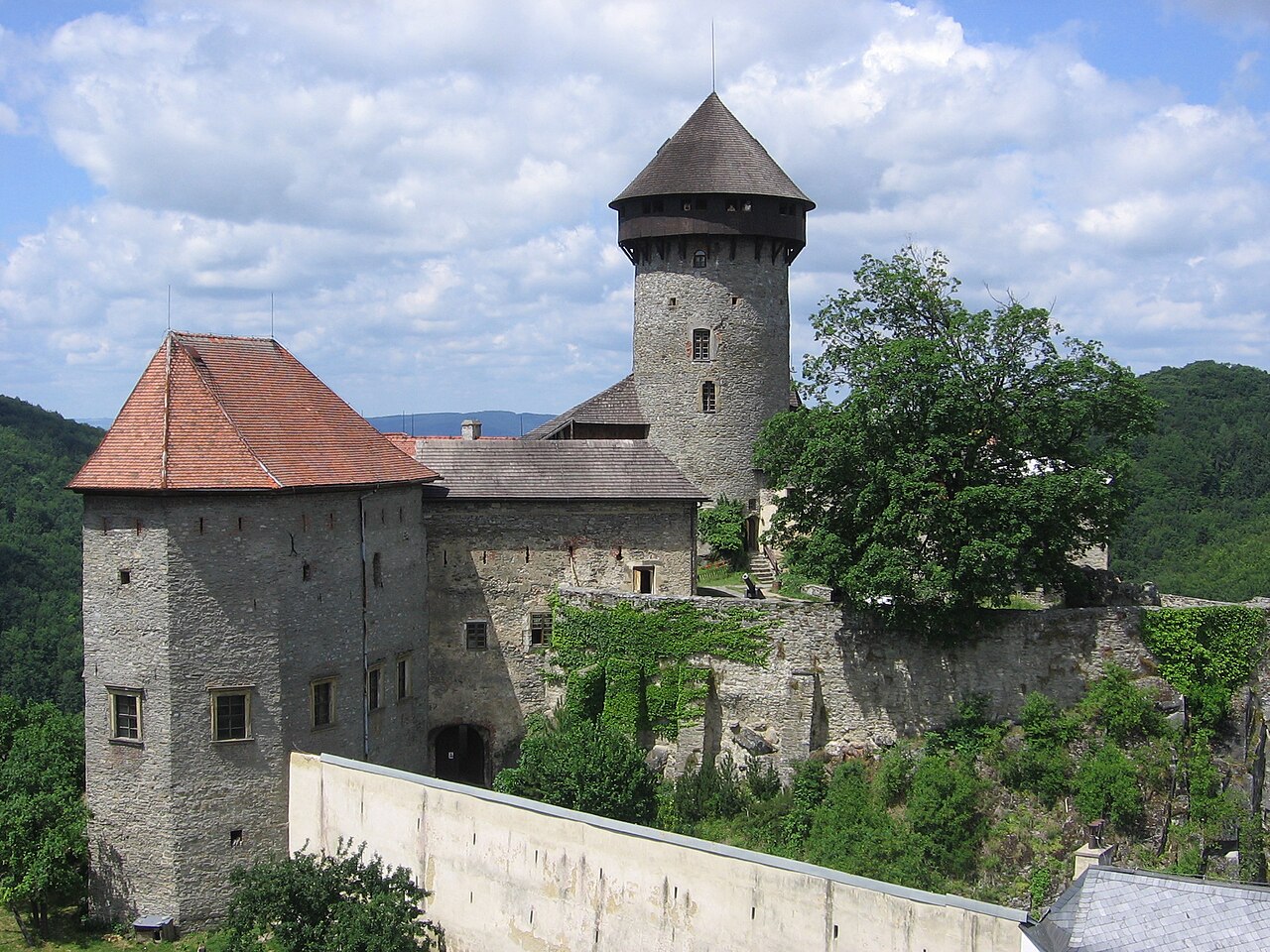
Sovinec (German: Eulenburg) is a castle in Jiříkov of Bruntál District in the Moravian-Silesian Region of the Czech Republic. It is situated on a cone-shaped hill located in the Nízký Jeseník range.
In the second half of the 13th century, due to their attempts at colonizing the mountains, the Olomouc bishops came into conflict with the Jeseníky landlords. Because of the pressure from Olomouc, the brothers Vok and Pavel of the traditional Moravian family of Hrutovic, and who later called themselves of "Huzová", built a castle in Sovinec in the years 1329–1332 to mark the border of their territory. Even though in the first half of the 14th century the Sovinec dynasty translated its name into the equivalent German Eulenburg, they remained the same ancient moravian branch of the Czech Hurtovic dynasty with their own insignia. From the second half of the 14th century they used either their German or their Czech name, and the latter prevailed since the 15th century.
According to Ctibor Tovačovský of Cimburk's legal work, the lords of Sovinec belonged to the 15 oldest Moravian ruling families such as the Boskovics, the Cimburks, and the Pernštejns. They had privileged status over all the other ruling families in the area, held the highest positions and took part in all important issues. As a proof of this might, the signature and seal of Petr of Sovinec is visible on the protest letter which Czech and Moravian noblemen wrote in the occasion of the burning of Jan Hus. Sovinec was also an important Hussite, stronghold which endangered even catholic Olomouc. And it is not by chance that Sovinec was chosen as the meeting place for the important political discussions between Prokop Holý, leader of the Hussite army and Sigismund Korybut, a candidate for the Czech throne.
The lords of Sovinec were strong supporters of King George of Poděbrady, famous for his attempts at uniting all European monarchs, in his efforts to include Silesia in his project. Due to their political activity, Mathias Corvinus destroyed the lands of the Sovinec dynasty in August 1474. As testified in 1490 in the Land Codex in the second half of the 15th century, Sovinec was the centre of a strong and united rule consisting of one town and 18 villages, ranging from Paseka in the plains through nearby Rýmařov to Štáhly (Malá Štáhle and Velká Štáhle) on the mountains.
Text adapted from “Sovinec” on Wikipedia, CC BY-SA 4.0.
Sovinec ranks #3,092 of 9,035 worldwide in the atlas's castle fame ranking, and #86 of the 243 mapped in Czech Republic. Founded c. 1400, it is older than 50% of the atlas's dated landmarks, one of 757 atlas entries founded in the 14th century. Its Wikipedia articles were opened 1,705 times in the last 60 days, more than 65% of the atlas. 4 more atlas landmarks stand within 25 km. The nearest day-trip guide is Olomouc, 27 km away. See how Czech Republic compares in the castle statistics.
View on the interactive castle map →