 England · 16th century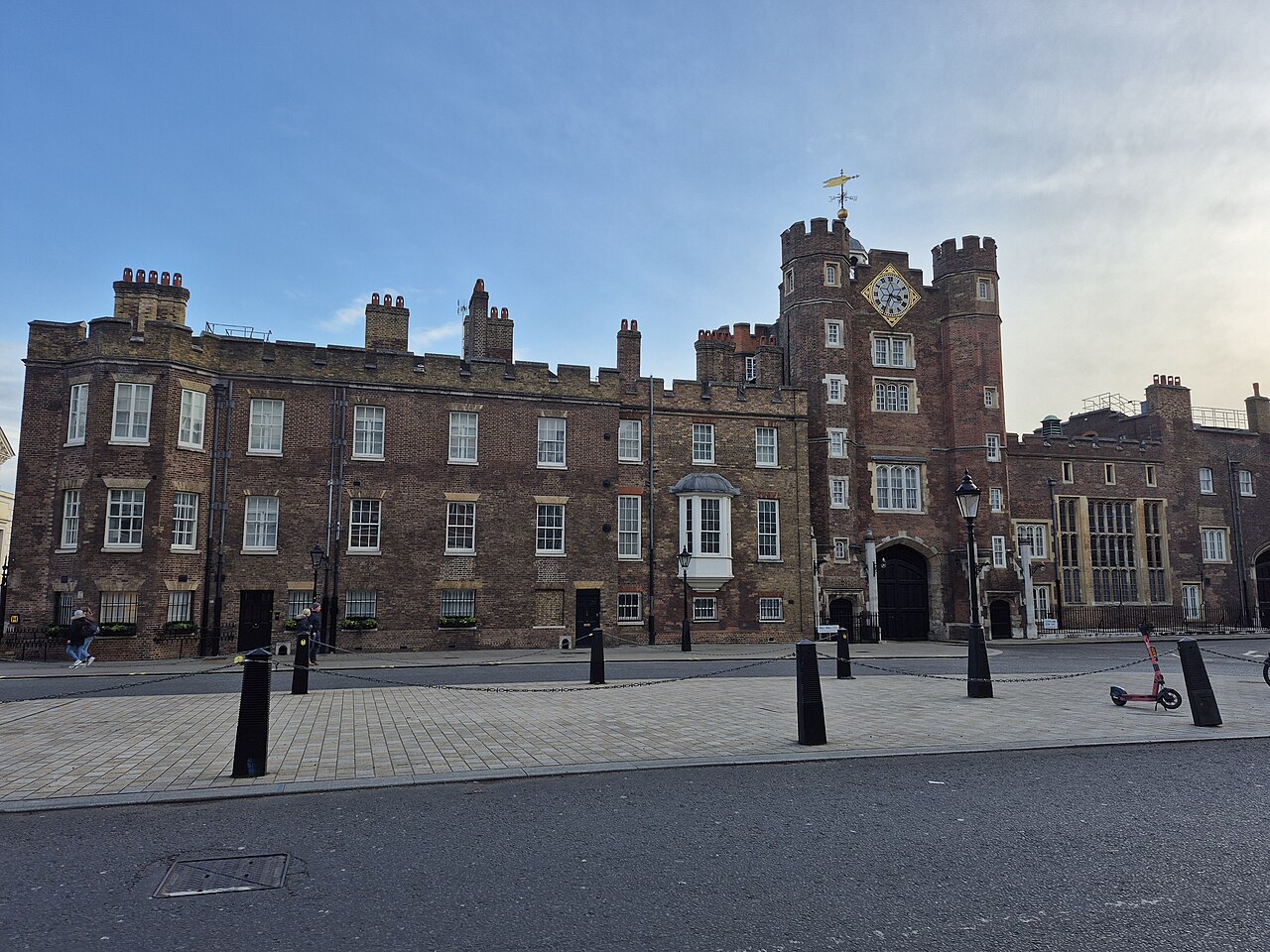
St James's Palace is the most senior royal palace in London, England. The palace gives its name to the Court of St James's, which is the monarch's royal court, and is located in the City of Westminster. Although no longer the principal residence of the monarch, it is the ceremonial meeting place of the Accession Council, the office of the Marshal of the Diplomatic Corps, and the London residence of several members of the royal family.
Built by order of King Henry VIII in the 1530s on the site of an isolated leper hospital dedicated to Saint James the Less, the palace was secondary in importance to the Palace of Whitehall for most Tudor and Stuart monarchs. Initially surrounded by a deer park and gardens, it was generally used as a hunting lodge and as a retreat from the formal court and occasionally as a royal guest house. After the Palace of Whitehall burned down, the palace took on administrative functions for the monarchy. It increased in importance during the reigns of the Hanoverian monarchs but began to be displaced by Buckingham Palace in the early 19th century. After decades of being used increasingly only for formal occasions, the move was formalised by Queen Victoria in 1837.
The palace now houses a number of offices and official societies and collections. All ambassadors and high commissioners to the United Kingdom are still accredited to the Court of St James. The palace's Chapel Royal is still used for functions of the British royal family. Official receptions are also regularly hosted at the palace.
The palace was built mainly between 1531 and 1536 in red brick, and its architecture is primarily Tudor in style. The Queen's Chapel was added in the 1620s, and Clarence House was built on palace grounds directly next to the Palace in the 1820s. A fire in 1809 destroyed parts of the palace, including the monarch's private apartments, which were never replaced.
Text adapted from “St James's Palace” on Wikipedia, CC BY-SA 4.0.
St James's Palace ranks #48 of 9,079 worldwide in the atlas's castle fame ranking, and #8 of the 360 mapped in England. Founded 1536, it is older than 40% of the atlas's dated landmarks — one of 891 atlas entries founded in the 16th century. Its Wikipedia articles were opened 56,037 times in the last 60 days, more than 99% of the atlas. 23 more atlas landmarks stand within 25 km. The nearest day-trip guide is London, 1 km away. See how England compares in the castle statistics.
View on the interactive castle map →