 Sweden · 13th century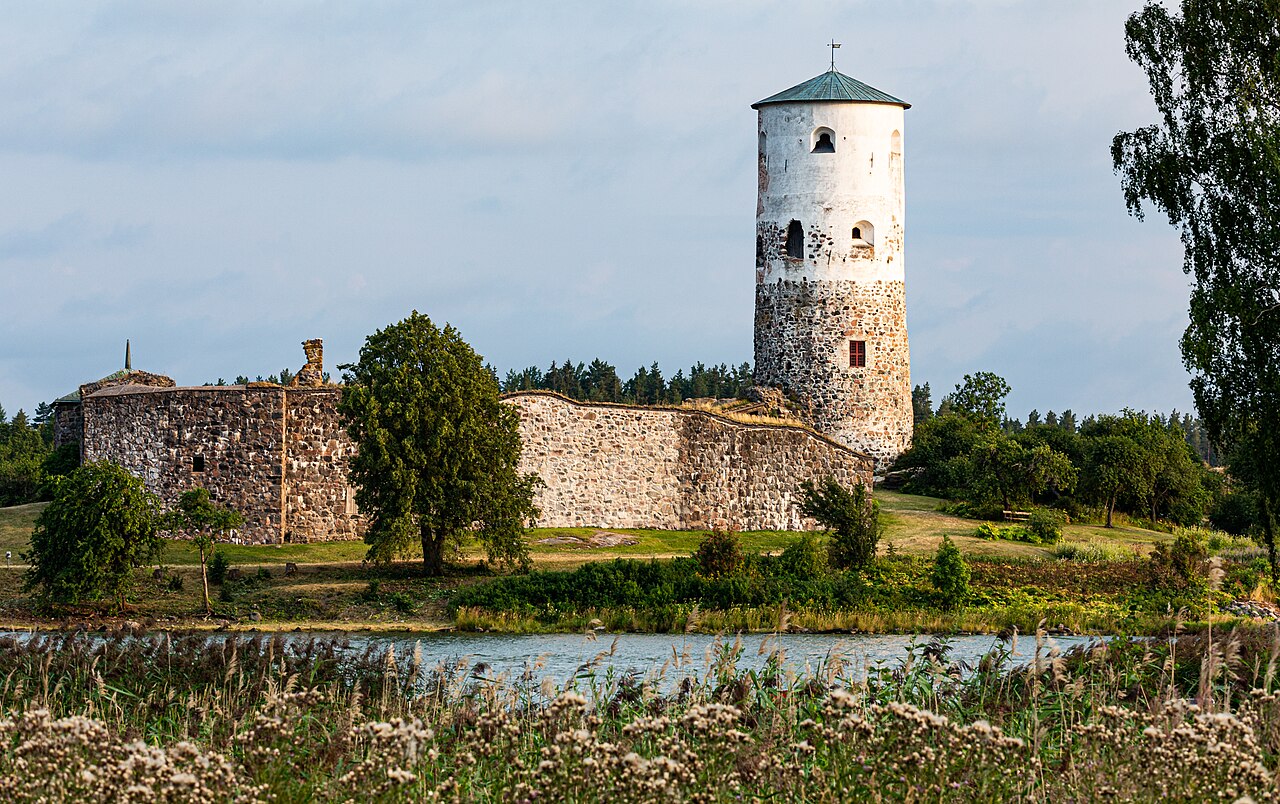
Stegeborg Castle is a ruined castle in St Anna parish, Söderköping, Östergötland, located on an island in a narrow sound at the bay of Slätbaken, Sweden.
The oldest part of the castle is a square brick tower in the southeast corner, built in the early 13th century, when Söderköping became a city. A simple fortified residence was added during the 14th century, expanded and supplemented by a wall and a round tower in the west. During the 16th and 17th centuries the building was further expanded, especially during the reign of John III of Sweden, when the round tower attained its present height. In addition, a castle church was added to the north wing. Several of the Vasa kings lived in Stegeborg, which was allotted 1652–1689 to the Palatine counts John Casimir (died 1652) and Adolph John.
The crown sold the castle in the 1730s for building materials. The bottom floor's large masonry protected it against complete destruction. Until 1689 the castle was the center of the Östergötland archipelago's local government. The new palace, a whitewashed three-storey building in neoclassical style, located at the former southern royal farm, was built in 1806.
The castle is mentioned in 1310 as Stækaborg: the name comes from stæk, mediaeval Swedish for stock, pile, or the other place name Stäket. "Stäk" refers to several systems of pilings - stakes - submerged in the water which blocked the channel. The oldest of these systems has been dated between the 7th and 9th century. Pilings dating back to the 11th century have been discovered in the waters north of the island. The purpose of the piling barriers was to prevent or hinder shipping. These pilings were still extant in the 19th century, and therefore vessels had to pass the island on the south side to reach Söderköping.
The early history of Stegeborg is tied with the estate of Skällsvik. A farm is attested as early as 1287, when it belonged to the Bishop of Linköping, Benedict Birgersson.
His successor Lars Albrektsson kept the property. Its strategic location at the entrance to Söderköping, at the time one of the country's wealthiest cities, was obvious to Birger Magnusson's guardianship, which was led by the marsk Torkel Knutsson. In 1305 at the latest the bishop's farm was sold to king Birger.
Subsequently, a castle was built on the islet, which is in the sea channel leading toward Söderköping.
Text adapted from “Stegeborg Castle” on Wikipedia, CC BY-SA 4.0.
Stegeborg Castle ranks #2,415 of 9,079 worldwide in the atlas's castle fame ranking, and #56 of the 209 mapped in Sweden. Founded c. 1225, it is older than 73% of the atlas's dated landmarks — one of 1080 atlas entries founded in the 13th century. Its Wikipedia articles were opened 3,486 times in the last 60 days, more than 81% of the atlas. 2 more atlas landmarks stand within 25 km. The nearest day-trip guide is Linköping, 57 km away. See how Sweden compares in the castle statistics.
View on the interactive castle map →