 Japan · 16th century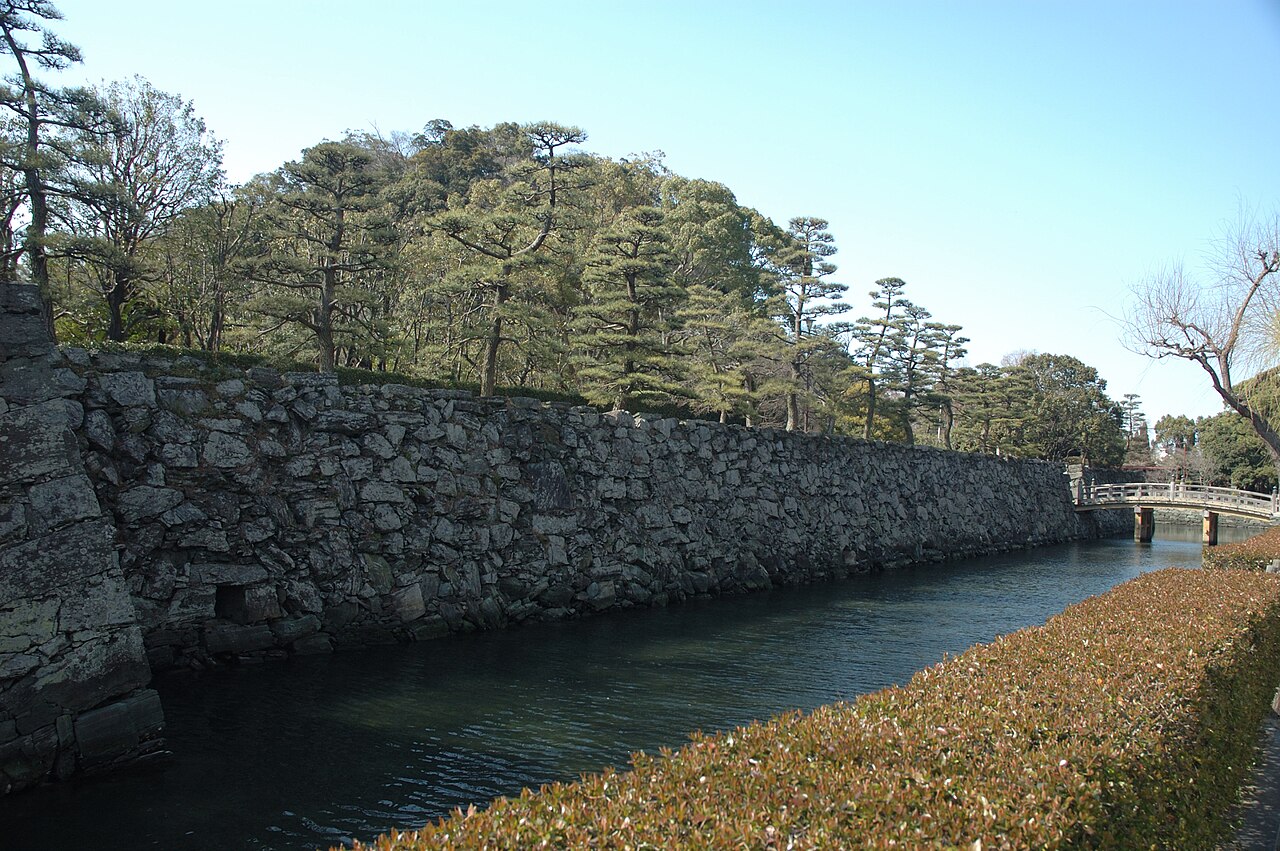
Tokushima Castle (徳島城, Tokushima-jō) was an Edo period Japanese castle located in the city of Tokushima, Tokushima Prefecture, Japan. Its ruins have been protected as a National Historic Site since 1957. Its Omotegoten Gardens are designated a national Place of Scenic Beauty.
Tokushima Castle is located on the 60-meter high Shiroyama hill, in the center of Tokushima city at the mouth of the Yoshino River. Its location makes it the main gateway to Shikoku from the Kinai region. During the Muromachi period, the area was dominated by the local Miyoshi clan, who also controlled Kawachi Province across the Kii Channel. In 1582, the warlord Chōsokabe Motochika of Tosa Province attempted to united the island of Shikoku under his rule, and defeated the Miyoshi. However, he was in turn defeated by the forces of Toyotomi Hideyoshi only three years later in Hideyoshi's conquest of Shikoku. As Awa Province was directly opposite Hideyoshi's stronghold of Osaka, he placed Hachisuka Iemasa, the son of one of his most trusted generals, Hachisuka Masakatsu as governor.
Masakatsu had originally been from Owari Province and had been one of Hideyoshi's closest confidants since an early age, participating at Hideyoshi's side through most of his campaigns, including the capture of Sanuki and Awa provinces. However, due to his advanced age, he turned the clan chieftainship to his son Iemasa.
Hachisuka Iemasa completed Tokushima Castle after about a year of construction. The site was a long and narrow ridge extending from east-to-west, with the central area over 150 meters long. As was typical for the Sengoku period, the castle originally consisted of a series of enclosures guarded by winding stone walls along the contours of the original terrain, and protected by masugata-style complex gates. Later, a three-story tenshu was added at the east edge of the hill. He also laid out the design of the castle town at the foot of the castle hill. Hachisuka Iemasa attempted to keep some distance from the Toyotomi government, as he did not get along with Ishida Mitsunari.
He also married his son Hachisuka Yoshishige to an adopted daughter of Tokugawa Ieyasu. For these reasons, at the time of the Battle of Sekigahara, Ishida Mitsunari forced Hachisuka Iemasa to take the tonsure and forcibly exiled him to Mount Koya and the castle was occupied by troops from the Mōri clan.
Text adapted from “Tokushima Castle” on Wikipedia, CC BY-SA 4.0.
Tokushima Castle ranks #1,920 of 9,035 worldwide in the atlas's castle fame ranking, and #118 of the 295 mapped in Japan. Founded 1585, it is older than 33% of the atlas's dated landmarks, one of 886 atlas entries founded in the 16th century. Its Wikipedia articles were opened 4,933 times in the last 60 days, more than 86% of the atlas. 3 more atlas landmarks stand within 25 km. The nearest day-trip guide is Wakayama, 59 km away. It is one of the 15 landmarks on the atlas's regional map of Shikoku. See how Japan compares in the castle statistics.
View on the interactive castle map →