 Estonia · 13th century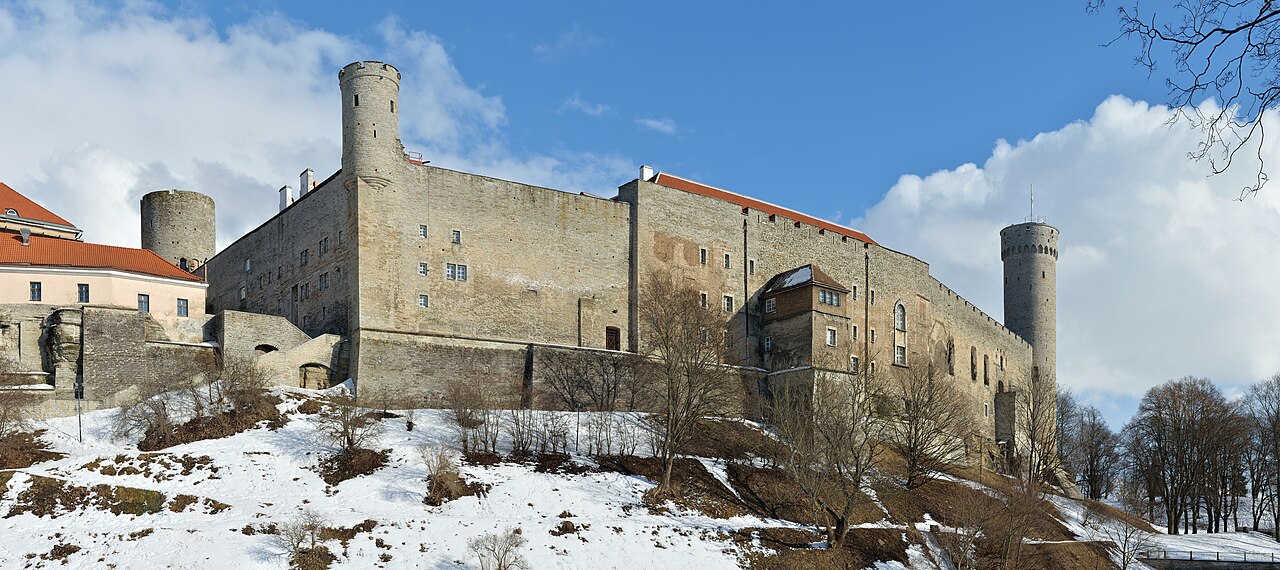
Toompea castle (Estonian: Toompea loss) is a medieval castle on Toompea hill in the central part of Tallinn, the capital of Estonia. In modern times, it houses the Parliament of Estonia (Riigikogu).
The Toompea castle's predecessor, an ancient Estonian stronghold had been in use since at least the 9th century AD. In 1219, the castle was taken over by Denmark's crusaders led by king Valdemar II. According to a popular Danish legend, the flag of Denmark (Dannebrog) fell from the sky during a critical stage of the battle (known as the Battle of Lindanise). This first proper castle was referred to as the "Castle of the Danes", in Latin castrum danorum and in contemporary archaic Estonian taani linna. From the latter, the modern name of the city of Tallinn is possibly derived (see also Tallinn § Names and etymology).
In 1227, the castle was taken over by the Order of the Brethren of the Sword, who initiated rebuilding schemes. The castle's reconstruction began in the 13th century and is to a large extent the castle that can be seen today. The castle again fell to Denmark just ten years later, in 1237, but was sold to the Teutonic Order in 1346, and would remain in their hands for the remainder of the Middle Ages.
As the crusading Teutonic Order was a religious order, the castle came to resemble a monastery in several ways. It included a chapel, a chapter house and a dormitory for the knights. The order was also responsible for erecting the still visible towers of the castle, including "Pilsticker" (translated as "arrow-sharpener"), "Stür den Kerl" ("ward off the enemy"), "Landskrone" ("crown of the land"), and "Langer Hermann" (in Estonian Pikk Hermann or "Tall Hermann"). Tall Hermann is 48 metres (157 ft) tall and dominates the castle skyline. The flag of Estonia is hoisted at the top of the tower every day at sunrise, to the sound of the national anthem, and lowered at sunset.
After the Protestant Reformation and many wars that followed in the 16th century, the Teutonic Order lost its last possessions in Estonia and the region became contested by Sweden, Poland and Muscovy (Russia). By 1561, northern Estonia had become part of the Kingdom of Sweden. The Swedish rulers transformed the castle from a medieval fortress into a ceremonial and administrative centre of political power in Estonia, a purpose the castle has served ever since.
Text adapted from “Toompea Castle” on Wikipedia, CC BY-SA 4.0.
Toompea Castle ranks #566 of 9,079 worldwide in the atlas's castle fame ranking, and #2 of the 36 mapped in Estonia. Founded c. 1201, it is older than 75% of the atlas's dated landmarks — one of 1080 atlas entries founded in the 13th century. Its Wikipedia articles were opened 5,042 times in the last 60 days, more than 87% of the atlas. 9 more atlas landmarks stand within 25 km. The nearest day-trip guide is Tallinn, 1 km away. See how Estonia compares in the castle statistics.
View on the interactive castle map →