Castle
Tripoli Castle
🇱🇾 Libya
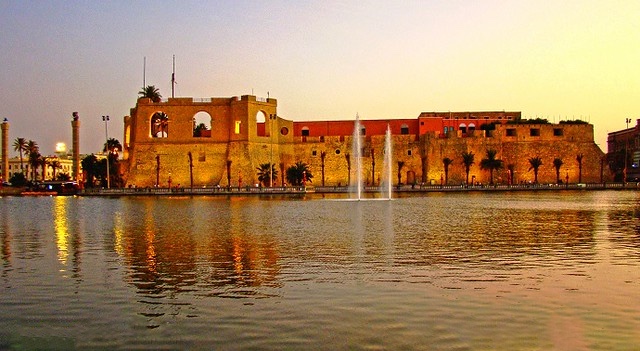
The Red Castle, in Arabic As-saraya Al-hamra (السرايا الحمراء), sometimes also Red Fort or Red Saraya, is a major landmark on the waterfront of Tripoli, bordering Martyrs' Square. It has been the home of the Red Castle Museum (under various names) since 1919, and of the Libyan Department of Archaeology since 1952.
The Red Castle used to be located directly on the sea. In the 1970s, the building of the seafront highway (Al-Shat Road) resulted in the creation of the Saraya Lake, as the castle was cut off from the sea. The building is bordered by the Saraya Lake to the northeast, the Central Bank of Libya to the northwest, the Souq al-Mushir neighborhood around the Karamanli Mosque to the southwest, and Martyrs' Square to the southeast.
The castle forms an imperfect square with sides of unequal length: 115 meters (north-east), 90 meters (north-west), 130 meters (south-west), and 140 meters (south-east). Its area is about 13,000 square meters. There are several buildings and courtyards inside the castle's walls.
The origins of the castle may be as old as the Phoenician foundation of Oea in the 7th century BCE; excavations have found remains dating back to Roman times. Like the surrounded region, it was taken over by the Vandal Kingdom around 439, recovered by the Roman Empire in 534, overrun by Amr ibn al-As in 642 or 643, reconquered by the Byzantines then again by the Umayyad Caliphate in the late 7th century; then under the rule of the Abbasid Caliphates (750–800), the Aghlabid Emirate of Ifriqiya (800–909), the Fatimid Caliphate (10th century) who refurbished it into a royal residence, the Zirid Emirate of Ifriqiya and Banu Khazrun (11th century-1146), the Norman Kingdom of Africa (1146-58), the Almohad Caliphate (1158-1229), the Hafsid Emirate of Ifriqiya (1234–1321), the Beni Ammar (1321–1401) and again the Hafsid Emirate (1401–1510, with another lapse in the mid-15th century).
In 1510 Tripoli was conquered by the Kingdom of Aragon. Much of the current structures appear to date from the subsequent period of rule by Aragonese military commanders and, after 1530, by the Knights Hospitaller until their expulsion by the Ottoman Empire following the Siege of Tripoli (1551). The castle is also said to have been painted red ochre during that time, thus its current name.
Text adapted from “Red Castle of Tripoli” on Wikipedia, CC BY-SA 4.0.
Tripoli Castle ranks #4,239 of 8,134 worldwide in the atlas's castle fame ranking, and #3 of the 6 mapped in Libya. Its Wikipedia articles were opened 1,448 times in the last 60 days, more than 58% of the atlas. See how Libya compares in the castle statistics.
View on the interactive castle map →Frequently asked questions
Where is Tripoli Castle?
Tripoli Castle stands in Libya, at 32.8961°, 13.1804°.
How famous is Tripoli Castle?
In this atlas's fame ranking: #4,239 of 8,134 worldwide, and #3 in Libya. Fame here combines how many Wikipedia language editions cover a landmark with how many people read them.
What is the nearest castle to Tripoli Castle?
Gasr Banat, about 214 km away.
More castles in Libya
- Fortress of Ghat Libya
- Fort Capuzzo Libya
- Bir Hakeim Libya
More castles
- Castle of San Francisco Spain · 17th century
- San Juan de las Águilas Castle Spain · 18th century
- Castillo de San Felipe (Los Escullos) Spain
- Castle of Nogueirosa Spain · 14th century