Castle
Trolle-Ljungby Castle
🇸🇪 Sweden · 17th century
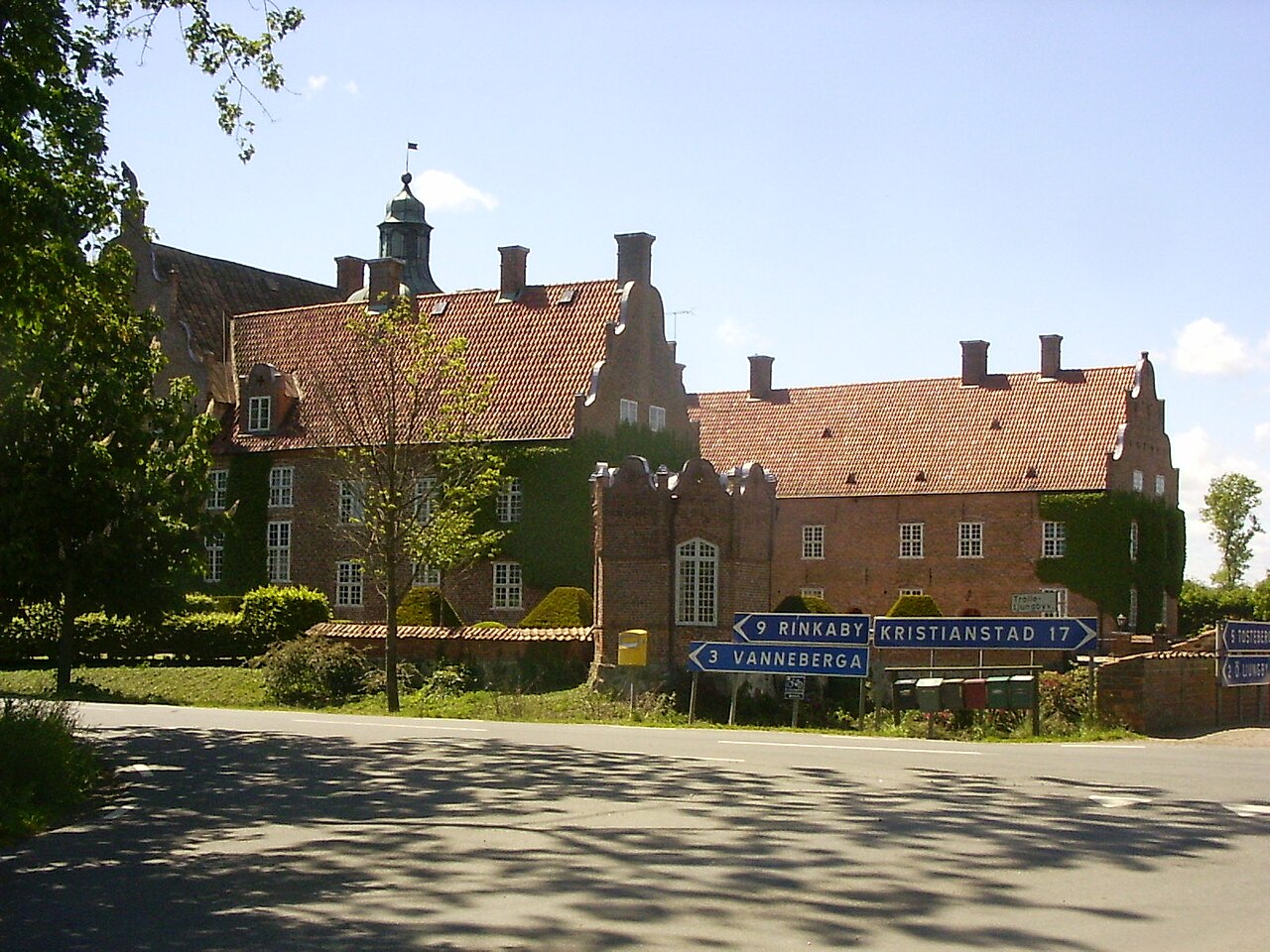
Trolle-Ljungby Castle (Swedish: Trolle-Ljungby slott) is a castle in Kristianstad Municipality, Scania, in southern Sweden. The Renaissance style castle is enclosed by a moat.
The castle is of medieval origins. It is mentioned as belonging to the Danish noble "Bille" family during the 14th and 15th centuries. In the 1460s, it was sold to Jens Holgersen Ulfstand, a Danish politician, admiral and county governor, who is famous for having commissioned the building of Glimmingehus, one of the best-preserved medieval manors in Scandinavia.
Little is known about the early history of the castle, but the western part is thought to be the oldest. Large reconstruction works were carried out after 1621 and it was at this time that the current Renaissance exterior was conceived. A drawing suggest that by 1680 the castle was more or less the same shape as it is now. In the wake of the Swedish conquest of Scania from Denmark and the following Scanian War, the castle was involved in the fighting and damaged by raiding Snapphanar or guerrilla fighters. Bullet holes and cutting marks in the tower door, from this conflict, are still visible. In the following years the castle was repaired and a defensive gate house was built. The castle park was visited by Carl Linnaeus in 1749.
In 1850, the house came into the possession of Hans Gabriel Trolle-Wachtmeister, the ancestor of the current owners, who initiated reconstruction works both internally and externally.
The current owner of the castle is Count Hans-Gabriel Trolle-Wachtmeister, married to Countess Alice Trolle-Wachtmeister, the Swedish Mistress of the Robes, until her death in 2017.
The castle consists of three wings surrounding a courtyard, located on a small island surrounded by a moat. Its style is an accomplished form of Danish Renaissance. Close to the castle lies Trolle-Ljungby Church. Internally, the castle retains few of the original furnishings but has richly decorated Rococo and Neoclassical rooms, including one of the finest private libraries in Sweden.
Among the castle's collections are a medieval drinking horn and a hunting flute or pipe, also of considerable age. These two objects, which (in summertime) are displayed in a window of the castle, are tied to an old legend which was first recorded in 1620.
Text adapted from “Trolle-Ljungby Castle” on Wikipedia, CC BY-SA 4.0.
Trolle-Ljungby Castle ranks #3,999 of 8,134 worldwide in the atlas's castle fame ranking, and #110 of the 206 mapped in Sweden. Founded 1621, it is older than 31% of the atlas's dated landmarks — one of 626 atlas entries founded in the 17th century. Its Wikipedia articles were opened 1,756 times in the last 60 days, more than 63% of the atlas. 6 more atlas landmarks stand within 25 km. The nearest day-trip guide is Kristianstad, 15 km away. See how Sweden compares in the castle statistics.
View on the interactive castle map →Frequently asked questions
Where is Trolle-Ljungby Castle?
Trolle-Ljungby Castle stands in Sweden, at 56.0218°, 14.3699°.
When was Trolle-Ljungby Castle built?
The atlas dates its founding to 1621. Earlier structures may have stood on the site; this is the earliest documented founding year.
How famous is Trolle-Ljungby Castle?
In this atlas's fame ranking: #3,999 of 8,134 worldwide, and #110 in Sweden. Fame here combines how many Wikipedia language editions cover a landmark with how many people read them.
What is the nearest castle to Trolle-Ljungby Castle?
Bäckaskog Castle, about 7 km away.
More castles in Sweden
- Näsbyholm Castle Sweden · 20th century
- Tomarps Kungsgård Castle Sweden · 16th century
- Tidö Castle Sweden · 17th century
- Dalarö Fort Sweden · 17th century
More castles
- Faulx-les-Tombes Castle Belgium · 19th century
- Rivieren Castle (Ganshoren) Belgium · 12th century
- Antoing Castle Belgium · 12th century
- Kruikenburg Castle Belgium