 Sweden · 12th century
Biskopskällaren ranks #8,167 of 9,040 worldwide in the atlas's castle fame ranking, and #205 of the 209 mapped in Sweden. Founded c. 1150, it is older than 80% of the atlas's dated landmarks, one of 763 atlas entries founded in the 12th century. 5 more atlas landmarks stand within 25 km. The nearest day-trip guide is Kristianstad, 20 km away. See how Sweden compares in the castle statistics.
Biskopskällaren is the ruin of Ivöhus on Ivö in Kristianstad Municipality in Skåne.
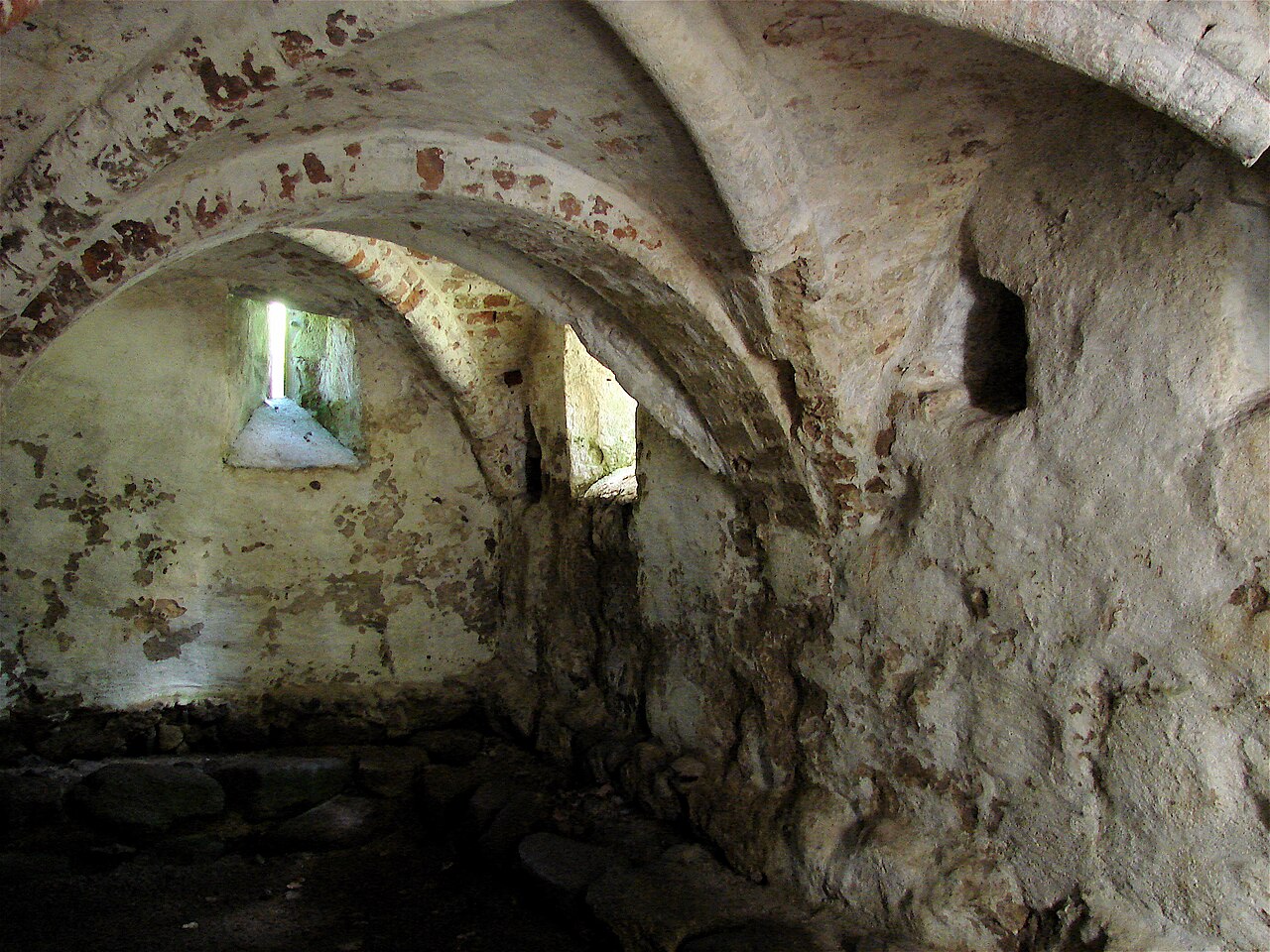
Ivöhus was a medieval house, and today's ruin consists of a cellar whose external dimensions are 9 by 8 metres. Narrow light openings lead daylight down through the one-metre-thick granite walls. There are two pillars and six groin vaults of masonry brick. Stone benches run around the walls. A stone stair leads down into the room from the west. On the southern long side there are three buttresses. The original cellar reaches about 0.5 metres above ground level. The roof, which was added to protect the cellar, is of later date.
The cellar is thought to derive from a keep of the 12th century, which was rebuilt for Archbishop Andreas Sunesen around 1220. The archbishop lived at Ivöhus until his death in 1228. He lived in the house during his last years, when he had been struck by rheumatism and had withdrawn from his episcopal office. There is a popular legend that he had contracted leprosy and did not want to pass the infection on, and therefore lived as a hermit on Ivö. His body is embalmed in Lund, and examinations of his skeleton have shown that he probably did not suffer from leprosy but from some form of gout.
On the site there stood a larger house, Ivöhus, west of the cellar. In Anders Ödman's book Borgar i Skåne there is a reconstruction drawing of the castle Ivöhus. Remains of Ivöhus were still standing in the 17th century. During Harald Gustavsson's investigations in the 1950s, suspicions arose that Ivöhus had been built on the site where a keep had stood, and that the cellar had originally belonged to the keep. The vaults were inserted afterwards, and the windows are probably older than the vaults and belong to the original building.
Machine-translated from “Biskopskällaren” on the Swedish Wikipedia, CC BY-SA 4.0.
View on the interactive castle map →