Ruin
Waldsteinburg
🇩🇪 Germany · 14th century
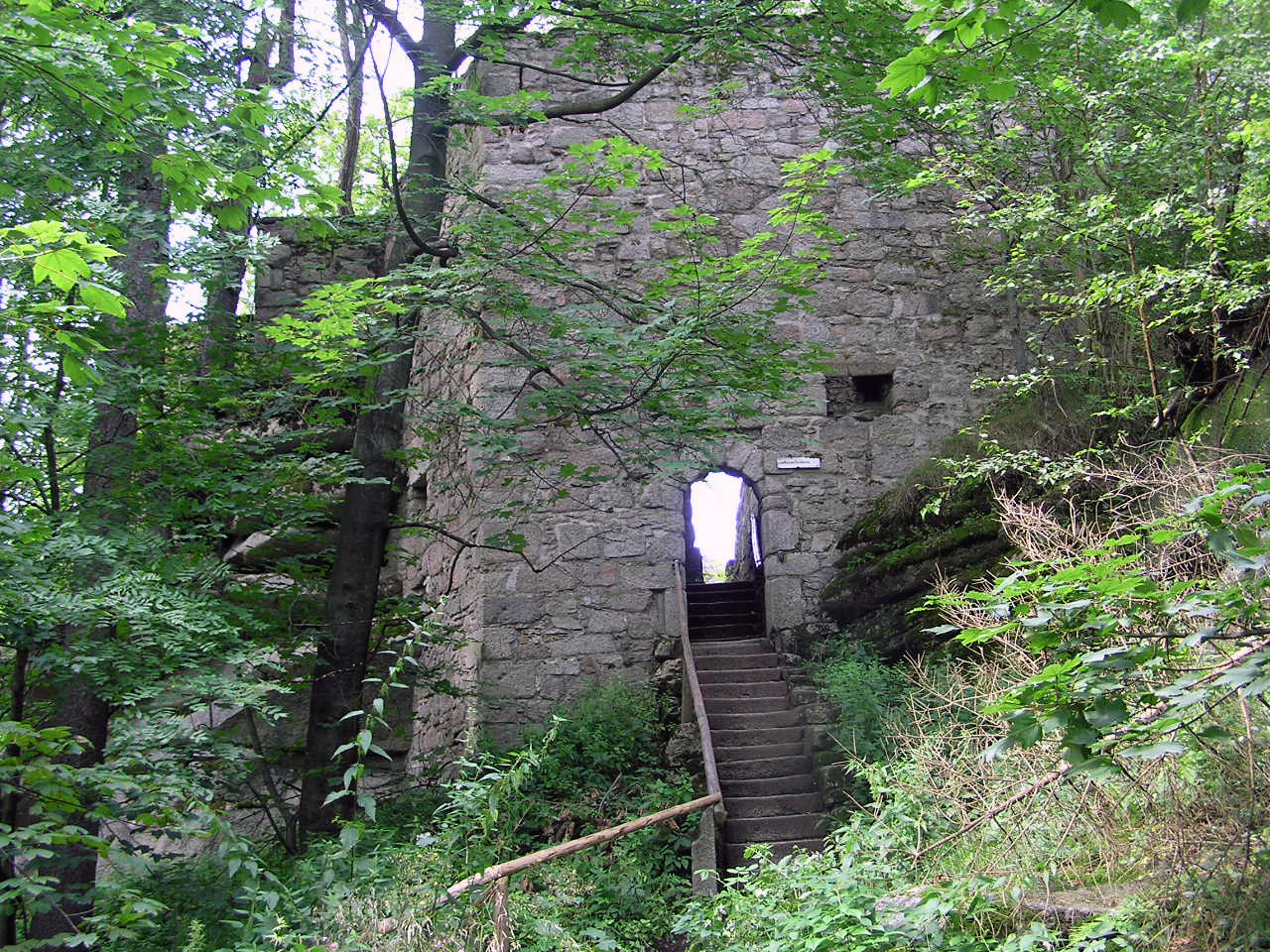
The Waldsteinburg, also called the Red Castle (German: Rotes Schloss) is a ruined castle on the summit of the Großer Waldstein in the Fichtel Mountains of Germany. It is also known as the Westburg ('west castle') to distinguish it from the older ruins of the Ostburg ('east castle').
The aforementioned Westburg, first recorded in 1350, was built to replace the older Ostburg, which no longer met the requirements for a defensive fortification. Its builders and owners were the knights of Sparneck.
For centuries the lords of Sparneck ruled over a territory, which corresponded roughly to the former district of Münchberg. Waldstein Castle was an integral part of the estate of this once powerful family. The most famous member on the Waldstein was Rüdiger von Sparneck (ca. 1300-1364/68), who in 1336 was elected count palatine of Eger. When the King of Bohemia was crowned as Emperor Charles IV, the centre of power of the Holy Roman Empire moved within easy reach of the Sparnecks and Waldstein Castle played an important role in the power structure of the western Egerland and its surrounding regions. This time is considered the heyday of the lords of Sparneck; and Rüdiger, who had become more powerful, awarded Münchberg the town rights of Nuremberg on 13 July 1364 .
His son Hans I of Sparneck was appointed to the chapter of Bamberg on 28 April 1352. Amongst other things, he enfeoffed the Waldstein to Konrad of Neuberg. He succeeded, however, together with his brothers Erhard (1364–1417), Frederick I (1364–1415) and Pabo II (1364–1373) to assume the fief of Waldstein from the emperor.
In the middle of the 15th century, many once powerful men operated in a manner which was later referred to a robber baronetcy, in order to keep their estates and if possible to expand them. Thomas von Absberg was particularly noted for this and, around 1500, had terrorized the whole of Franconia. He kidnapped traders on several occasions and demanded a large ransom for their release. On 24 June 1520 he attacked a group of travellers on the Hahnenkamm. Joachim, Count of Oettingen, who was with the group, was so badly wounded in the melee that, on 6 July, he died of his injuries. This event was reported to the Swabian League and to Charles V, who had just been named the "elected" German Emperor; he promptly placed the imperial ban on the Absberg family.
Text adapted from “Waldsteinburg” on Wikipedia, CC BY-SA 4.0.
Waldsteinburg ranks #6,075 of 8,134 worldwide in the atlas's castle fame ranking, and #465 of the 505 mapped in Germany. Founded 1350, it is older than 57% of the atlas's dated landmarks — one of 604 atlas entries founded in the 14th century. The nearest day-trip guide is Karlovy Vary, 73 km away. See how Germany compares in the castle statistics.
View on the interactive castle map →Frequently asked questions
Where is Waldsteinburg?
Waldsteinburg stands in Germany, at 50.1289°, 11.855°.
When was Waldsteinburg built?
The atlas dates its founding to 1350. Earlier structures may have stood on the site; this is the earliest documented founding year.
How famous is Waldsteinburg?
In this atlas's fame ranking: #6,075 of 8,134 worldwide, and #465 in Germany. Fame here combines how many Wikipedia language editions cover a landmark with how many people read them.
What is the nearest castle to Waldsteinburg?
Smrčina Chateau, about 27 km away.
More castles in Germany
- Wiesenburg Castle Germany · 12th century
- Castle Kastellaun Germany · 13th century
- Burg Eltville Germany · 14th century
- Burgstall Gegenpoint Germany
More ruins
- Battenberg Castle Germany
- Wildenberg Castle (Kirchzell) Germany · 12th century
- Saffenburg Germany
- Bertradaburg Germany · 13th century