Castle
Wiesenburg Castle
🇩🇪 Germany · 12th century
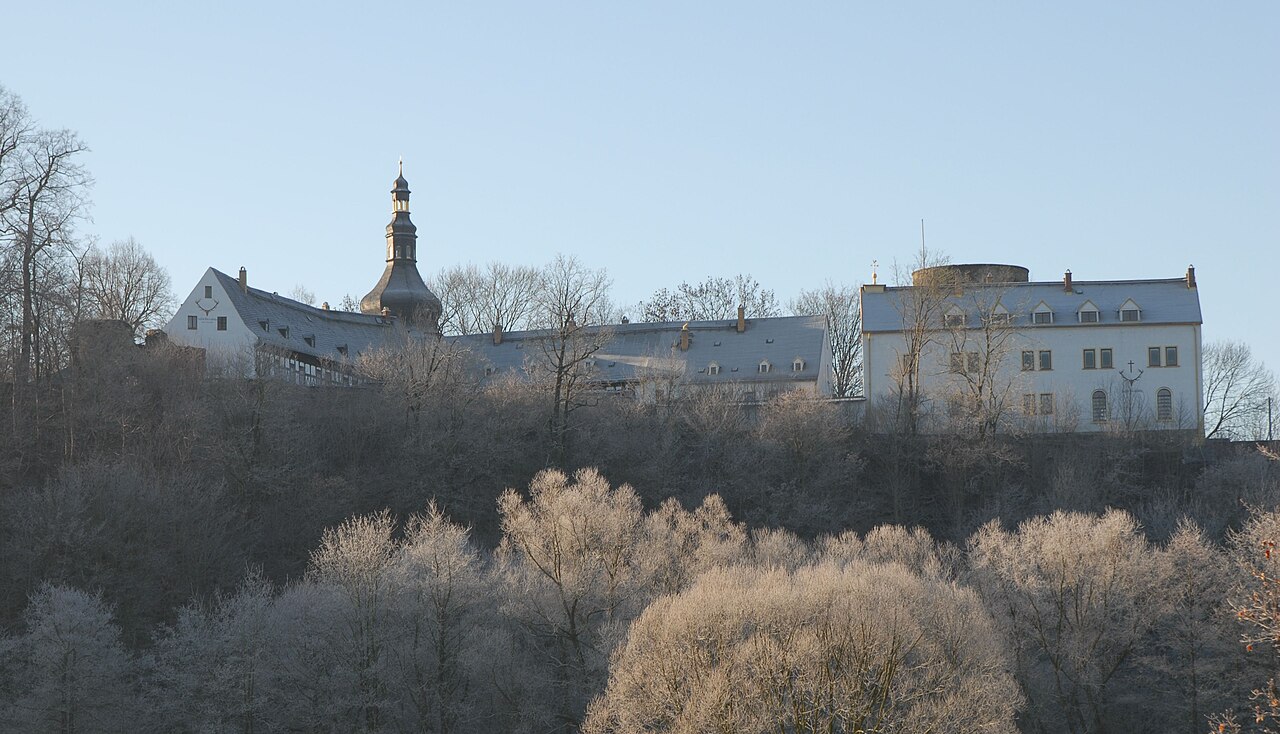
The Wiesenburg Castle (German: Burg Wiesenburg or Schloss Wiesenburg) is a castle located in the Wiesenburg district of Wildenfels, Germany, on a hill overlooking the eastern shore of the Mulde river. The castle protects the bridge across the Mulde to Schönau and Wildenfels.
Today's castle arose out of a medieval castle, the construction of which probably began around the year 1200. The castle was first mentioned in a document dated 1251. The building was expanded in the 14th century.
The only remains of the original castle are a part of the round keep, remnants of the castle wall, and a moat. Today's courtyard, with its timber construction and the octagonal gate tower, were developed when the castle was reconstructed in 1664 after the Thirty Years' War.
The first owners were the Vogts of Weida, who monitored the settling of the Kirchberg, Saxony basin and the Mulde area south-east of Zwickau. The inhabitants of more than twenty villages in the area had to pay socage to the castle, for example, all villages in the Rödel valley. Later, the castle ownership changed many times:
1350 the castle came into the possession of the House of Wettin 1412–1591 the castle was owned by the von der Planitz family 1523, i.e. before the German Peasants' War, the castle was sacked by the serfs. Two years later, the peasants revolted again. Based on the time-imposed fines, one can calculate that 283 farmers must have participated in the uprising. That would have been almost all farmers of the estate subject to socage.
1591 the city of Zwickau purchased the castle and the dominion 1618 the Elector of Saxony obtained them 1663 castle and lordship of Wiesenburg plus the city of Kirchberg were sold to Philip Louis of Holstein-Sonderburg 1724 the lordship was acquired by Augustus II the Strong, who turned it into am Amt 1803 the great hall collapsed 1864 the castle and dominion were separated, the castle was sold to the district poor law association 1864–1911 the castle was in use as a poor house 1911 the castle was bought back 1945 the castle was publicly owned; many homes were created inside the structure. The farm buildings were used by the local Landwirtschaftliche Produktionsgenossenschaft (collectived farms, comparable to a Kolkhoz in the Soviet Union).
1990 the castle is privately owned again. It is not publicly accessible.
Text adapted from “Wiesenburg Castle” on Wikipedia, CC BY-SA 4.0.
Wiesenburg Castle ranks #6,323 of 8,134 worldwide in the atlas's castle fame ranking, and #481 of the 505 mapped in Germany. Founded 1200, it is older than 77% of the atlas's dated landmarks — one of 564 atlas entries founded in the 12th century. 3 more atlas landmarks stand within 25 km. The nearest day-trip guide is Karlovy Vary, 52 km away. See how Germany compares in the castle statistics.
View on the interactive castle map →Frequently asked questions
Where is Wiesenburg Castle?
Wiesenburg Castle stands in Germany, at 50.6517°, 12.5669°.
When was Wiesenburg Castle built?
The atlas dates its founding to 1200. Earlier structures may have stood on the site; this is the earliest documented founding year.
How famous is Wiesenburg Castle?
In this atlas's fame ranking: #6,323 of 8,134 worldwide, and #481 in Germany. Fame here combines how many Wikipedia language editions cover a landmark with how many people read them.
What is the nearest castle to Wiesenburg Castle?
Stein Castle (Saxony), about 7 km away.
More castles in Germany
- Castle Kastellaun Germany · 13th century
- Burg Eltville Germany · 14th century
- Burgstall Gegenpoint Germany
- Ehrenburg (Plaue) Germany · 14th century
More castles
- Burg Rode Germany
- Ronneburg Castle Germany · 12th century
- Burg Beeskow Germany
- Castle Blankenheim Germany · 12th century