 Germany · 2nd century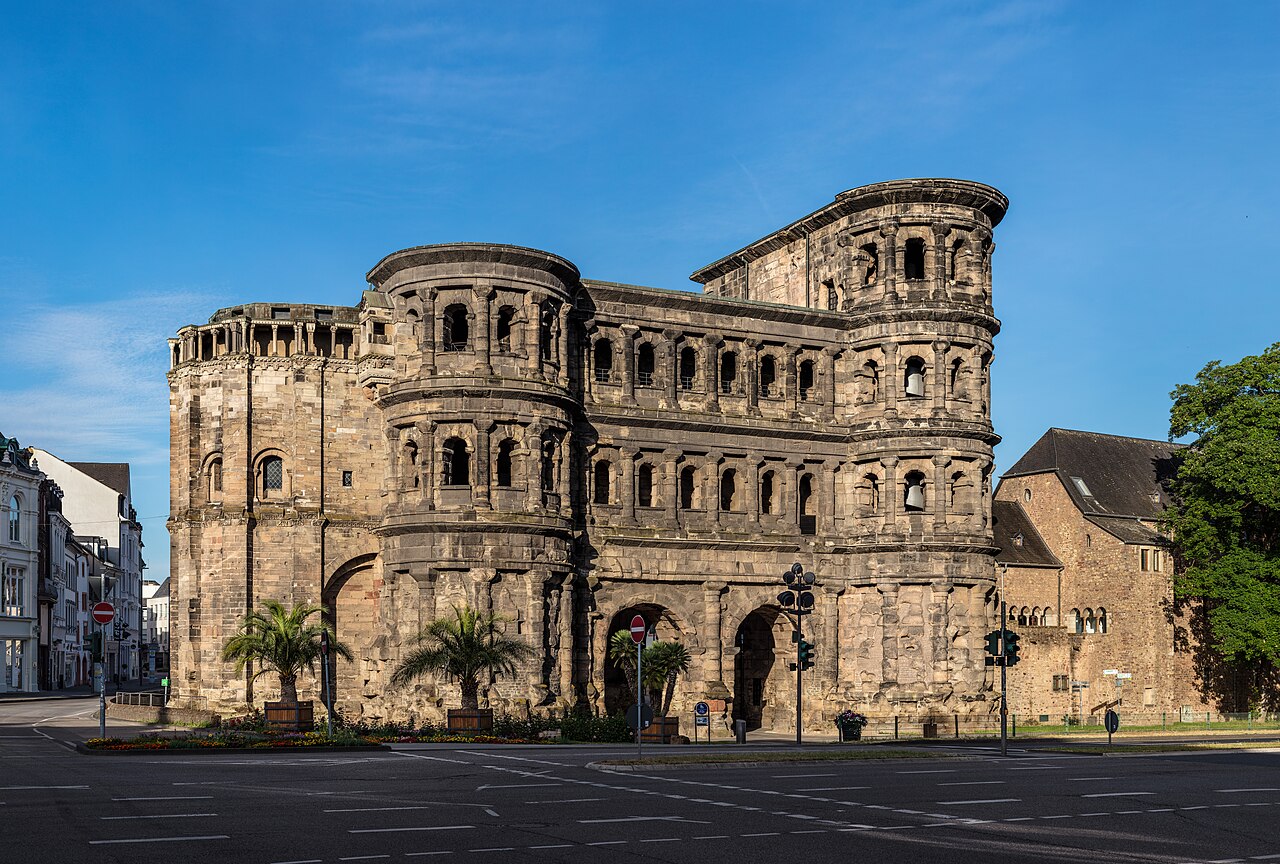
The Porta Nigra (Latin for black gate), referred to by locals as the Porta, is a large Roman city gate in Trier, Germany. It is a monumental gateway representative of Hellenistic military architecture of the time. It is a UNESCO World Heritage Site.
The name Porta Nigra originated in the Middle Ages due to the darkened colour of its stone; the original Roman name has not been preserved.
The Porta Nigra was built in grey sandstone after 170 AD. The original gate consisted of two four-storeyed towers, projecting as near semicircles on the outer side. A narrow courtyard separated the two gate openings on either side. For unknown reasons, however, the construction of the gate remained unfinished. For example, the stones at the northern (outer) side of the gate were never abraded, and the protruding stones would have made it impossible to install movable gates. Nonetheless, the gate was used as a town entrance for centuries until the end of the Roman era in Trier.
In Roman times, the Porta Nigra was part of a system of four city gates, one of which stood at each side of the roughly rectangular Roman city. The arrangement of the gates was complex and was used as a system to reinforce the defenses of vulnerable parts of the surrounding wall. It guarded the northern entry to the Roman city, while the Porta Alba (White Gate) was built in the east, the Porta Media (Middle Gate) in the south, and the Porta Inclyta (Famous Gate) in the west, next to the Roman bridge across the Moselle. The gates stood at the ends of the two main streets of the Roman Trier, one of which led north-south and the other east-west. Of these gates, only the Porta Nigra still exists.
In the early Middle Ages the Roman city gates were no longer used for their original function and their stones were taken and reused for other buildings. Moreover, iron and lead braces were broken out of the walls of the Porta Nigra for reuse. Traces of this destruction are still clearly visible on the north side of the gate.
After 1028, the Greek monk Simeon lived as a hermit in the ruins of the Porta Nigra. After his death (1035) and sanctification, the Simeonstift monastery was built next to the Porta Nigra to honor him.
To save it from further destruction, the Porta Nigra was transformed into two superimposed churches with identical floor plans.
Text adapted from “Porta Nigra” on Wikipedia, CC BY-SA 4.0.
Porta Nigra ranks #88 of 9,079 worldwide in the atlas's castle fame ranking, and #8 of the 711 mapped in Germany. Founded 180, it is older than 98% of the atlas's dated landmarks — one of 21 atlas entries founded in the 2nd century. Its Wikipedia articles were opened 28,808 times in the last 60 days, more than 98% of the atlas. 4 more atlas landmarks stand within 25 km. The nearest day-trip guide is Trier, 1 km away. It is one of the 51 landmarks on the atlas's regional map of the Moselle. It is stop 2 of 36 on the Moselle castle route, Trier to Koblenz. See how Germany compares in the castle statistics.
View on the interactive castle map →