 Germany · 12th century
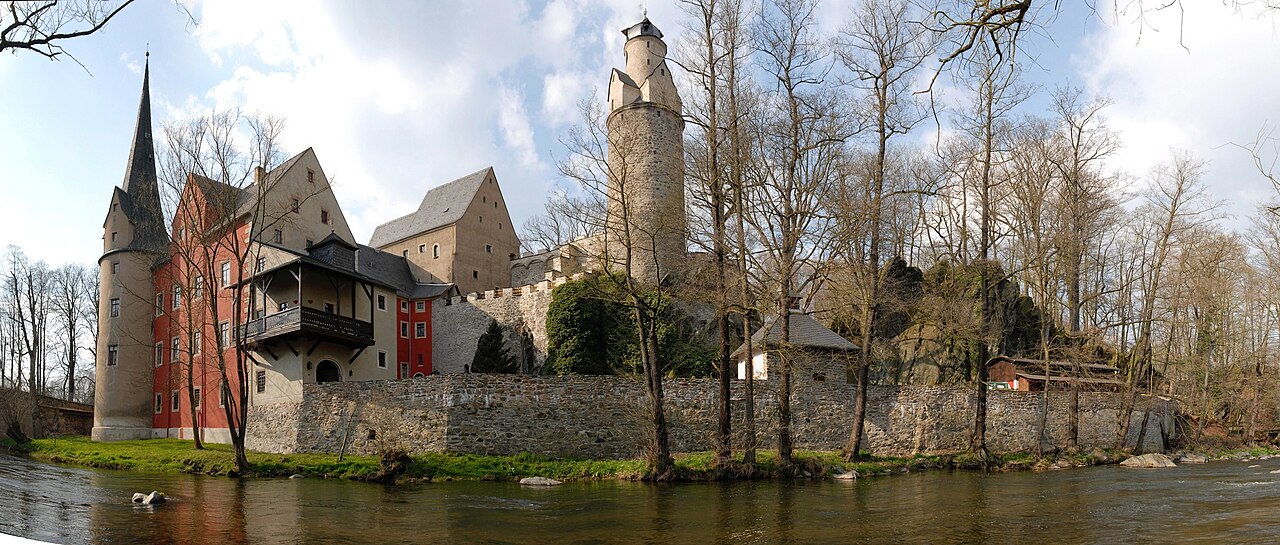
Stein Castle (Saxony) ranks #5,638 of 9,040 worldwide in the atlas's castle fame ranking, and #492 of the 714 mapped in Germany. Founded 1200, it is older than 75% of the atlas's dated landmarks, one of 763 atlas entries founded in the 12th century. 4 more atlas landmarks stand within 25 km. The nearest day-trip guide is Karlovy Vary, 49 km away. See how Germany compares in the castle statistics.
Stein Castle (German: Burg Stein or Burg und Schloss Stein) is a Saxon castle located southeast of Zwickau in the village of Stein in the municipality of Hartenstein on the rocky banks of the Zwickauer Mulde in the east German state of Saxony.
Just above the castle is a weir on the River Mulde. The impounded river drove a mill with four large water wheels. In 1788 its milling rights (Mahlzwang) were transferred from an older mill to this one. As a result of its exclusive milling rights, several mill tracks led to Stein. In 1912 the construction of a stately home, Wolfsbrunn House (Schloss Wolfsbrunn), began on the opposite bank of the river. The ruins of Isenburg castle are located only two kilometres upstream. Towards Langenbach were once the villages of Ober- and Niederopritz, which used to belong to Stein Castle, but were probably destroyed during the Hussite Wars.
The settlement of the Ore Mountains began in the 12th/13th centuries, especially along the rivers. River crossings and religious orders (Niederlassungen) were protected by fortified sites. Along the Zwickauer Mulde river, numerous castles were built.
Construction of the castle was probably started around 1200 on a rock made of hornblende right on the southern banks of the Mulde. This oldest part of the site form the upper ward (Oberburg) today, consisting of a round bergfried, a palas, with its great hall, and defensive walls. Its architecture still has Romanesque influences. The fortifications probably also served as an outer ward of Hartenstein Castle which had not at that time been converted into a stately residence or schloss.
The remaining elements of the building are younger. The pointed round tower in the southwest may have been erected in the 14th century; the other parts of the lower ward (Niederburg) at the end of the 15th century. The bergfried of the upper ward were enhanced in the 16th century by an additional storey (Aufbau).
There used to be a ford by the castle and, later, a ferry as well as various wooden and stone bridges, some of which, in old drawings, are portrayed as covered. A bridge toll was still charged until 1924. A more modern steel arch bridge (Stahlbogenbrücke) was blown up in 1945 by the SS; since 1950 there has been a concrete bridge on the site.
Text adapted from “Stein Castle (Saxony)” on Wikipedia, CC BY-SA 4.0.
View on the interactive castle map →